Chasteberry for PMS: What Symptoms Have Studies Measured?
Most chasteberry trials measured overall PMS scores, so they offer a less clear answer about specific symptoms like cramps or breast tenderness.
Researchers have tested chasteberry, or Vitex agnus-castus, for PMS using symptom diaries and rating scales, usually to measure overall symptom burden. A placebo-controlled trial found a greater drop in total scores with a Vitex extract than with placebo after three cycles. Reviews found encouraging results overall, but trial quality and methods varied, and the research doesn’t clearly establish which individual symptoms improve. 2 4 5
Overall scores tell only part of the story
PMS can include physical, emotional, and behavioral symptoms that recur before a period. Chasteberry trials have generally asked whether symptoms improve as a whole, using tools such as a PMS diary or a rating scale. Those tools can show that a group’s total score changed, but a total score alone doesn’t tell you whether a particular symptom, such as cramps, breast tenderness, or irritability, reliably improved. 2 4
That’s the key distinction if you’re considering chasteberry for one main concern: evidence for a change in overall PMS scores is not the same as evidence for a dependable effect on that specific symptom. Reviews also report that trials used varying definitions of PMS, different symptom measures, and different Vitex preparations, making direct comparisons harder. 4 5
What one placebo-controlled trial found
A multicenter, double-blind trial in China randomized 217 women with moderate to severe PMS to a Vitex extract or placebo for up to three cycles. Efficacy data were available for 104 people in each group. By the third cycle, the mean total PMS diary score had fallen from 29.23 to 6.41 in the Vitex group, and from 28.14 to 12.64 in the placebo group. The reduction was greater with Vitex, although scores improved in both groups. These are group averages, not a promise of the same result for an individual. 2
The study used a specific extract, and the result applies to that trial’s participants, product, and treatment period. It doesn’t establish that every chasteberry supplement will have the same effect. The trial abstract reports no serious adverse events during the study, but that finding does not establish safety for every product or situation. 2
Reviews find a signal, but not a settled answer
A 2017 systematic review found 17 randomized trials and included 14 in its quantitative analysis. Thirteen of those 14 reported a positive effect on total PMS symptoms. The pooled estimate from placebo-controlled trials was large, but the studies varied substantially in their results: heterogeneity was high, most trials had a high risk of bias, and the reviewers found signs of publication bias. They cautioned that the pooled effect might overestimate the true benefit. 4
A separate review included eight randomized trials of PMS or premenstrual dysphoric disorder (PMDD). All eight reported positive results, but the reviewers also pointed to changing diagnostic criteria, different outcome measures, and three different Vitex preparations. Taken together, the reviews suggest possible benefit for overall symptoms, but they don’t pin down how large or dependable that benefit is, or which individual symptoms respond best. 5
Why symptom-specific findings need a closer look
Some studies did assess symptom clusters, but they tested more than chasteberry. One small analysis involved 14 late-perimenopausal women in a larger trial of Vitex combined with St. John’s wort. The study reported results for anxiety, depression, fluid-related symptoms, and cravings. Because the treatment combined two herbs and the subgroup was small, it can’t show which changes came from Vitex alone or how well they apply to people with PMS more broadly. 7
Other combination-product studies measured outcomes such as mood, sleep, menstrual pain, or quality of life. A 42-person pilot tested a product containing Vitex, GABA, Rhodiola, vitamin B6, and melatonin. Some outcomes improved within the supplement group, but the comparison between supplement and placebo found no statistically significant differences. The results therefore don’t establish that the product worked better than placebo, or that Vitex was responsible for any change. 3
A separate open-label study measured menstrual-period pain, including cramps and backache, and quality of life while testing a supplement containing Vitex, vitamin B6, and magnesium. These were outcomes during menstruation, not clear evidence about pain before a period. Because the study combined ingredients and had no blinded placebo comparison, it cannot isolate chasteberry’s effect on menstrual cramps or pain. 6
Match the research to the symptom you care about
If you’re asking whether chasteberry has been studied for PMS, yes: randomized trials have measured overall symptoms, and one placebo-controlled trial reported a larger reduction in total scores than placebo after three cycles. If you’re asking whether chasteberry alone has been shown to reliably ease a particular symptom, the available trial summaries give a less definite answer. 2 4
The distinction is useful when weighing claims on supplement labels or deciding what outcome would matter to you. A study of a blend may be relevant to the blend, but it can’t show that chasteberry itself caused the result. And a change in an overall PMS score doesn’t necessarily mean every symptom improved.
The PMS trials described here do not establish pregnancy safety or specific medicine interactions. One clinical reference advises checking with a doctor or pharmacist before taking regular supplements if you also take medicines. 1
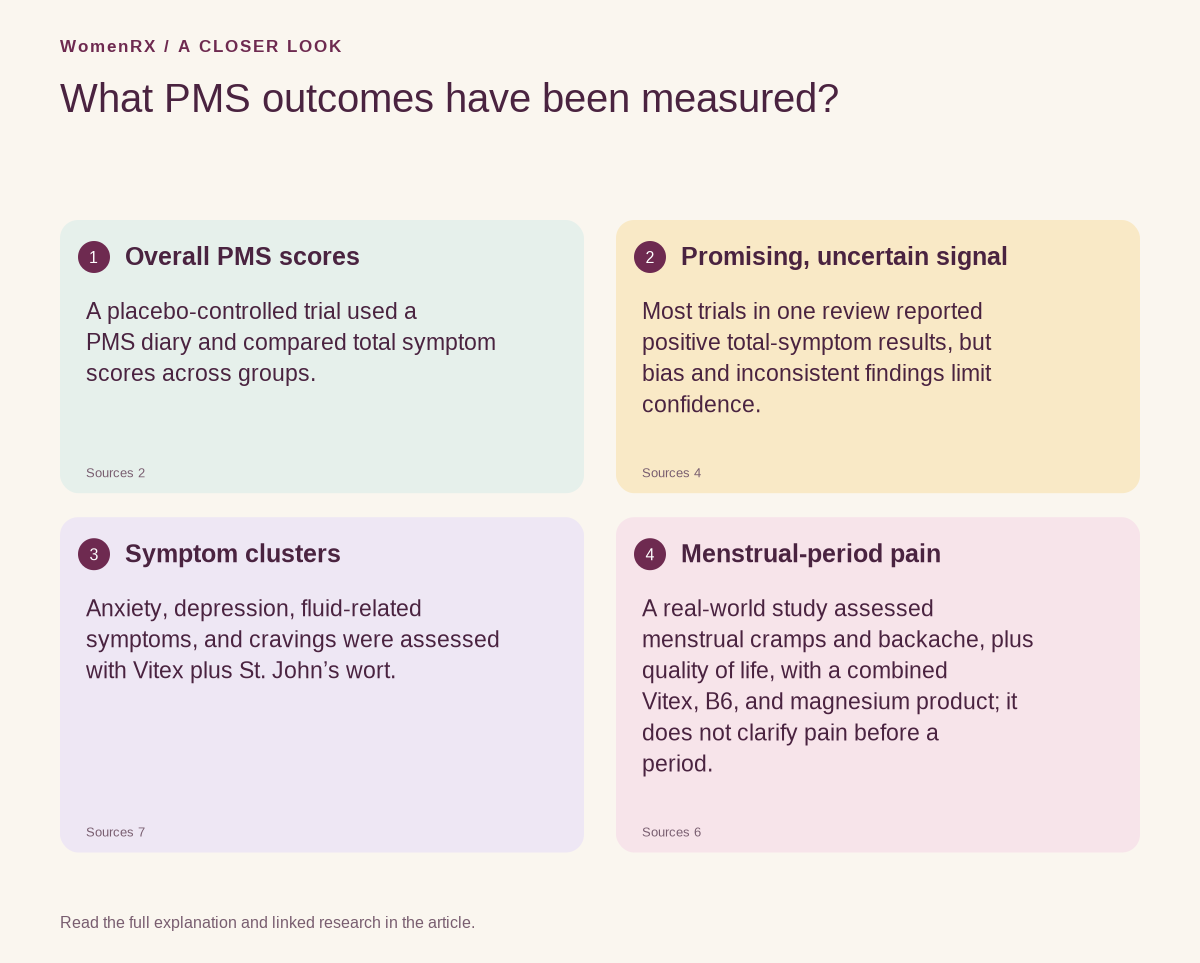
What PMS outcomes have been measured?
Overall PMS scores: A placebo-controlled trial used a PMS diary and compared total symptom scores across groups.2
Promising, uncertain signal: Most trials in one review reported positive total-symptom results, but bias and inconsistent findings limit confidence.4
Symptom clusters: Anxiety, depression, fluid-related symptoms, and cravings were assessed with Vitex plus St. John’s wort.7
Menstrual-period pain: A real-world study assessed menstrual cramps and backache, plus quality of life, with a combined Vitex, B6, and magnesium product; it does not clarify pain before a period.6
Read the figure as text
This map distinguishes trials of overall PMS scores from symptom-specific findings that came from studies of combination products.- Overall PMS scores: A placebo-controlled trial used a PMS diary and compared total symptom scores across groups.2
- Promising, uncertain signal: Most trials in one review reported positive total-symptom results, but bias and inconsistent findings limit confidence.4
- Symptom clusters: Anxiety, depression, fluid-related symptoms, and cravings were assessed with Vitex plus St. John’s wort.7
- Menstrual-period pain: A real-world study assessed menstrual cramps and backache, plus quality of life, with a combined Vitex, B6, and magnesium product; it does not clarify pain before a period.6
More questions, answered
Have studies shown that chasteberry helps cramps or breast tenderness?
The studies summarized here don’t establish a reliable effect from chasteberry alone on either symptom. One combination-product study measured menstrual-period cramps and backache, not clearly pain before a period; because it included other ingredients and wasn’t blinded against placebo, it can’t show that Vitex caused any change. 6
Sources you can check
- PMS (premenstrual syndrome) - NHSAccessed 2026-09-25Return to first citation
- Treatment for premenstrual syndrome with Vitex agnus castus: A prospective, randomized, multi-center placebo controlled study in China.He Z, Chen R, Zhou Y, Geng L, Zhang Z, Chen S, Yao Y, Lu J, Lin S. · Maturitas · 2009Return to first citation
- Effects of the PREMEN-CALM® in the Management of the Premenstrual Syndrome: A Randomized, Double-Blind, Placebo-Controlled Pilot Study.Herrera A, Al Adib M, Rodríguez AB, Carrasco C. · Journal of dietary supplements · 2024Return to first citation
- The treatment of premenstrual syndrome with preparations of Vitex agnus castus: a systematic review and meta-analysis.Verkaik S, Kamperman AM, van Westrhenen R, Schulte PFJ. · American journal of obstetrics and gynecology · 2017Return to first citation
- Vitex agnus castus for premenstrual syndrome and premenstrual dysphoric disorder: a systematic review.Cerqueira RO, Frey BN, Leclerc E, Brietzke E. · Archives of women's mental health · 2017Return to first citation
- Efficacy and Tolerability Evaluation of a Nutraceutical Composition Containing Vitex agnus-castus Extract (EVX40™), Pyridoxine, and Magnesium in Premenstrual Syndrome: A Real-World, Interventional, Comparative Study.Sureja VP, Kheni DB, Dubey VP, Kansagra J, Soni ZK, Bhatt SP, Mathuria A, Deshpande SS. · Cureus · 2023Return to first citation
- Effects of a combination of Hypericum perforatum and Vitex agnus-castus on PMS-like symptoms in late-perimenopausal women: findings from a subpopulation analysis.van Die MD, Bone KM, Burger HG, Reece JE, Teede HJ. · Journal of alternative and complementary medicine (New York, N.Y.) · 2009Return to first citation