Chasteberry for PMS: What to Check on the Label
Chasteberry has some evidence for premenstrual symptoms, but the research applies to particular extracts, not every product or every menstrual complaint.
If you’re comparing chasteberry, or Vitex agnus-castus, products for PMS, check that the label identifies the plant and extract, then compare it with the preparation studied for the symptom you want to address. Trials suggest possible benefit for PMS, but different extracts and study designs make products hard to compare. Check pregnancy and medication cautions before buying, especially if you’re in fertility treatment.
Chasteberry, also called Vitex agnus-castus, is worth considering only for a specific reason: some studies suggest certain extracts may ease premenstrual syndrome (PMS). That isn’t evidence that any bottle will work, that it treats every menstrual symptom, or that it “balances hormones.” The useful comparison is between the product’s actual preparation and the evidence for your particular symptoms.
Start with the symptom, not the promise
PMS refers to recurring symptoms before a period. Studies have measured a mix of concerns, including irritability, low mood, headache, bloating, breast tenderness and fatigue. Evidence for PMS doesn’t automatically apply to menstrual cramps, irregular bleeding, PMDD, fertility, or symptoms that occur at other points in the cycle. A systematic review of clinical trials found that most of the eight included PMS trials favored Vitex extracts, but the studies varied in quality, size and comparison treatments. 4
That makes broad label language such as “hormone support” a poor way to choose. Instead, ask: Does the research match the symptom I’m hoping to ease, and does the product identify a preparation that can be compared with what researchers tested?
Why extract details matter
“Chasteberry” identifies the plant, but it doesn’t tell you that two products are interchangeable. The clinical trials in the evidence base used particular preparations. For example, one randomized, placebo-controlled study in Chinese women with moderate-to-severe PMS tested the BNO 1095 extract, described as corresponding to 40 mg of herbal drug. A separate open-label study in Japanese women tested a 20 mg extract product over three menstrual cycles. Those figures describe the preparations used in those studies; they are not a recommended dose and shouldn’t be treated as equivalent amounts. 12
On a label, look for the botanical name, the plant part or preparation, and how much is present per serving. If a product doesn’t make its preparation clear, you can’t tell from the label whether it resembles a studied extract. Even a matching number of milligrams may not mean the products are the same preparation.
Be especially careful with combination products. A real-world, open-label study tested a product containing Vitex extract, vitamin B6 and magnesium, so it cannot show which ingredient, if any, accounted for changes in symptoms. Its findings also don’t establish that other combinations will work. 3
What the PMS findings can, and can’t, tell you
The placebo-controlled Chinese study offers a more useful comparison than an uncontrolled report because participants were assigned to Vitex extract or placebo. Both groups’ symptom scores improved over three cycles, and the Vitex group had a greater average improvement. That supports possible benefit for PMS with that preparation in the study population; it doesn’t establish the same effect for every extract or person. 2
Other findings need more restraint. In the Japanese study, symptoms improved during treatment, but there was no comparison group, so the study can’t separate the treatment’s effect from other reasons symptoms may have changed. A larger retrospective study reported improvement among women using two specific products for menstrual disorders, but its design also can’t establish that Vitex caused those changes. 16
A systematic review found promising PMS results overall, while noting limitations such as small studies, varied conditions and differences in study quality. The practical takeaway is neither “it works for everyone” nor “there’s no evidence”: there’s a signal for PMS, but confidence in a specific product depends on whether its preparation and intended outcome match the research. 4
Check safety in your situation
A review of safety reports and studies found that reported side effects were generally mild and reversible. They included nausea, headache, digestive symptoms, menstrual changes, acne, itching and rash. The review also said Vitex should be avoided during pregnancy and while lactating. These safety findings are limited by the available data, so “no serious events reported” is not the same as proof of safety for every person or product. 5
That review found no reported drug interactions, but noted a theoretical possibility of interaction with medicines that block dopamine. If you take one of those medicines, ask a pharmacist or prescriber whether the specific product is appropriate. The review does not establish that other medication interactions are absent. 5
If you’re pregnant, breastfeeding, trying to conceive through fertility treatment, or using medication as part of fertility care, get individualized advice before considering Vitex. The studies here do not establish its safety or benefit during fertility treatment. Don’t use a PMS supplement as a substitute for care for a new, severe or otherwise concerning menstrual symptom.
A short label check
Before buying, see whether you can answer four questions: Is the botanical identity clear? Does the label identify the extract or preparation? Is your target symptom PMS, the outcome studied, rather than a broad hormone claim? Have you checked pregnancy, breastfeeding and medication considerations that apply to you?
If the preparation is vague or the claim reaches beyond PMS, the label isn’t giving you a sound basis to assume the product matches the research. And if the label describes a combination, remember that evidence for the blend doesn’t tell you what the Vitex ingredient alone does.
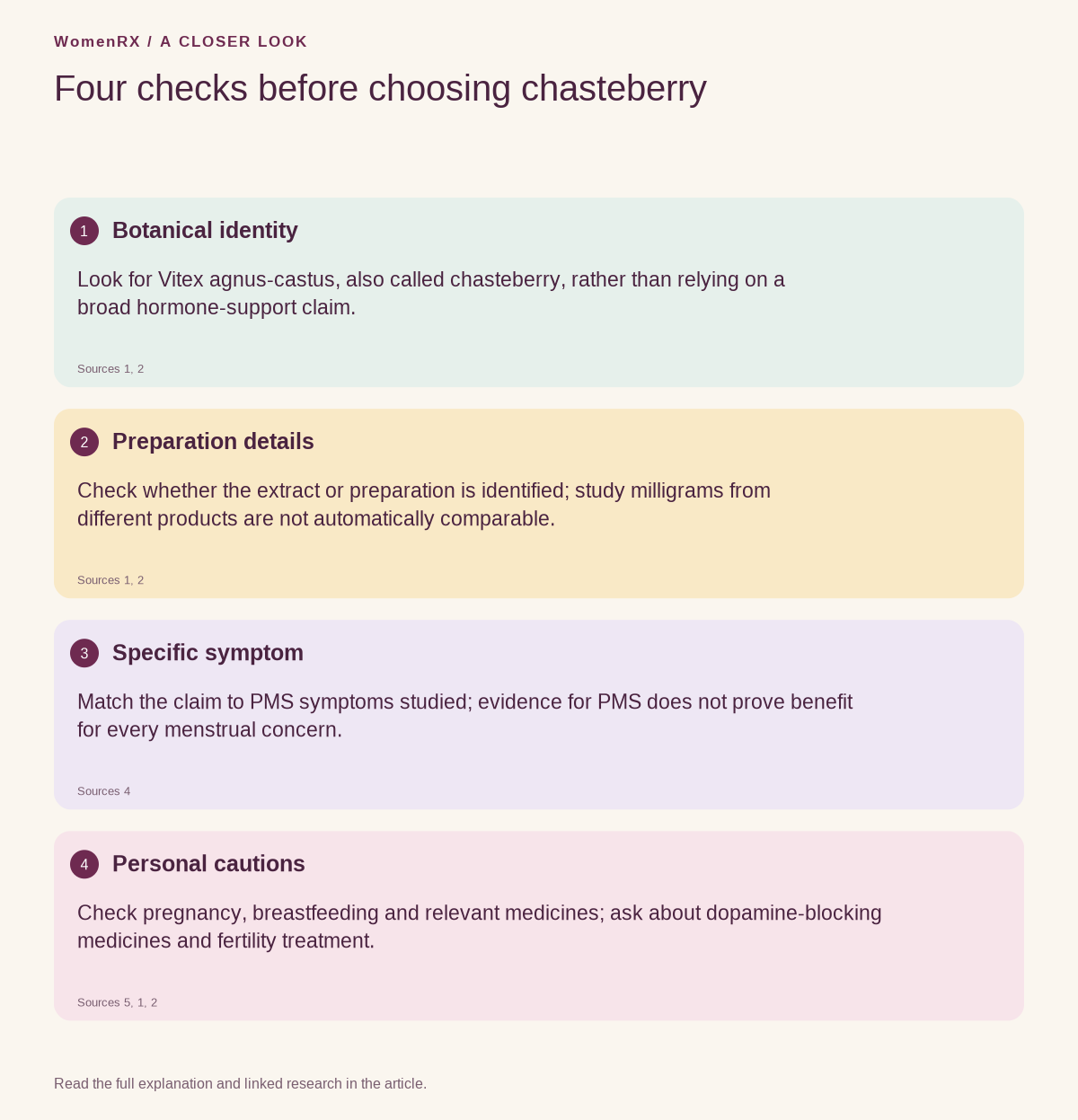
Four checks before choosing chasteberry
Botanical identity: Look for Vitex agnus-castus, also called chasteberry, rather than relying on a broad hormone-support claim.12
Preparation details: Check whether the extract or preparation is identified; study milligrams from different products are not automatically comparable.12
Specific symptom: Match the claim to PMS symptoms studied; evidence for PMS does not prove benefit for every menstrual concern.4
Personal cautions: Check pregnancy, breastfeeding and relevant medicines; ask about dopamine-blocking medicines and fertility treatment.512
Read the figure as text
Use the label to judge whether a product is identifiable and whether its claim fits the PMS evidence, then check the personal safety questions that matter.- Botanical identity: Look for Vitex agnus-castus, also called chasteberry, rather than relying on a broad hormone-support claim.12
- Preparation details: Check whether the extract or preparation is identified; study milligrams from different products are not automatically comparable.12
- Specific symptom: Match the claim to PMS symptoms studied; evidence for PMS does not prove benefit for every menstrual concern.4
- Personal cautions: Check pregnancy, breastfeeding and relevant medicines; ask about dopamine-blocking medicines and fertility treatment.512
More questions, answered
Does chasteberry have evidence for cramps?
Some studies have included menstrual pain or cramps, but the clearest trial evidence summarized here concerns PMS, and the studies used different products and designs. A result for PMS symptoms shouldn’t be taken as proof that a chasteberry product will relieve cramps. 46
Can I compare products by milligrams alone?
No. The studies used named preparations, and a milligram amount for one extract may not be comparable to the same amount of another. The label’s botanical identity and preparation details matter alongside the amount. 12
Sources you can check
- Efficacy and safety of Vitex agnus-castus extract for treatment of premenstrual syndrome in Japanese patients: a prospective, open-label study.Momoeda M, Sasaki H, Tagashira E, Ogishima M, Takano Y, Ochiai K. · Advances in therapy · 2014Return to first citation
- Treatment for premenstrual syndrome with Vitex agnus castus: A prospective, randomized, multi-center placebo controlled study in China.He Z, Chen R, Zhou Y, Geng L, Zhang Z, Chen S, Yao Y, Lu J, Lin S. · Maturitas · 2009Return to first citation
- Efficacy and Tolerability Evaluation of a Nutraceutical Composition Containing Vitex agnus-castus Extract (EVX40™), Pyridoxine, and Magnesium in Premenstrual Syndrome: A Real-World, Interventional, Comparative Study.Sureja VP, Kheni DB, Dubey VP, Kansagra J, Soni ZK, Bhatt SP, Mathuria A, Deshpande SS. · Cureus · 2023Return to first citation
- Vitex agnus-castus extracts for female reproductive disorders: a systematic review of clinical trials.van Die MD, Burger HG, Teede HJ, Bone KM. · Planta medica · 2013Return to first citation
- Vitex agnus castus: a systematic review of adverse events.Daniele C, Thompson Coon J, Pittler MH, Ernst E. · Drug safety · 2005Return to first citation
- Use of Vitex agnus-castus in patients with menstrual cycle disorders: a single-center retrospective longitudinal cohort study.Höller M, Steindl H, Abramov-Sommariva D, Kleemann J, Loleit A, Abels C, Stute P. · Archives of gynecology and obstetrics · 2024Return to first citation