Chasteberry for PMS: Which Symptoms Has It Been Studied For?
Chasteberry has some evidence for easing overall PMS symptoms, but the research doesn’t show which one symptom is most likely to improve.
Chasteberry, or Vitex agnus-castus, has been studied for recurring premenstrual symptoms such as mood changes, headache, bloating, breast fullness, and fatigue. A placebo-controlled trial found greater improvement in overall PMS scores with a specific extract than with placebo, but that doesn’t establish which individual symptom responds best or that other products work the same way. Avoid it during pregnancy and breastfeeding, and review medicine questions first. 125
What chasteberry has actually been studied for
The clinical research is mainly about premenstrual syndrome (PMS): symptoms that recur before a period. It doesn’t establish chasteberry as a general hormone balancer or as a treatment for infertility or every kind of irregular period.
In a randomized, double-blind trial, 217 Chinese women with moderate to severe PMS were assigned to a particular Vitex extract or placebo for up to three cycles. By the third cycle, the extract group had a greater reduction in total PMS diary scores. Scores also improved in the placebo group, so improvement over time alone doesn’t show that the extract caused the change. 2
That trial’s main reported comparison was an overall symptom score, not a clear answer about which one symptom benefits most. A separate, smaller Japanese study measured ten symptoms, including irritability, low mood, headache, bloating, breast fullness, and fatigue. Participants’ scores decreased over three cycles, but everyone received the extract, so the study can’t separate an effect of the extract from other reasons symptoms might change. 1
A review of randomized trials found that seven of eight PMS trials favored Vitex, while also noting differences in study quality, size, and comparison treatments. That supports a possible benefit for PMS overall, but not a reliable prediction for a specific symptom or person. 4
Does your symptom pattern match the research?
The studies are most relevant when symptoms reliably appear before your period and are part of a recurring pattern. If a concern happens throughout the month, is new, or involves a changing cycle, these PMS studies don’t tell you whether chasteberry is likely to help.
Some symptoms, such as breast fullness or low mood, were measured in the Japanese study, but its lack of a comparison group limits what those changes can establish. The stronger placebo-controlled comparison reported overall scores. So it’s fair to say that several kinds of PMS symptoms have been studied, but not that the research identifies a “best” symptom to target. 12
Also consider whether a product matches what was studied. Clinical findings apply to the specific preparations in those trials, not automatically to every supplement labeled chasteberry. A 2023 real-world study assessed a combination of Vitex, vitamin B6, and magnesium; because the ingredients were combined, it can’t show how much Vitex alone contributed. The studies don’t establish a best brand or show that different products are interchangeable. 23
Safety questions to check first
A systematic review of safety data advises avoiding Vitex during pregnancy and breastfeeding. It lists nausea, headache, digestive problems, menstrual changes, acne, itching, and rash among reported adverse effects. That review also notes that more rigorous safety research is needed, so a history of mild reported effects shouldn’t be mistaken for proof that every risk is known. 5
The same review found no drug interactions reported in the material it assessed, but raised a theoretical concern about medicines that block dopamine. “None reported” doesn’t prove that interactions can’t occur. If you take a dopamine-blocking medicine, ask a pharmacist or prescriber about the exact Vitex product before using it. The review also doesn’t establish whether Vitex is compatible with hormonal medicines, so include those in the same safety question. 5
The practical takeaway: chasteberry may be worth discussing as an option for recurring PMS, but the research is stronger for overall symptom scores than for any single complaint. Check whether your situation matches PMS, whether the product resembles a studied preparation, and whether pregnancy, breastfeeding, or your medicines change the safety picture.
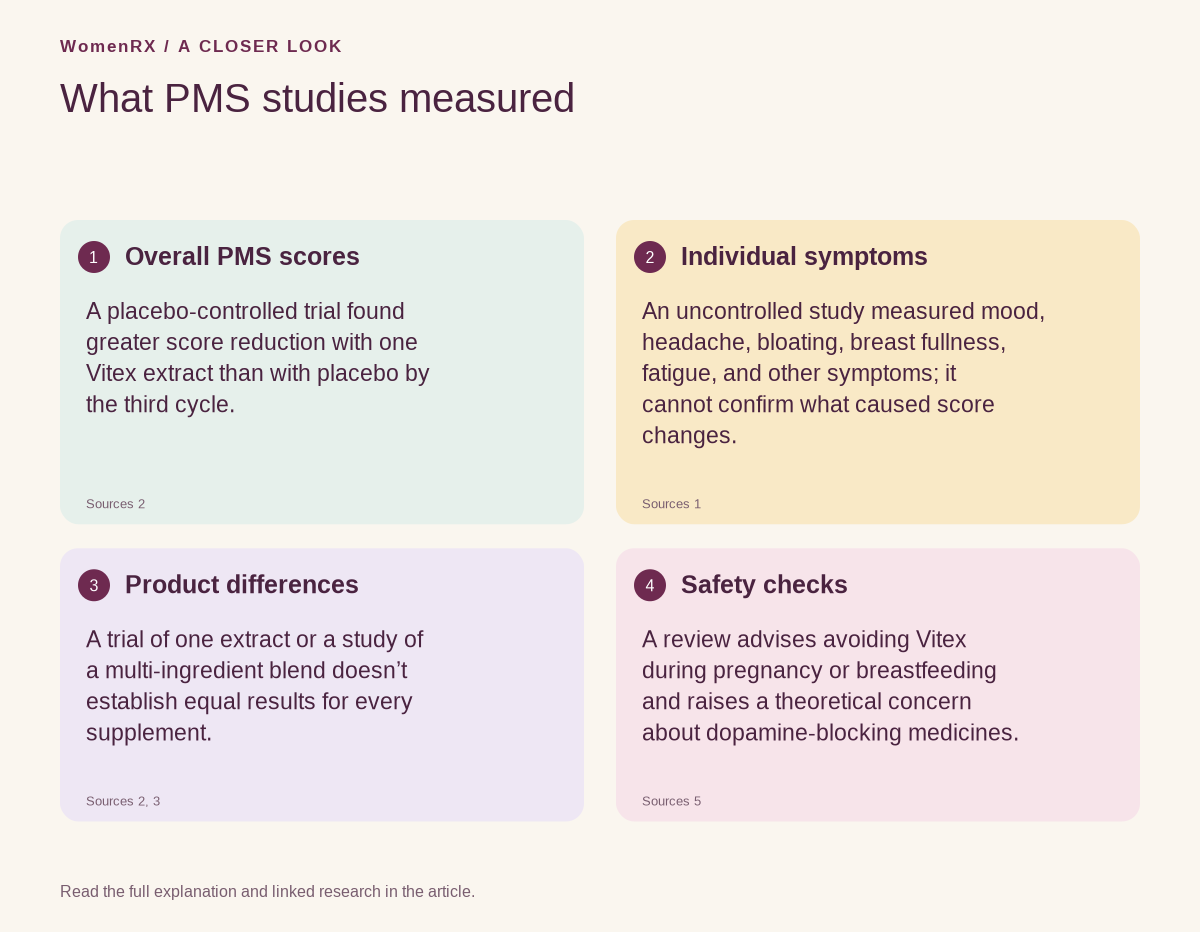
What PMS studies measured
Overall PMS scores: A placebo-controlled trial found greater score reduction with one Vitex extract than with placebo by the third cycle.2
Individual symptoms: An uncontrolled study measured mood, headache, bloating, breast fullness, fatigue, and other symptoms; it cannot confirm what caused score changes.1
Product differences: A trial of one extract or a study of a multi-ingredient blend doesn’t establish equal results for every supplement.23
Safety checks: A review advises avoiding Vitex during pregnancy or breastfeeding and raises a theoretical concern about dopamine-blocking medicines.5
Read the figure as text
The research offers a signal for overall PMS symptoms, but the type of study affects what you can conclude about individual symptoms, products, and safety.- Overall PMS scores: A placebo-controlled trial found greater score reduction with one Vitex extract than with placebo by the third cycle.2
- Individual symptoms: An uncontrolled study measured mood, headache, bloating, breast fullness, fatigue, and other symptoms; it cannot confirm what caused score changes.1
- Product differences: A trial of one extract or a study of a multi-ingredient blend doesn’t establish equal results for every supplement.23
- Safety checks: A review advises avoiding Vitex during pregnancy or breastfeeding and raises a theoretical concern about dopamine-blocking medicines.5
More questions, answered
Is the evidence the same for PMDD?
No. PMS and premenstrual dysphoric disorder (PMDD) are distinct conditions. A review found two Vitex trials for PMDD with mixed results: one reported an outcome similar to fluoxetine, while another found fluoxetine performed better. That limited and mixed evidence doesn’t establish Vitex as a PMDD treatment. 4
Sources you can check
- Efficacy and safety of Vitex agnus-castus extract for treatment of premenstrual syndrome in Japanese patients: a prospective, open-label study.Momoeda M, Sasaki H, Tagashira E, Ogishima M, Takano Y, Ochiai K. · Advances in therapy · 2014Return to first citation
- Treatment for premenstrual syndrome with Vitex agnus castus: A prospective, randomized, multi-center placebo controlled study in China.He Z, Chen R, Zhou Y, Geng L, Zhang Z, Chen S, Yao Y, Lu J, Lin S. · Maturitas · 2009Return to first citation
- Efficacy and Tolerability Evaluation of a Nutraceutical Composition Containing Vitex agnus-castus Extract (EVX40™), Pyridoxine, and Magnesium in Premenstrual Syndrome: A Real-World, Interventional, Comparative Study.Sureja VP, Kheni DB, Dubey VP, Kansagra J, Soni ZK, Bhatt SP, Mathuria A, Deshpande SS. · Cureus · 2023Return to first citation
- Vitex agnus-castus extracts for female reproductive disorders: a systematic review of clinical trials.van Die MD, Burger HG, Teede HJ, Bone KM. · Planta medica · 2013Return to first citation
- Vitex agnus castus: a systematic review of adverse events.Daniele C, Thompson Coon J, Pittler MH, Ernst E. · Drug safety · 2005Return to first citation