Chasteberry for PMS: What Doses and Preparations Have Been Studied?
PMS trials have tested specific extracts and very different schedules, so a milligram amount alone doesn’t show whether a supplement matches the research.
There isn’t one universal chasteberry dose established by these studies. A trial of the specific extract Ze 440 compared 8, 20, and 30 mg over three cycles; 20 mg performed better than placebo and 8 mg, while 30 mg showed no clear added benefit over 20 mg. Other studies used different extracts or schedules, so their results don’t automatically apply to a product with a different preparation. 6
If you’re comparing a chasteberry label with PMS research, start with the preparation, not just the number of milligrams. Studies have tested particular extracts, drops, and combination products. A result for one formulation isn’t proof that another product, even one labeled Vitex agnus-castus, will work the same way.
The clearest dose comparison: one named extract
In a randomized, double-blind trial, 162 women ages 18 to 45 with PMS received placebo or one of three doses of the extract Ze 440 for three menstrual cycles. The doses tested were 8, 20, and 30 mg. The 20 mg group had greater improvement in total symptom scores than the placebo and 8 mg groups. The 30 mg dose did not significantly improve symptoms more than 20 mg. 6
That finding applies to Ze 440 as studied. It doesn’t establish 20 mg as a dose for every chasteberry supplement, or show that 30 mg of another extract is equivalent. The study measured symptoms such as irritability, mood changes, anger, headache, bloating, and breast fullness; it doesn’t establish an effect for every symptom someone might call PMS. 6
Other studies used different preparations and schedules
A placebo-controlled trial used 40 drops of a Vitex extract for the six days before menstruation, repeated over six cycles. Participants rated symptoms including headache, irritability, depressed mood, and breast fullness. The abstract doesn’t report the extract concentration, so its details don’t allow the number of drops to be converted into a comparable milligram dose. 5
Another trial in Chinese women with moderate-to-severe PMS tested the specific extract BNO 1095 for three cycles. The trial abstract doesn’t state its dose, so it can’t guide a milligram-for-milligram label comparison. 7
These aren’t interchangeable instructions. One study compared extract doses across three cycles; another used drops only in the days before a period; and another named an extract but doesn’t state its dose in the abstract. Don’t infer that one schedule is better, or combine them into a new routine.
Why the extract name matters
A systematic review of randomized trials found that studies used three different Vitex preparations, with varied PMS definitions and outcome measures. A separate review and meta-analysis found 17 randomized trials, with 14 included in its pooled analysis. Most trials reported benefit, but many had a high risk of bias, results varied substantially between studies, and the reviewers noted possible publication bias. They concluded that the pooled effect shouldn’t be treated as definitive. 3 4
For a label-to-study comparison, look for the exact extract name and amount per serving, and check whether the directions describe daily use or use tied to particular cycle days. If a label gives only a plant name and a total amount, without identifying the preparation, you may not be able to tell whether it matches the tested extract. Even when the name matches, check the schedule and serving details rather than assuming the study result transfers directly.
Combination products make the comparison harder
A two-cycle study tested a product containing chasteberry along with seeds and other ingredients. It reported symptom improvements, but it was open-label, had no control group, and tested the full combination. The results can’t show whether chasteberry itself caused the changes or tell you what dose of chasteberry alone to use. 2
A real-world study likewise evaluated chasteberry together with vitamin B6 and magnesium, so its results don’t isolate the effect of chasteberry. 8
A practical label check, without treating it as a prescription
Before comparing a product with a study, check:
- Preparation: Does the label name the same extract, such as Ze 440, that a trial tested?
- Amount: Is the amount for that extract stated, rather than only a total for a blend?
- Schedule: Was use timed to the days before a period, or studied across cycles?
- Other ingredients: Is it a combination product whose effects can’t be separated?
If those details aren’t clear, there may not be a meaningful way to match that product to a trial. The evidence also doesn’t establish a universal dose for chasteberry products as a category.
The studies summarized here don’t establish safety during pregnancy or breastfeeding, or for people with hormone-sensitive conditions. If any of those apply, don’t assume that a PMS trial in cycling adults answers whether the product is appropriate for you. If you take medication, check with a pharmacist or clinician before starting a regular supplement. 1
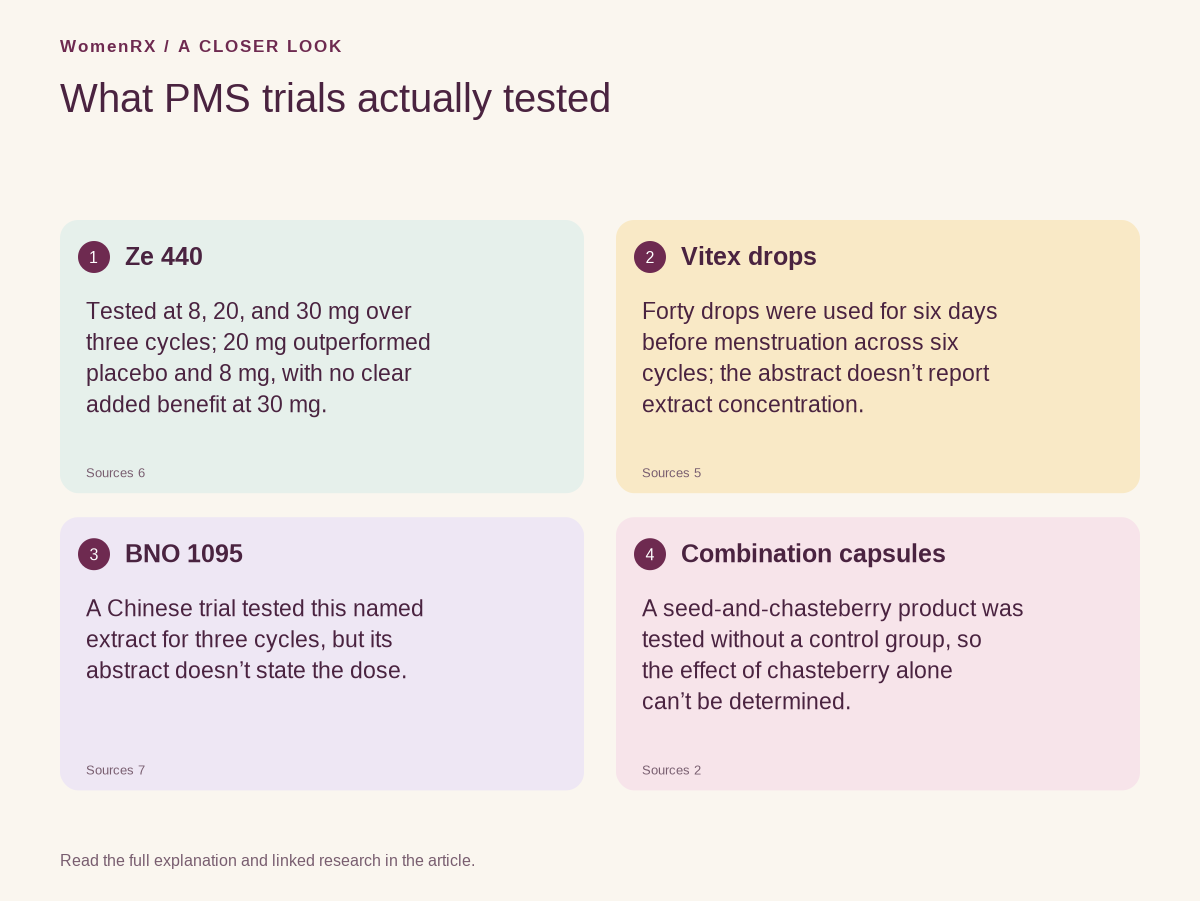
What PMS trials actually tested
Ze 440: Tested at 8, 20, and 30 mg over three cycles; 20 mg outperformed placebo and 8 mg, with no clear added benefit at 30 mg.6
Vitex drops: Forty drops were used for six days before menstruation across six cycles; the abstract doesn’t report extract concentration.5
BNO 1095: A Chinese trial tested this named extract for three cycles, but its abstract doesn’t state the dose.7
Combination capsules: A seed-and-chasteberry product was tested without a control group, so the effect of chasteberry alone can’t be determined.2
Read the figure as text
Compare the named preparation and schedule before treating a product label as equivalent to a study.- Ze 440: Tested at 8, 20, and 30 mg over three cycles; 20 mg outperformed placebo and 8 mg, with no clear added benefit at 30 mg.6
- Vitex drops: Forty drops were used for six days before menstruation across six cycles; the abstract doesn’t report extract concentration.5
- BNO 1095: A Chinese trial tested this named extract for three cycles, but its abstract doesn’t state the dose.7
- Combination capsules: A seed-and-chasteberry product was tested without a control group, so the effect of chasteberry alone can’t be determined.2
More questions, answered
Does the research show that chasteberry regulates hormones?
The trials summarized here mainly assessed PMS symptom scores. They don’t establish that chasteberry regulates hormones, so a hormone-related explanation shouldn’t be treated as a proven result of these studies. 5 6 7
Can I compare a product’s drop dose with a trial’s milligram dose?
Not from the details in the abstract of the six-day drops study: it reports 40 drops but not the extract concentration. Without matching preparation and concentration details, drops and milligrams aren’t directly comparable. 5
Sources you can check
- PMS (premenstrual syndrome) - NHSAccessed 2026-09-25Return to first citation
- Symptoms of Premenstrual Syndrome in Women Receiving Seed Cycling Capsules With Chasteberry: A Single-Arm Clinical Trial Over Two Cycles.O'Gorman E, Kaunzner UW, Mitschke S. · Cureus · 2026Return to first citation
- Vitex agnus castus for premenstrual syndrome and premenstrual dysphoric disorder: a systematic review.Cerqueira RO, Frey BN, Leclerc E, Brietzke E. · Archives of women's mental health · 2017Return to first citation
- The treatment of premenstrual syndrome with preparations of Vitex agnus castus: a systematic review and meta-analysis.Verkaik S, Kamperman AM, van Westrhenen R, Schulte PFJ. · American journal of obstetrics and gynecology · 2017Return to first citation
- Therapeutic effect of Vitex agnus castus in patients with premenstrual syndrome.Zamani M, Neghab N, Torabian S. · Acta medica Iranica · 2012Return to first citation
- Dose-dependent efficacy of the Vitex agnus castus extract Ze 440 in patients suffering from premenstrual syndrome.Schellenberg R, Zimmermann C, Drewe J, Hoexter G, Zahner C. · Phytomedicine : international journal of phytotherapy and phytopharmacology · 2012Return to first citation
- Evaluating therapeutic effect in symptoms of moderate-to-severe premenstrual syndrome with Vitex agnus castus (BNO 1095) in Chinese women.Ma L, Lin S, Chen R, Zhang Y, Chen F, Wang X. · The Australian & New Zealand journal of obstetrics & gynaecology · 2010Return to first citation
- Efficacy and Tolerability Evaluation of a Nutraceutical Composition Containing Vitex agnus-castus Extract (EVX40™), Pyridoxine, and Magnesium in Premenstrual Syndrome: A Real-World, Interventional, Comparative Study.Sureja VP, Kheni DB, Dubey VP, Kansagra J, Soni ZK, Bhatt SP, Mathuria A, Deshpande SS. · Cureus · 2023Return to first citation