Chasteberry for PMS: Does Timing Make a Difference?
Studies suggest chasteberry may ease PMS symptoms over several cycles, but they don’t establish a best time of day.
Chasteberry (Vitex agnus-castus) has some evidence for easing PMS symptoms, though results apply to the extracts and schedules studied. One placebo-controlled trial assessed symptoms after up to three treatment cycles. The cited findings don’t establish whether morning or evening works better, or whether taking it only on certain cycle days works as well. 2 3
If you’re reading a chasteberry label, “when to take it” can mean three different things: what time of day, which days of your cycle, and how many cycles it may take to assess a change. The PMS research is most useful for that last question.
What changed in the PMS studies?
A systematic review identified eight randomized trials of Vitex extracts for PMS. Seven found an advantage over a comparison treatment: five over placebo, one over vitamin B6, and one over magnesium oxide. The review noted limitations, including small samples in some studies and differences in the conditions and comparison treatments studied. That’s encouraging evidence for PMS symptoms, not a finding that every chasteberry product works the same way. 2
In one double-blind trial, 217 Chinese women with moderate-to-severe PMS were randomized to a specific Vitex extract or placebo after three screening and preparation cycles. Treatment lasted up to three more cycles. Among the 104 women in each group who provided efficacy data, the average decrease in PMS diary score from baseline to the third treatment cycle was 22.71 points with Vitex and 15.50 points with placebo. Symptoms improved in both groups, but the average decrease was greater with the studied extract. 3
Three treatment cycles tell you when that trial assessed its result. They aren’t a promise that you’ll notice a benefit by a particular date, and they don’t establish how long to use a different product.
Does the hour or cycle day matter?
The cited PMS findings don’t establish that morning beats evening, that taking chasteberry with food changes its effect, or that taking it only once premenstrual symptoms begin works as well as the schedules studied. Follow the directions for the product you’re considering rather than treating a research timeline as universal instructions. A label also doesn’t, by itself, show that the product contains the specific extract tested in the Chinese trial. 2 3
You may also see a cycle-day schedule. In a two-cycle study, a capsule containing chasteberry and other ingredients was used on days 15-28, while a different seed capsule was used on days 1-14. The study had no comparison group. Its results cannot tell you whether chasteberry itself helped or whether taking chasteberry only in the second half of a cycle is better than another schedule. 4
If you want to judge whether a product is helping your PMS, focus on the symptoms you’re trying to change. For example, note whether breast tenderness, cravings, or mood changes appear before your period, how much they interfere with your day, and whether that pattern changes across cycles. PMS symptoms can vary from month to month. If they’re affecting daily life, you don’t have to wait through a supplement experiment before discussing treatment options with a clinician. 1
Keep PMS, fertility, and life stage separate
The PMS trials measured symptoms; they don’t show that chasteberry improves fertility or generally “balances hormones.” The review also covered trials in other reproductive conditions, but a finding for one condition doesn’t establish a benefit for another. 2
There’s even less reason to carry a PMS result into pregnancy or breastfeeding: these findings don’t establish benefit or safety in either setting. Perimenopause deserves its own distinction, too. A small analysis of 14 late-perimenopausal women examined a combination of chasteberry and St. John’s wort for PMS-like symptoms. It can’t isolate an effect of chasteberry alone. 5
Reported adverse effects in the randomized-trial review were generally mild and infrequent, and the Chinese trial reported no serious adverse events during its treatment period. Those findings don’t settle longer-term safety or suitability alongside your medicines. If you take medication, including hormone-related treatment, ask a pharmacist or clinician to check the particular supplement before starting regular use; that’s a precaution, not a claim that a specific interaction was demonstrated in these PMS studies. 2 3 1
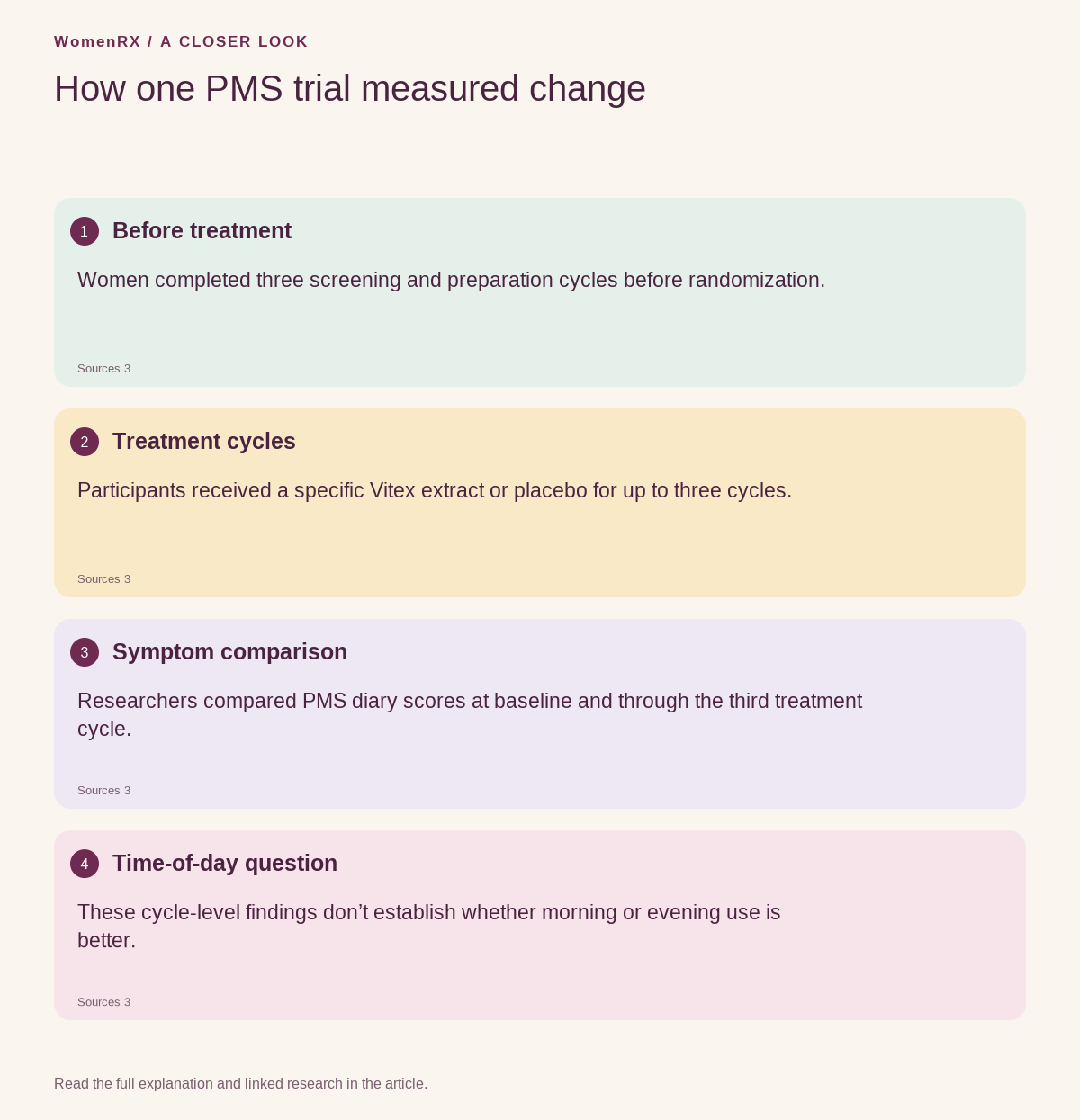
How one PMS trial measured change
Before treatment: Women completed three screening and preparation cycles before randomization.3
Treatment cycles: Participants received a specific Vitex extract or placebo for up to three cycles.3
Symptom comparison: Researchers compared PMS diary scores at baseline and through the third treatment cycle.3
Time-of-day question: These cycle-level findings don’t establish whether morning or evening use is better.3
Read the figure as text
The study followed symptoms across cycles. Its timeline answers a different question from whether morning or evening is better.- Before treatment: Women completed three screening and preparation cycles before randomization.3
- Treatment cycles: Participants received a specific Vitex extract or placebo for up to three cycles.3
- Symptom comparison: Researchers compared PMS diary scores at baseline and through the third treatment cycle.3
- Time-of-day question: These cycle-level findings don’t establish whether morning or evening use is better.3
Sources you can check
- PMS (premenstrual syndrome) - NHSAccessed 2026-09-25Return to first citation
- Vitex agnus-castus extracts for female reproductive disorders: a systematic review of clinical trials.van Die MD, Burger HG, Teede HJ, Bone KM. · Planta medica · 2013Return to first citation
- Treatment for premenstrual syndrome with Vitex agnus castus: A prospective, randomized, multi-center placebo controlled study in China.He Z, Chen R, Zhou Y, Geng L, Zhang Z, Chen S, Yao Y, Lu J, Lin S. · Maturitas · 2009Return to first citation
- Symptoms of Premenstrual Syndrome in Women Receiving Seed Cycling Capsules With Chasteberry: A Single-Arm Clinical Trial Over Two Cycles.O'Gorman E, Kaunzner UW, Mitschke S. · Cureus · 2026Return to first citation
- Effects of a combination of Hypericum perforatum and Vitex agnus-castus on PMS-like symptoms in late-perimenopausal women: findings from a subpopulation analysis.van Die MD, Bone KM, Burger HG, Reece JE, Teede HJ. · Journal of alternative and complementary medicine (New York, N.Y.) · 2009Return to first citation