Should You Take Chasteberry With Food?
There’s no established meal-timing advantage, but nausea or abdominal discomfort may help you decide what feels workable.
You don’t need to assume chasteberry works better on an empty stomach. The human studies and safety reviews summarized here don’t establish whether taking it with food changes its effects or prevents stomach symptoms. Nausea and abdominal discomfort have been reported. Check your particular product’s directions, and if your stomach feels unsettled, notice whether that changes when you take it with a meal.23
What the research can tell you
Chasteberry, also called Vitex agnus-castus, comes in different forms. A review of studies involving women of reproductive age and menstrual bleeding included tablets, capsules and oral drops. It reported nausea and abdominal pain among side effects, but did not establish whether taking chasteberry with a meal changed those symptoms.2
A broader review of human safety reports also identified nausea and other gastrointestinal disturbances among the more commonly reported adverse events. It did not provide a comparison of taking chasteberry with food versus on an empty stomach.3 That leaves a practical distinction: stomach discomfort is a reported possibility; food as a way to prevent it is unproven. There’s no basis here for claiming that fasting improves absorption, either.
The menstrual-bleeding studies involved women in their cycling years, so they’re more relevant to someone taking chasteberry for a cycle-related reason than a food-formulation experiment would be. Still, they don’t answer this specific timing question. Results from one preparation may not carry over neatly to another, because supplements can differ in their ingredients and amounts.12
A practical way to choose a time
Start with the directions on the bottle you actually have. If they specify taking it with food or give other timing instructions, use those rather than a general rule you’ve heard about chasteberry. If they don’t address meals, there isn’t an evidence-based reason in these studies to choose an empty stomach for better results.
If you notice nausea or abdominal discomfort, pay attention to the pattern: Does it happen after each use? Does it seem different when you’ve eaten? Taking it alongside a meal is a reasonable personal tolerability check, not a proven fix. If discomfort keeps coming back, don’t assume changing meal timing is all you need to do. A pharmacist or your care team can help you look at the product and the symptom.
For a quick decision, use these four checks:
- Read your label: Look for directions about meals on your particular product.
- Separate evidence from assumptions: Human safety reports describe stomach symptoms, not a tested food-timing solution.23
- Notice your pattern: If discomfort appears, compare how you feel when taking it with and without a meal.
- Reassess persistent discomfort: If the symptom continues, get help assessing it rather than repeatedly adjusting the timing.
Pregnancy and breastfeeding are different questions
Whether to take chasteberry with food doesn’t settle whether to take it at all during pregnancy or breastfeeding. A human safety review advises avoiding it during pregnancy and lactation. LactMed also advises avoiding chasteberry while breastfeeding because of safety concerns and the possibility that it could reduce milk production.13 If either situation applies to you, address that question before experimenting with meal timing.
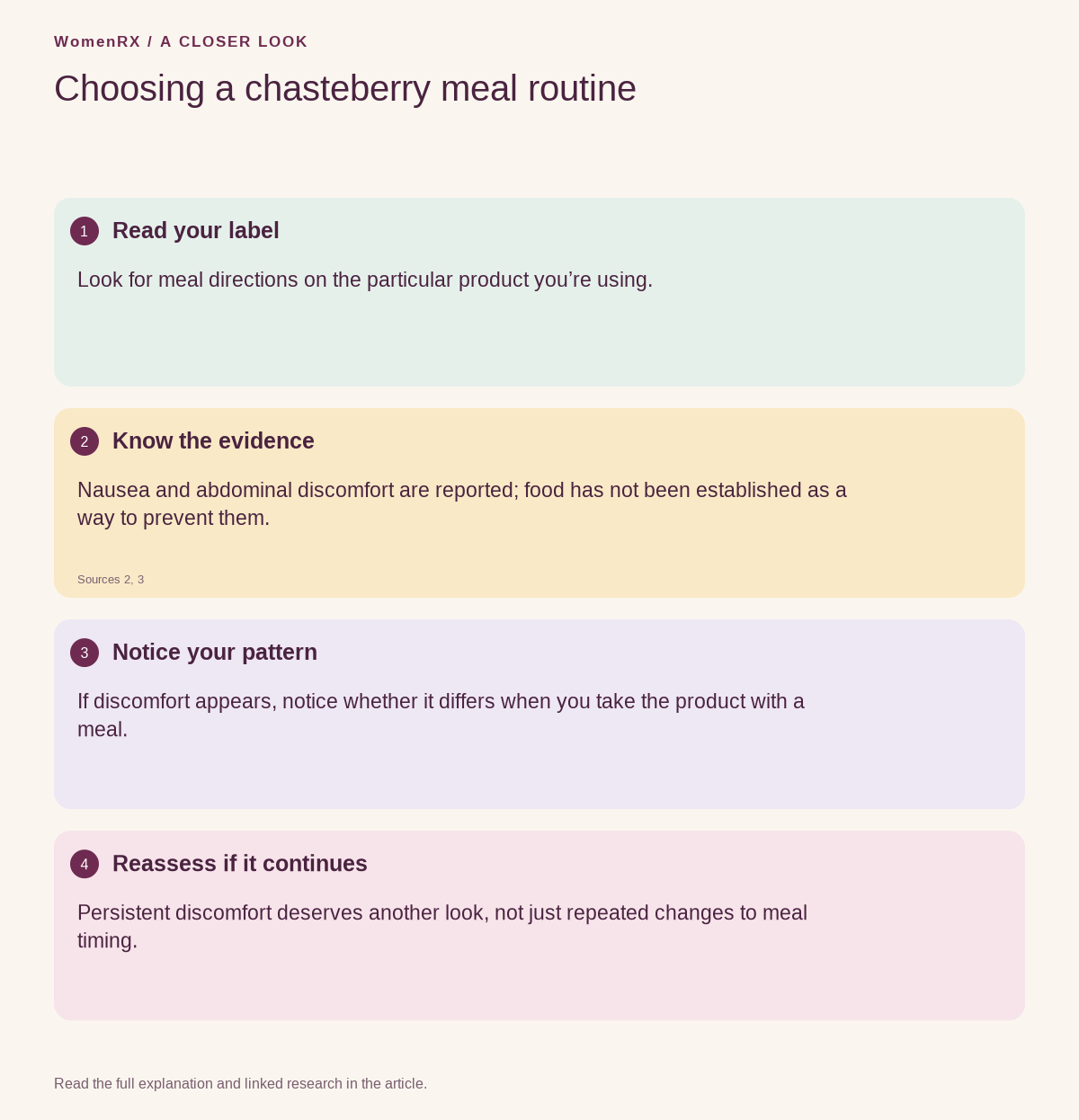
Choosing a chasteberry meal routine
Read your label: Look for meal directions on the particular product you’re using.
Know the evidence: Nausea and abdominal discomfort are reported; food has not been established as a way to prevent them.23
Notice your pattern: If discomfort appears, notice whether it differs when you take the product with a meal.
Reassess if it continues: Persistent discomfort deserves another look, not just repeated changes to meal timing.
Read the figure as text
A four-part check that separates product directions, reported side effects and your own experience.- Read your label: Look for meal directions on the particular product you’re using.
- Know the evidence: Nausea and abdominal discomfort are reported; food has not been established as a way to prevent them.23
- Notice your pattern: If discomfort appears, notice whether it differs when you take the product with a meal.
- Reassess if it continues: Persistent discomfort deserves another look, not just repeated changes to meal timing.
Sources you can check
- Chasteberry2006Return to first citation
- The effects of Vitex agnus-castus on menstrual bleeding: A systematic review and meta-analysis.Mollazadeh S, Mirghafourvand M, Abdollahi NG. · Journal of complementary & integrative medicine · 2019Return to first citation
- Vitex agnus castus: a systematic review of adverse events.Daniele C, Thompson Coon J, Pittler MH, Ernst E. · Drug safety · 2005Return to first citation