Chasteberry Safety: Side Effects and When to Ask First
Reported side effects have generally been mild, but pregnancy, breastfeeding, and treatment that affects prolactin deserve a closer look before you take chasteberry.
Nausea, abdominal pain, headache, and dizziness were reported among participants taking chasteberry, also called Vitex, in clinical studies; a review of reproductive-health trials described adverse events as generally mild and infrequent.567 That doesn’t establish safety during pregnancy or breastfeeding. Check before use if you’re pregnant, nursing, receiving fertility care, or taking medicine that affects prolactin. A possible interaction is not the same as a proven one.247
What side effects have actually been reported?
The clearest starting point is what women in studies reported, rather than every effect a supplement might cause. A review of five studies involving women of reproductive age without gynecologic disorders found that nausea and abdominal pain were the only side effects reported in those studies. The reviewers also judged the underlying studies to be relatively low quality.5
A separate review of randomized trials of chasteberry extracts for premenstrual symptoms and prolactin-related concerns described adverse events as generally mild and infrequent. The trials differed in the conditions treated and the extracts used, and some were small.7 In a review that included a small menopause-symptom trial, headache and dizziness were listed for the chasteberry group.6
These reports are useful if you’re deciding whether a new symptom could be related to chasteberry. They aren’t a complete list of possible effects, and small or short studies cannot settle questions about uncommon harms. If a symptom begins after you start a product, don’t assume it’s either harmless or definitely caused by the herb. Note the product’s ingredients and discuss what changed with a clinician or pharmacist.
Why prolactin treatment needs a closer look
Chasteberry isn’t simply an inert addition to a wellness routine. Laboratory and animal findings suggest activity at dopamine receptors, and one report describes reduced prolactin levels in patients given a particular extract.4 Prolactin is relevant to some menstrual and fertility evaluations, so a supplement with possible effects on it can complicate decisions about treatment or the interpretation of results.
For example, a chasteberry trial compared the extract with bromocriptine, a prolactin-lowering medicine. It did not test whether taking them together is safe or effective.7 If you’re being treated for a prolactin-related condition, tell the clinician managing that treatment about chasteberry before adding it. This is a reason to check for a possible interaction, not evidence that a harmful interaction has been demonstrated.
The same distinction matters if you use hormonal contraception or hormone treatment. A trial reviewed in the reproductive-health literature reported changes in certain hormone measurements with a chasteberry extract, but that does not show that chasteberry makes contraception fail or establishes an interaction with a particular hormone medicine.7 Bring the exact product and your medicine list to a pharmacist or prescribing clinician rather than relying on a blanket claim that all hormone medicines interact with Vitex.
Pregnancy and breastfeeding call for different questions
If you’re pregnant or might be pregnant: Check before taking chasteberry. Guidance on pregnancy and medicines explicitly includes herbs and supplements among products to review before use. Don’t stop a medicine you need because you’re considering an herb; review the risks and benefits of both with the clinician caring for you.2
If you’re breastfeeding: Ask about the specific product before using it, especially if milk supply is a concern. Prolactin findings from chasteberry research give a reason to raise the question, but they do not establish what chasteberry does to milk production or an infant’s exposure during breastfeeding.4 General breastfeeding guidance notes that some substances can pass into breast milk; it does not establish that chasteberry does so or quantify a risk.1
A chasteberry product may also contain other active ingredients. For example, one pilot trial used a blend containing Vitex, rhodiola, vitamin B6, melatonin, and GABA. Its safety observations cannot be treated as evidence about every ingredient on its own, or about a different blend.3 Check the full ingredient list when you ask about safety.
A practical way to make the decision
First, identify why you want to take it: for a recurring premenstrual symptom, a fertility concern, or something else. Then check whether you’re pregnant or nursing, whether a clinician is assessing your cycle or prolactin, and which medicines and ingredients would be taken alongside it. Those details make the conversation more useful than asking whether chasteberry is universally “safe” or “unsafe.” Its reported side effects are one part of that decision; unanswered questions about your particular situation are another.457
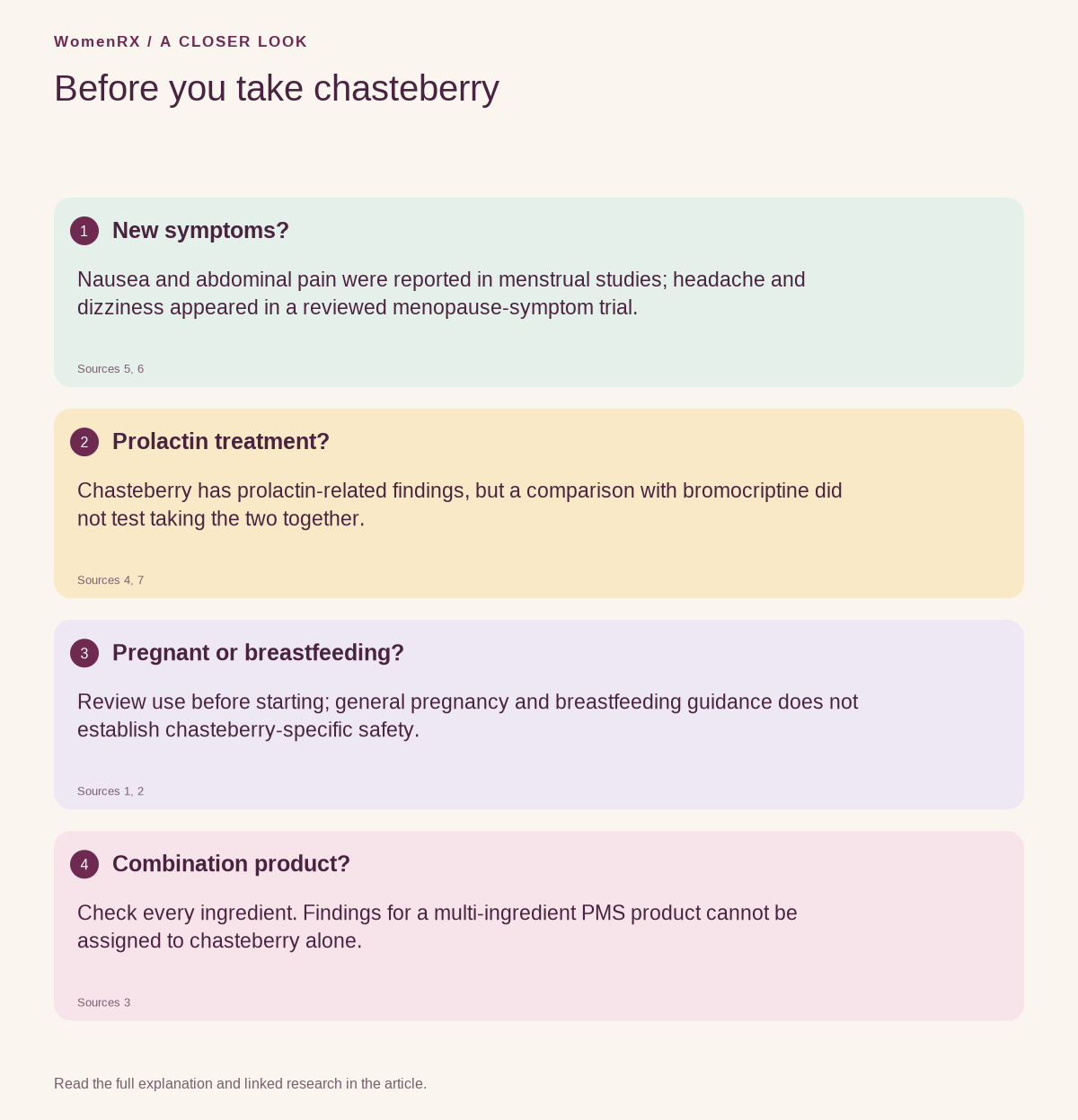
Before you take chasteberry
New symptoms?: Nausea and abdominal pain were reported in menstrual studies; headache and dizziness appeared in a reviewed menopause-symptom trial.56
Prolactin treatment?: Chasteberry has prolactin-related findings, but a comparison with bromocriptine did not test taking the two together.47
Pregnant or breastfeeding?: Review use before starting; general pregnancy and breastfeeding guidance does not establish chasteberry-specific safety.12
Combination product?: Check every ingredient. Findings for a multi-ingredient PMS product cannot be assigned to chasteberry alone.3
Read the figure as text
Four different safety questions, with different kinds of evidence behind them. This is a conversation aid, not a diagnostic score.- New symptoms?: Nausea and abdominal pain were reported in menstrual studies; headache and dizziness appeared in a reviewed menopause-symptom trial.56
- Prolactin treatment?: Chasteberry has prolactin-related findings, but a comparison with bromocriptine did not test taking the two together.47
- Pregnant or breastfeeding?: Review use before starting; general pregnancy and breastfeeding guidance does not establish chasteberry-specific safety.12
- Combination product?: Check every ingredient. Findings for a multi-ingredient PMS product cannot be assigned to chasteberry alone.3
More questions, answered
Does a trial reporting no adverse events prove chasteberry is safe?
No. One small pilot study reported no adverse events with a multi-ingredient product containing chasteberry, but it cannot establish the safety of chasteberry alone or rule out uncommon effects.3
Is an interaction with bromocriptine proven?
No. A reviewed trial compared chasteberry against bromocriptine; it did not evaluate taking both together. Chasteberry’s reported prolactin-related activity makes the combination a sensible question for the clinician managing your treatment, not a documented interaction.47
Sources you can check
- Breastfeeding | Benefits of Breastfeeding | MedlinePlusAccessed 2026-09-25Return to first citation
- Pregnancy and Medicines | MedlinePlusAccessed 2026-09-25Return to first citation
- Effects of the PREMEN-CALM® in the Management of the Premenstrual Syndrome: A Randomized, Double-Blind, Placebo-Controlled Pilot Study.Herrera A, Al Adib M, Rodríguez AB, Carrasco C. · Journal of dietary supplements · 2024Return to first citation
- Low potency homeopathic remedies and allopathic herbal medicines: is there an overlap?Csupor D, Boros K, Hohmann J. · PloS one · 2013Return to first citation
- The effects of Vitex agnus-castus on menstrual bleeding: A systematic review and meta-analysis.Mollazadeh S, Mirghafourvand M, Abdollahi NG. · Journal of complementary & integrative medicine · 2019Return to first citation
- Effects of flaxseed and Hypericum perforatum on hot flash, vaginal atrophy and estrogen-dependent cancers in menopausal women: a systematic review and meta-analysis.Ghazanfarpour M, Sadeghi R, Latifnejad Roudsari R, Khadivzadeh T, Khorsand I, Afiat M, Esmaeilizadeh M. · Avicenna journal of phytomedicine · 2016Return to first citation
- Vitex agnus-castus extracts for female reproductive disorders: a systematic review of clinical trials.van Die MD, Burger HG, Teede HJ, Bone KM. · Planta medica · 2013Return to first citation