Can Vitamins Treat Hormone Symptoms? Start With the Cause
A vitamin may help in a specific situation, but that’s different from balancing hormones or treating the condition behind a symptom.
Vitamins aren’t a general treatment for “hormone imbalance.” Treating a deficiency differs from treating PMS, PCOS, or menopause symptoms. Vitamin B6 has limited evidence for PMS; a small trial suggests vitamin D may help women with both PMS and low vitamin D, but broader evidence remains uncertain. 3 6 5 Persistent irregular periods with signs of PCOS, or severe premenstrual distress that may indicate PMDD, merit evaluation rather than just a supplement trial. 1 2
First ask what the symptom is pointing to
“Hormone symptoms” can mean very different things: periods that are far apart, acne or extra facial hair, mood changes before a period, or symptoms during menopause. A vitamin that might help one specific symptom or deficiency doesn’t automatically help the others. And a change in a blood vitamin level or hormone-related marker doesn’t by itself show that a supplement treats the cause.
Vitamins have specific roles, and low levels of some nutrients can cause health problems. That supports addressing a documented or likely deficiency when appropriate. It doesn’t support using a vitamin as a broad hormone treatment. 4
If your cycles are irregular or you have signs of PCOS
Irregular or absent periods, acne, increased facial or body hair, or difficulty becoming pregnant can be reasons to ask whether PCOS or another condition could be involved. PCOS is diagnosed from a pattern of findings, not one specific test; evaluation may include blood tests to check hormone levels. It’s a condition with possible effects beyond the ovaries, so treating a supplement as the whole answer could miss other needs. 1
Vitamin D is sometimes discussed in relation to PCOS because lower vitamin D levels are associated with greater insulin resistance in women with PCOS. But that finding comes from observational studies: it shows a relationship, not that vitamin D causes the insulin resistance or that supplements treat PCOS. A supplement can address low vitamin D when that’s relevant, but the association alone isn’t evidence that it will regulate cycles or treat acne, hair growth, or the underlying condition. 8
If symptoms arrive before your period
For PMS, vitamin B6 has some supportive but limited evidence. An NIH review describes a meta-analysis of nine trials involving nearly 1,000 women that found fewer PMS symptoms with B6 than placebo, while noting that most studies were small or had methodological weaknesses. High or prolonged supplemental B6 can also damage nerves, so more isn’t automatically better. 3
Vitamin D has also been tested for PMS. A randomized trial in 44 women who had both PMS and low vitamin D found improved symptom scores after four months compared with placebo. But a later review of five trials with 436 participants rated the overall evidence very low certainty, with substantial variation between studies. That makes vitamin D a possibility for study, not a proven general PMS treatment or a reason to assume every person with PMS is deficient. 5 6
If emotional or physical symptoms before your period are severe enough to disrupt work, relationships, or daily life, consider an evaluation for PMDD or another cause. PMDD can resemble PMS but is more intense and can substantially affect functioning. A supplement claim shouldn’t delay getting help for symptoms that are taking over your life. 2
If symptoms are happening around menopause
A study about when natural menopause occurs doesn’t tell you whether a vitamin treats symptoms such as hot flashes or sleep disruption. A systematic review of prospective studies found no consistent association between micronutrient intake and the age at natural menopause; that’s a different question from symptom relief. Look for evidence tied to the symptom and life stage you’re dealing with, rather than assuming that a product that claims to “balance hormones” has been shown to help. 7
A practical way to judge the claim
Before starting a product, translate “balances hormones” into a specific claim: Which symptom is it supposed to help, in whom, and based on what kind of evidence? A small PMS trial, an association between vitamin D and insulin resistance in PCOS, and treatment of a confirmed deficiency are three different things. None of them proves that a supplement treats every hormone-related symptom.
A useful next step is to describe the symptom and its pattern plainly: for example, “My periods have become irregular,” “My mood drops before each period,” or “I’m having new symptoms around menopause.” That gives an evaluation a clearer starting point than a broad label like hormone imbalance. If you’re considering supplements, check the ingredients and amounts, especially if you already take a multivitamin: high doses of some vitamins can cause harm, and excessive B6 over time can injure nerves. 1 3 4
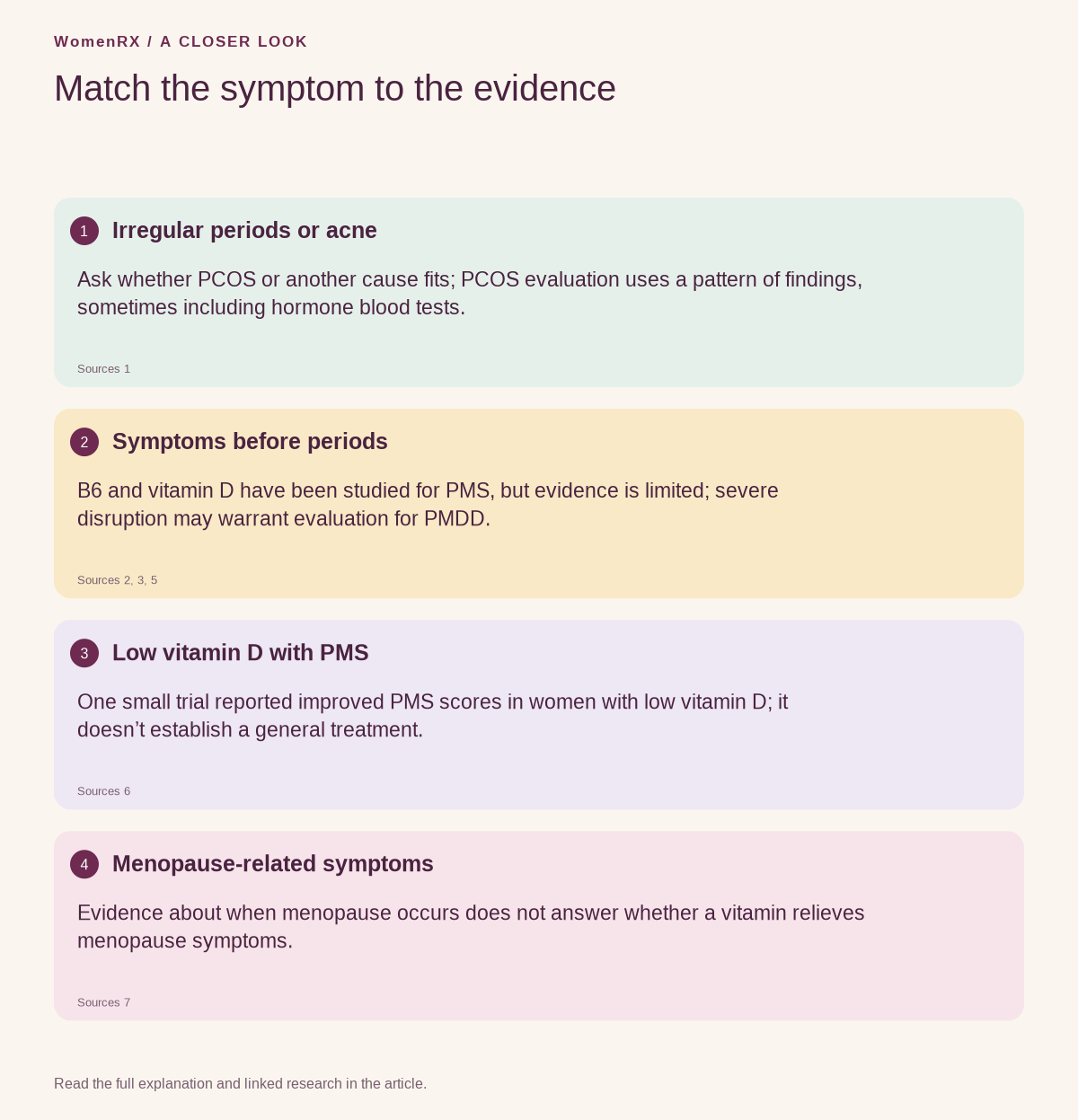
Match the symptom to the evidence
Irregular periods or acne: Ask whether PCOS or another cause fits; PCOS evaluation uses a pattern of findings, sometimes including hormone blood tests.1
Symptoms before periods: B6 and vitamin D have been studied for PMS, but evidence is limited; severe disruption may warrant evaluation for PMDD.235
Low vitamin D with PMS: One small trial reported improved PMS scores in women with low vitamin D; it doesn’t establish a general treatment.6
Menopause-related symptoms: Evidence about when menopause occurs does not answer whether a vitamin relieves menopause symptoms.7
Read the figure as text
This flow separates symptoms that may merit evaluation from narrow supplement findings, so a broad hormone claim doesn’t stand in for a diagnosis.- Irregular periods or acne: Ask whether PCOS or another cause fits; PCOS evaluation uses a pattern of findings, sometimes including hormone blood tests.1
- Symptoms before periods: B6 and vitamin D have been studied for PMS, but evidence is limited; severe disruption may warrant evaluation for PMDD.235
- Low vitamin D with PMS: One small trial reported improved PMS scores in women with low vitamin D; it doesn’t establish a general treatment.6
- Menopause-related symptoms: Evidence about when menopause occurs does not answer whether a vitamin relieves menopause symptoms.7
More questions, answered
Does vitamin D treat PCOS?
Lower vitamin D levels are associated with greater insulin resistance in women with PCOS, but that association doesn’t establish cause and effect or prove that supplements treat PCOS. 8
Can vitamin B6 help with PMS?
It may help some PMS symptoms, but much of the research has limitations. High or prolonged supplemental use can damage nerves, so don’t assume a higher amount will work better. 3
Sources you can check
- PCOS | Polycystic Ovary Syndrome | MedlinePlusAccessed 2026-09-25Return to first citation
- PMDD (premenstrual dysphoric disorder) - NHSAccessed 2026-09-25Return to first citation
- Vitamin B6 - Health Professional Fact SheetAccessed 2026-09-25Return to first citation
- Vitamins: MedlinePlusAccessed 2026-09-25Return to first citation
- Efficacy of Vitamin D Supplementation to Alleviate Premenstrual Syndrome Symptoms: A Systematic Review and Meta-Analysis of Randomized Controlled Trials.Zainab A, Tageldin RS, Patel R, Hassan MA, Aburas LA, Alkahily M, Shamsan L, Al-Olaimat SS, Sayeed A, Abu-Zaid A. · Journal of clinical medicine · 2026Return to first citation
- Effect of vitamin D supplementation on symptoms severity in vitamin D insufficient women with premenstrual syndrome: A randomized controlled trial.Heidari H, Abbasi K, Feizi A, Kohan S, Amani R. · Clinical nutrition ESPEN · 2024Return to first citation
- Dietary factors and onset of natural menopause: A systematic review and meta-analysis.Grisotto G, Farago JS, Taneri PE, Wehrli F, Roa-Díaz ZM, Minder B, Glisic M, Gonzalez-Jaramillo V, Voortman T, Marques-Vidal P, Franco OH, Muka T. · Maturitas · 2022Return to first citation
- Association Between Serum Vitamin D Levels and Insulin Resistance in Women With Polycystic Ovary Syndrome: A Systematic Review and Meta-Analysis.Guo Q, Du R, Guo C, Ma S. · The journal of obstetrics and gynaecology research · 2026Return to first citation