Which Vitamins Might You Need? Start With Your Life Stage
A supplement makes the most sense when it matches a real need, such as pregnancy planning, a limited food source, or a deficiency found during clinical assessment.
There isn’t one vitamin plan for every woman. Start with what you regularly eat, whether you’re planning a pregnancy, and any health conditions or medicines that could affect nutrient intake or absorption. Folic acid is widely recommended around conception and early pregnancy; heavy periods can raise concern about iron deficiency. For other concerns, assessment can be more useful than guessing from symptoms or taking a broad multivitamin. 1 2 5
Begin with your usual diet and life stage
Before choosing a bottle, look for a specific reason you might need a nutrient: a food group you rarely eat, a restrictive diet, a health condition, a medicine that can affect absorption, or a life stage with established guidance. A supplement can fill a gap, but the right choice depends on what the gap is.
For example, vitamin B12 comes mainly from animal foods such as meat, fish, and dairy. People following a vegan diet who don’t regularly use B12-fortified foods or supplements can be at risk. Some medicines, including proton pump inhibitors and anticonvulsants, can also affect absorption. If one of these situations fits you, it’s worth asking whether assessment is appropriate rather than relying on a multivitamin to address a possible deficiency. 2 4
If pregnancy is possible or planned
Folic acid has a specific role around conception and early pregnancy: it’s widely recommended to help prevent neural tube defects. If you’re trying to conceive or could become pregnant, ask about folic acid as part of your plan before pregnancy, rather than waiting to see whether you develop symptoms. The appropriate advice can depend on your circumstances. 5
Pregnancy also raises the body’s demand for folate. That doesn’t mean every other vitamin or mineral should be added automatically. Review your diet and any existing supplements with a clinician who knows your health history. 4
Breastfeeding is a distinct life stage, so don’t assume that general guidance for healthy adults settles which supplements are right for you. A review of adult vitamin D guidelines, for instance, specifically excluded pregnant and breastfeeding women. 6
Heavy periods make iron worth considering, not guessing
Heavy menstrual bleeding is a common cause of iron-deficiency anemia. Pregnancy can also contribute. If your periods are heavy, or you have symptoms that concern you, discuss whether clinical assessment and a blood test make sense. Tiredness or weakness alone can’t tell you which nutrient, if any, is low. Finding a cause matters too: blood loss can be the reason iron is low, and replacing iron doesn’t explain or address that cause by itself. 1 3
This is a situation where a broad multivitamin may be the wrong shortcut. A clinician can assess whether anemia is present and what might be causing it; treatment can then be matched to the finding. Don’t start iron just because you menstruate. 1
When vitamin D testing or a supplement may be worth discussing
Vitamin D recommendations aren’t uniform across clinical guidelines. A systematic review of 31 guidelines from Europe and North America found that none recommended screening or supplementation for the general adult population without risk factors. Many guidelines supported considering screening or supplementation for people at risk, though they differed on how to define risk. The review covered guidelines through June 2024, so it doesn’t settle individual decisions or recommendations for pregnancy and breastfeeding. 6
That distinction is useful: a question about a particular risk factor is different from testing every healthy adult or taking vitamin D simply because it’s marketed to women. If you have a health condition or another reason to think your risk is higher, ask whether testing or a targeted supplement is appropriate for you.
Symptoms are a reason to assess, not a nutrient checklist
Low energy, weakness, and other nonspecific symptoms can have many causes. B12 or folate deficiency can involve anemia, and B12 deficiency may also affect the nervous system; these conditions are assessed using symptoms and blood-test results. A symptom by itself doesn’t identify the missing nutrient. If you have numbness, balance problems, memory changes, or persistent symptoms that concern you, seek assessment rather than trying several supplements in turn. 2 3
A practical way to choose your next step
Write down the specific reason you’re considering a supplement: pregnancy planning, heavy periods, a diet that excludes particular foods, a relevant medicine, or a test result. Then ask whether the next step is a food change, a targeted supplement, or clinical assessment. If there’s no clear reason and you’re generally healthy, evidence summarized in adult guidelines does not support routine vitamin D screening or supplementation for everyone. That’s a better starting point than assuming a multivitamin is a requirement of being a woman. 6
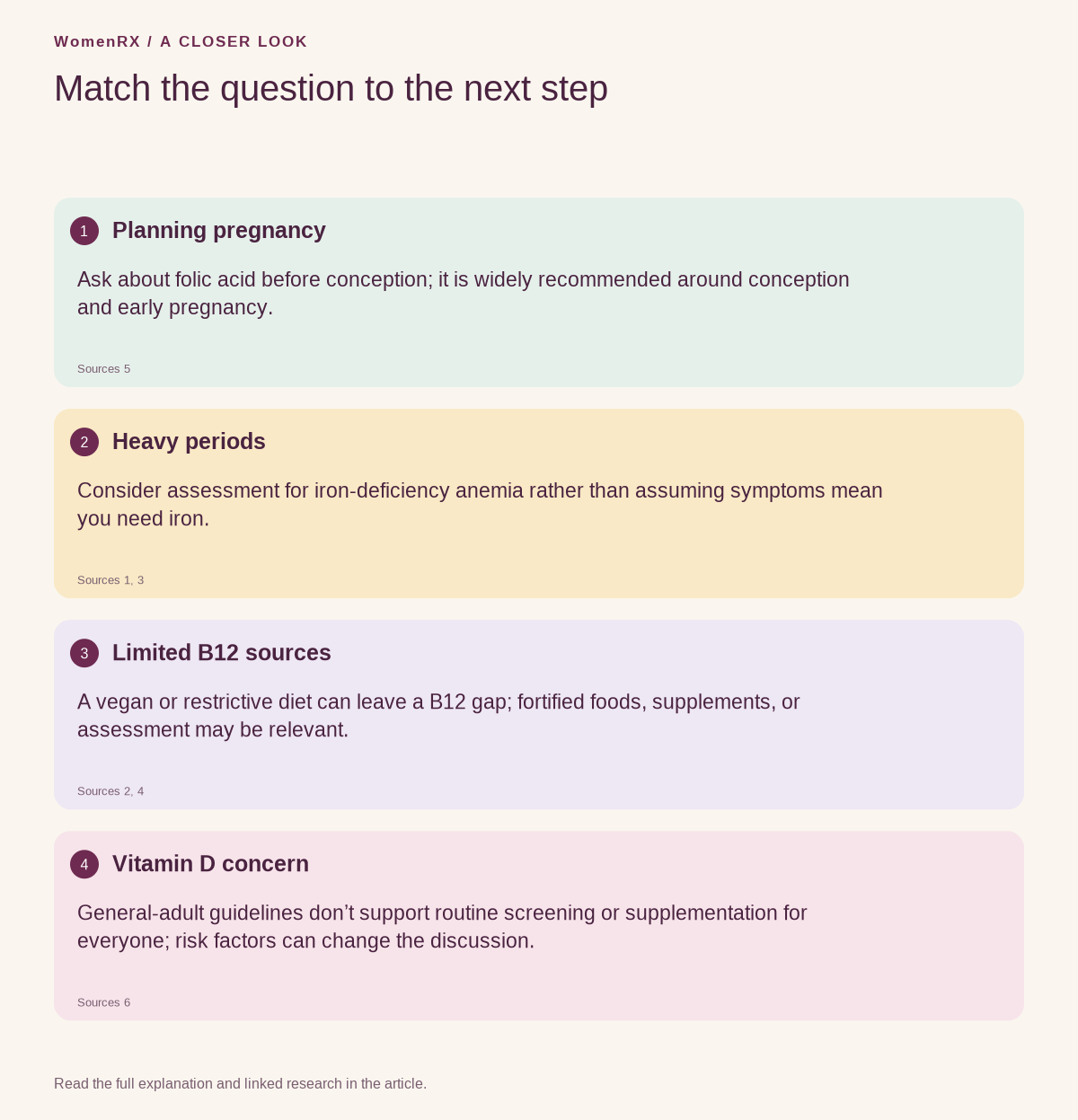
Match the question to the next step
Planning pregnancy: Ask about folic acid before conception; it is widely recommended around conception and early pregnancy.5
Heavy periods: Consider assessment for iron-deficiency anemia rather than assuming symptoms mean you need iron.13
Limited B12 sources: A vegan or restrictive diet can leave a B12 gap; fortified foods, supplements, or assessment may be relevant.24
Vitamin D concern: General-adult guidelines don’t support routine screening or supplementation for everyone; risk factors can change the discussion.6
Read the figure as text
A supplement decision starts with the situation that may create a nutrient need, then moves toward a food change, targeted discussion, or assessment.- Planning pregnancy: Ask about folic acid before conception; it is widely recommended around conception and early pregnancy.5
- Heavy periods: Consider assessment for iron-deficiency anemia rather than assuming symptoms mean you need iron.13
- Limited B12 sources: A vegan or restrictive diet can leave a B12 gap; fortified foods, supplements, or assessment may be relevant.24
- Vitamin D concern: General-adult guidelines don’t support routine screening or supplementation for everyone; risk factors can change the discussion.6
More questions, answered
Can tiredness tell me which vitamin I’m low in?
No. Tiredness can occur with several nutrient deficiencies and many other conditions, so it can’t identify a particular vitamin on its own. When deficiency is a concern, clinical assessment and blood-test results can help clarify what’s going on. 2 3
Sources you can check
- Iron deficiency anaemia - NHSAccessed 2026-09-25Return to first citation
- Vitamin B12 or folate deficiency anaemia - NHSAccessed 2026-09-25Return to first citation
- Vitamin B12 or folate deficiency anaemia - Symptoms - NHSAccessed 2026-09-25Return to first citation
- Vitamin B12 or folate deficiency anaemia - Causes - NHSAccessed 2026-09-25Return to first citation
- Effects of excess folic acid and high blood folate during preconception and pregnancy: systematic review.Ledowsky C, Scarf V, Sobczyńska-Malefora A, Carter T, Timbrell NE, Steel A. · Reproductive biomedicine online · 2026Return to first citation
- A systematic review of evidence-based clinical guidelines for vitamin D screening and supplementation over the last decade.Zemp J, Erol C, Kaiser E, Aubert CE, Rodondi N, Moutzouri E. · Archives of public health = Archives belges de sante publique · 2025Return to first citation