Supplements in Your 30s: Start With What You Need
Your age alone can’t identify a nutrient gap; diet, pregnancy plans, and specific health circumstances make a better starting point.
There’s no single supplement list for every woman in her 30s. Start by reviewing what you eat, whether pregnancy is possible or planned, your health history, medicines, and supplements you already take. Folic acid has a particular role before and during pregnancy; iron and vitamin D questions depend more on individual context and, sometimes, assessment. 134
Begin with the question, not the bottle
Being 30 to 39 doesn’t tell you which supplement, if any, you need. A useful review starts with your usual diet, pregnancy plans, health history, medicines, and anything you already take. Those details can point to a specific question. They’re more useful than choosing a multivitamin or a “women’s” formula based on age alone.
You can make that review practical: jot down a few typical meals, bring a list of medicines, and take photos of supplement labels. Then ask whether any of those details change what makes sense for you. The goal is to decide whether you need a closer look, not to build a stack by default.
If pregnancy is possible or planned, start with folic acid
Getting enough folic acid before and during pregnancy can help prevent major birth defects of a baby’s brain or spine. Leafy greens and enriched breads, cereals, and other grain products are food sources. If food isn’t providing enough, a supplement may be an option. That makes folic acid a timely question if pregnancy is possible, not only after you know you’re pregnant. 1
Iron is another pregnancy-related question, but recommendations aren’t entirely uniform. The NIH Office of Dietary Supplements fact sheet says that ACOG recommends low-dose iron beginning in the first trimester to reduce maternal anemia at delivery. The fact sheet doesn’t give a dose, and it notes that organizations differ on routine screening and supplementation for pregnant people without symptoms. Make this part of pregnancy care rather than guessing at a product or amount. 4
For iron, food and assessment both matter
Iron comes from different foods in different forms. Meat, poultry, and seafood contain heme and nonheme iron; plant foods and iron-fortified foods provide nonheme iron. On average, iron is less readily absorbed from vegetarian diets than from mixed diets. That’s useful context for reviewing your eating pattern, but it doesn’t tell you whether your iron stores are low. 4
If iron is a concern, ask whether assessment would help before adding a supplement. Hemoglobin and hematocrit are commonly used to screen for iron deficiency, but neither is sensitive or specific on its own. Ferritin can help indicate iron stores, although inflammation can affect it. A clinician may consider multiple measures alongside diet and supplement intake. 4
Vitamin D depends on more than sunlight
Vitamin D helps your body absorb calcium and supports bone mineralization. You can get it from sunlight, supplements, some naturally occurring food sources, and fortified foods. Since few foods naturally contain much vitamin D, your usual food choices are worth including in the conversation. 23
MedlinePlus names obesity and having had gastric bypass surgery as circumstances in which some people may need extra vitamin D. If either applies to you, ask whether assessment or testing is useful. A blood test measures 25-hydroxyvitamin D, but an optimal level for bone and general health hasn’t been established. A test result should be interpreted in context, not treated as an automatic instruction to buy a supplement. 23
Bring the details that shape your question
A short review can cover four things:
- Food: Which foods or fortified products do you eat regularly, and are there foods you avoid?
- Pregnancy: Is pregnancy possible, planned, or current? Ask specifically about folic acid and pregnancy-related iron guidance.
- Health: Do you have a condition or history, such as gastric bypass, that might make a nutrient question more relevant?
- Medicines and supplements: Bring a current list and ask whether any of them change your options.
You don’t have to resolve every question at once. Start with the one that fits your circumstances, and ask what information or assessment would actually change the next step. That keeps the conversation focused on a need you may have, rather than a supplement routine built around your age.
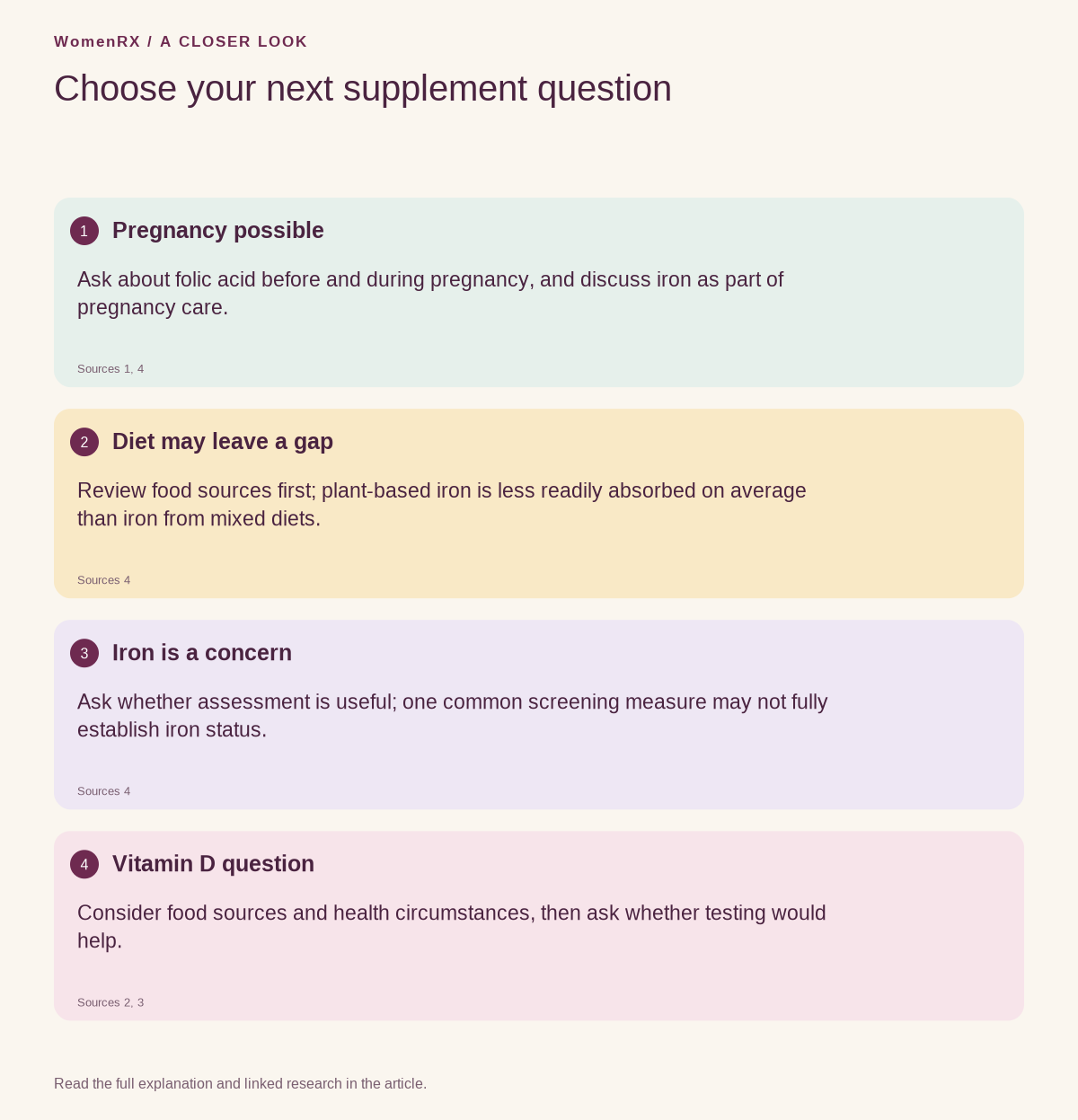
Choose your next supplement question
Pregnancy possible: Ask about folic acid before and during pregnancy, and discuss iron as part of pregnancy care.14
Diet may leave a gap: Review food sources first; plant-based iron is less readily absorbed on average than iron from mixed diets.4
Iron is a concern: Ask whether assessment is useful; one common screening measure may not fully establish iron status.4
Vitamin D question: Consider food sources and health circumstances, then ask whether testing would help.23
Read the figure as text
Use your circumstances to identify a useful question or assessment, not a prescribed supplement stack.- Pregnancy possible: Ask about folic acid before and during pregnancy, and discuss iron as part of pregnancy care.14
- Diet may leave a gap: Review food sources first; plant-based iron is less readily absorbed on average than iron from mixed diets.4
- Iron is a concern: Ask whether assessment is useful; one common screening measure may not fully establish iron status.4
- Vitamin D question: Consider food sources and health circumstances, then ask whether testing would help.23
Sources you can check
- Folic Acid: MedlinePlusAccessed 2026-09-25Return to first citation
- Vitamin D - Health Professional Fact SheetAccessed 2026-09-25Return to first citation
- Vitamin D: MedlinePlusAccessed 2026-09-25Return to first citation
- Iron - Health Professional Fact SheetAccessed 2026-09-25Return to first citation