Do You Need a Multivitamin? Start With the Gap
A multivitamin can fill a nutrient gap, but the right choice depends on what you need and what you already take.
You don’t need a multivitamin simply because it’s labeled “for women.” It may help you get recommended nutrients when food alone falls short, but formulas vary and can duplicate separate supplements. Start with the gap you’re trying to address, compare amounts across every product you take, and treat pregnancy-related folic acid needs as a separate question. 23
Give the multivitamin a job
Before comparing brands, finish this sentence: “I’m considering a multivitamin because…” Maybe your eating pattern is limited, or you’re trying to understand a nutrient need that changes with pregnancy. A multivitamin can raise vitamin and mineral intake when food alone doesn’t meet recommended amounts. That’s a reason to consider one, not a reason every woman needs one. 2
Be specific about the job. If you’re concerned about one nutrient, a broad formula may add nutrients you already get while providing an amount that doesn’t address your particular concern. If you suspect a deficiency, the label won’t tell you whether you have one. For example, vitamin D status can be assessed with a blood test; older adults and people with certain conditions or medicines are among those at higher risk of vitamin D deficiency. 1
Read across products, not down one label
Start with the serving size, then look at the amount of each nutrient. The percent Daily Value (%DV) is useful for comparing labels, but it isn’t a personal prescription: Daily Values are set for broad age groups, while recommended intakes can differ by age and sex. 2
Next, put the multivitamin beside anything else you take. If you already use a vitamin D supplement, for example, check the vitamin D amount in both products. Do the same for folic acid and iron if they appear in more than one product. The NIH Office of Dietary Supplements reports that excessive nutrient intakes are more likely among people who combine a multivitamin with individual vitamin or mineral supplements. For many nutrients, intake above a tolerable upper limit carries greater potential for harm. 2
This isn’t just a concern with unusually large numbers on one bottle. In an observational analysis of U.S. adults age 51 and older, regular multivitamin use was associated with a greater proportion exceeding the upper intake limit for folic acid. The analysis did not report a separate result for women, and it cannot show what would happen to you. It does show why checking your combined intake is more useful than judging each product in isolation. 4
Pregnancy changes which question comes first
If you may become pregnant, folic acid needs specific attention. Getting enough before and during pregnancy can help prevent major birth defects of a baby’s brain or spine. That finding supports addressing folic acid; it does not mean any general “women’s” multivitamin is the right pregnancy formula. 3
Other life stages can change the picture without creating a universal rule. Older adults are at higher risk of vitamin D deficiency, for instance. A known deficiency or a condition that affects nutrient absorption calls for attention to that particular need rather than an assumption that a general-purpose formula covers it. 1
Choose for fit, then examine quality claims
Multivitamins differ substantially in which nutrients they contain and how much they provide. Research on one formula therefore can’t establish the benefits or risks of every product on the shelf. 2
Once you’ve checked that a formula fits the need you identified, ask what any quality claim actually documents for that specific product. A “complete” label or a high %DV doesn’t answer whether its amounts suit you, and a quality claim doesn’t establish a health benefit. The most useful comparison is still concrete: the nutrients per serving, what overlaps with your other products, and the reason you’re taking them. 2
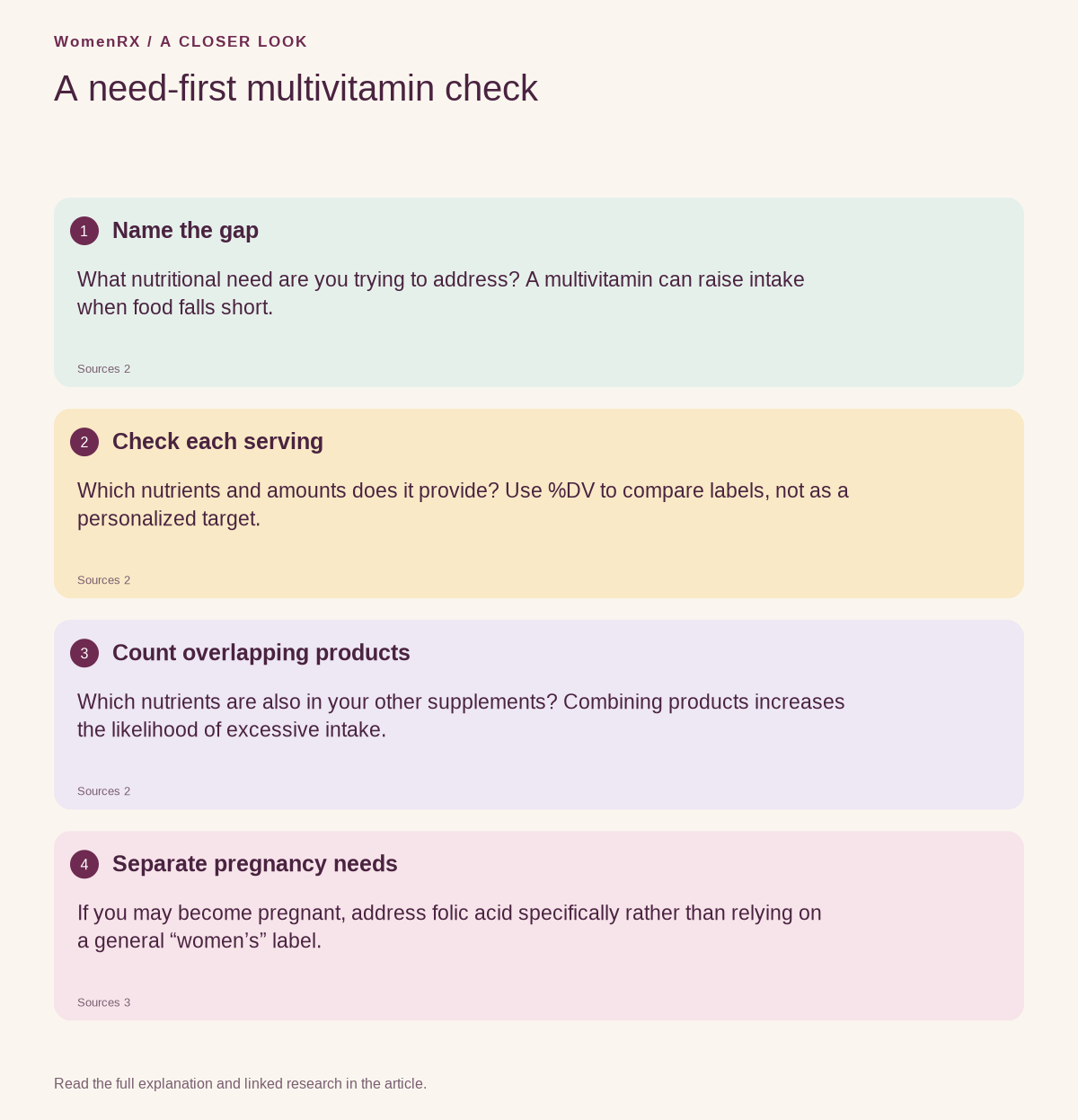
A need-first multivitamin check
Name the gap: What nutritional need are you trying to address? A multivitamin can raise intake when food falls short.2
Check each serving: Which nutrients and amounts does it provide? Use %DV to compare labels, not as a personalized target.2
Count overlapping products: Which nutrients are also in your other supplements? Combining products increases the likelihood of excessive intake.2
Separate pregnancy needs: If you may become pregnant, address folic acid specifically rather than relying on a general “women’s” label.3
Read the figure as text
Use these questions to decide what a formula would add and where it might overlap.- Name the gap: What nutritional need are you trying to address? A multivitamin can raise intake when food falls short.2
- Check each serving: Which nutrients and amounts does it provide? Use %DV to compare labels, not as a personalized target.2
- Count overlapping products: Which nutrients are also in your other supplements? Combining products increases the likelihood of excessive intake.2
- Separate pregnancy needs: If you may become pregnant, address folic acid specifically rather than relying on a general “women’s” label.3
More questions, answered
Can a multivitamin make up for a limited diet?
It can help increase vitamin and mineral intake when food alone falls short. But whether it addresses your gap depends on the nutrients and amounts in that formula; products vary considerably. 2
Sources you can check
- Vitamin D Deficiency: MedlinePlusAccessed 2026-09-25Return to first citation
- Multivitamin/mineral Supplements - Health Professional Fact SheetAccessed 2026-09-25Return to first citation
- Folic Acid: MedlinePlusAccessed 2026-09-25Return to first citation
- Multivitamin/Multimineral Supplement Use is Associated with Increased Micronutrient Intakes and Biomarkers and Decreased Prevalence of Inadequacies and Deficiencies in Middle-Aged and Older Adults in the United States.Wallace TC, Frankenfeld CL, Frei B, Shah AV, Yu CR, van Klinken BJ, Adeleke M. · Journal of nutrition in gerontology and geriatrics · 2019Return to first citation