How to Compare Prenatal Vitamins Before and During Pregnancy
Start with the full serving, then check folic acid, iron, and iodine with your stage of pregnancy in mind.
Compare prenatal vitamins using the nutrient amounts in each product’s full labeled serving. If you’re planning pregnancy, pay particular attention to folic acid: getting enough before and during pregnancy helps prevent major brain and spine birth defects. During pregnancy, check iron and iodine too. An iodine number needs context because guidance distinguishes total daily intake from the amount provided by a supplement. 134
Start with the full serving, not the front of the bottle
Put two labels side by side and find the serving size on each. If one product’s serving is one pill and another’s is several, compare the amounts listed for each full serving. Write down the folic acid, iron, and iodine amounts, including their units. That gives you a fairer comparison than the number of pills or the length of the ingredient list.
More isn’t automatically better. High doses of some vitamins can cause problems, and a label can’t account for nutrients you get from food or other supplements. 2 Here’s how to make the three most useful label checks mean something.
Planning pregnancy? Check folic acid first
Look for folic acid on the label and note the amount. Getting enough before and during pregnancy can prevent major birth defects of a baby’s brain or spine. That’s why this is worth checking while you’re planning, rather than waiting for a positive pregnancy test. 3
If you already take a supplement containing folic acid, include it when you compare products. And if you take sulfasalazine, raise that specifically before trying to conceive: it can interfere with folate metabolism, so an ordinary prenatal-label comparison may not address your folic acid needs. A published case report illustrates the concern but cannot establish that the medicine caused a birth defect in that pregnancy. Don’t change a prescribed medicine on the basis of a supplement label. 15
Pregnant? Check iron, then read iodine in context
Pregnancy increases the need for certain nutrients, including iron. Check whether each prenatal lists iron and record the amount. A larger iron number isn’t, by itself, evidence that the product is a better fit for you; the label doesn’t tell you whether you need iron beyond what your prenatal provides. 1
Iodine is the clearest example of why a supplement amount and a daily intake recommendation aren’t interchangeable. The recommended dietary allowance (RDA) is 150 micrograms a day before pregnancy and 220 micrograms a day during pregnancy. The pregnancy RDA concerns total intake, including food, rather than the amount that must appear on a prenatal label. Separately, the American Thyroid Association recommends a supplement providing 150 micrograms of iodine as potassium iodide for people planning pregnancy or already pregnant. 4
For example, if a prenatal lists 150 micrograms of iodine, don’t treat it as “70 micrograms short” simply because the pregnancy RDA is 220 micrograms. Those figures answer different questions. Check both the iodine amount and, if stated, its form. Potassium iodide is the form named in that recommendation; the information here doesn’t establish that every other form is inferior. 4
Make the comparison about everything you take
Keep the two labels and a list of your other supplements and medicines together. For each prenatal, you should now be able to see its full-serving amounts, whether it contains the nutrients you’re checking, and where amounts may overlap with another product. Before adding or changing a supplement or medicine during pregnancy, review that complete list with your prenatal care team. 1
A focused question might be: “This prenatal lists this much iodine as potassium iodide, and I also take another supplement. How should I think about my total intake?” If you’re planning pregnancy, make folic acid the first question. If you’re pregnant, ask whether the iron listed fits your needs. The point isn’t to find the bottle with the biggest numbers; it’s to find out what each number actually tells you.
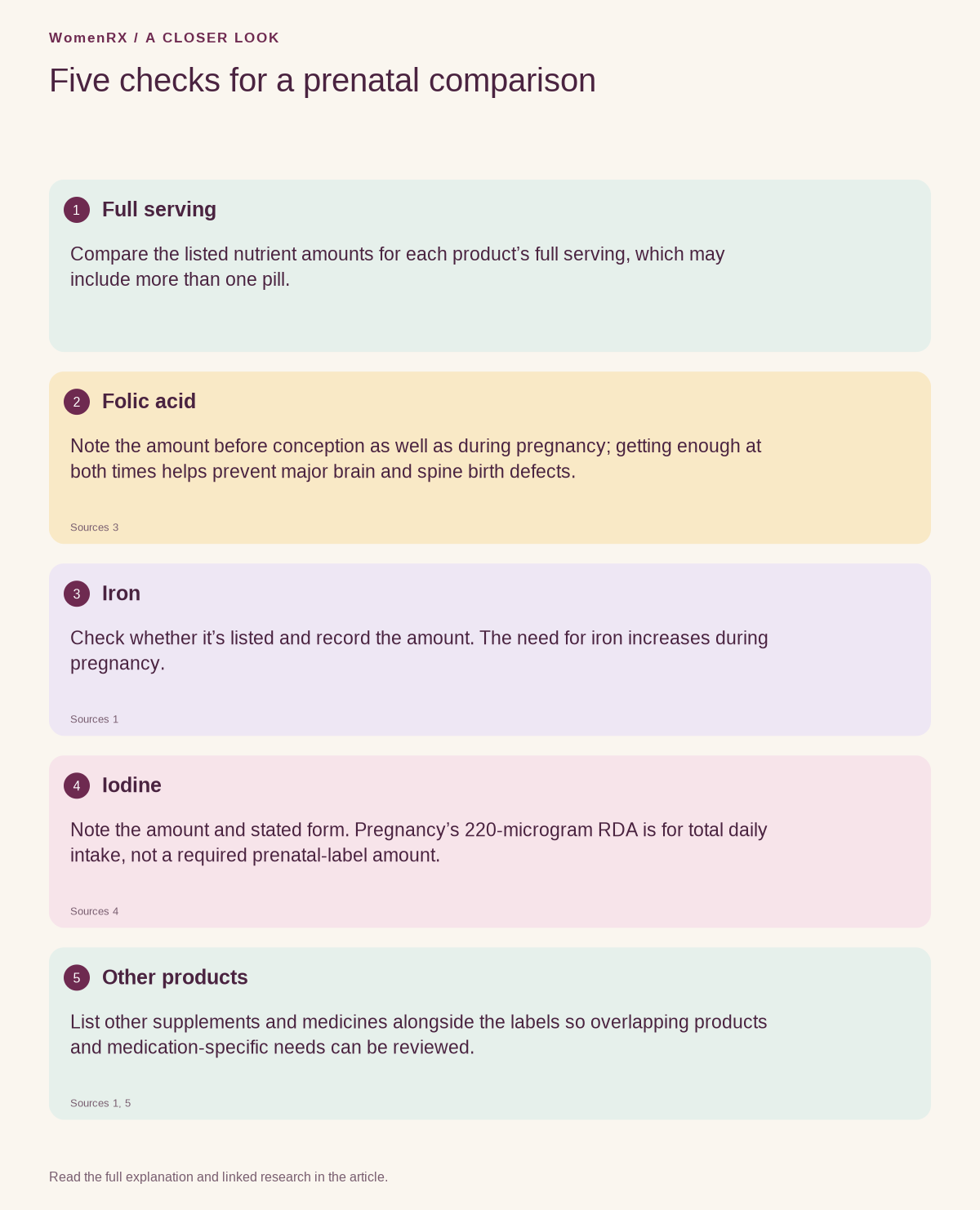
Five checks for a prenatal comparison
Full serving: Compare the listed nutrient amounts for each product’s full serving, which may include more than one pill.
Folic acid: Note the amount before conception as well as during pregnancy; getting enough at both times helps prevent major brain and spine birth defects.3
Iron: Check whether it’s listed and record the amount. The need for iron increases during pregnancy.1
Iodine: Note the amount and stated form. Pregnancy’s 220-microgram RDA is for total daily intake, not a required prenatal-label amount.4
Other products: List other supplements and medicines alongside the labels so overlapping products and medication-specific needs can be reviewed.15
Read the figure as text
Use these checks to compare what two labels actually provide and identify what needs individual review.- Full serving: Compare the listed nutrient amounts for each product’s full serving, which may include more than one pill.
- Folic acid: Note the amount before conception as well as during pregnancy; getting enough at both times helps prevent major brain and spine birth defects.3
- Iron: Check whether it’s listed and record the amount. The need for iron increases during pregnancy.1
- Iodine: Note the amount and stated form. Pregnancy’s 220-microgram RDA is for total daily intake, not a required prenatal-label amount.4
- Other products: List other supplements and medicines alongside the labels so overlapping products and medication-specific needs can be reviewed.15
Sources you can check
- Pregnancy | Pregnant | Prenatal Care | MedlinePlusAccessed 2026-09-25Return to first citation
- Vitamins: MedlinePlusAccessed 2026-09-25Return to first citation
- Folic Acid: MedlinePlusAccessed 2026-09-25Return to first citation
- Iodine - Health Professional Fact SheetAccessed 2026-09-25Return to first citation
- A Case of Neural Tube Defect in Early Pregnancy Following Sulfasalazine Exposure Without Folic Acid Supplementation.Holden F, Hughes R. · Case reports in rheumatology · 2026Return to first citation