How to Read a Prenatal Vitamin Label Before You Buy
Compare the amount per serving, check for folic acid and iodine, and look at your other supplements before choosing a prenatal.
There isn’t one standard prenatal formula, so compare the label rather than relying on the product name. Check the serving size and amounts of key nutrients, look for folic acid and iodine, and add in nutrients from any other supplements you take. Your diet, pregnancy stage, and health history can change what belongs on your list of questions. 3 4
Start with the serving size, not the front of the bottle
A bottle labeled “prenatal” doesn’t guarantee a particular set of ingredients or amounts. U.S. products vary, and there is no federal standard specifying what doses a prenatal must contain. Some products leave out iodine or choline; others include a nutrient at an amount below what’s recommended. 4
On the Supplement Facts panel, find the serving size first. Then compare the amount of each nutrient in that serving, not just the number of capsules or gummies. Make a short list of what the product supplies and what you also get from separate vitamins, minerals, or other supplements. High doses of some vitamins can cause problems, so more products or higher totals aren’t automatically better. 2
Give folic acid a close look
Check whether the label lists folic acid. The NIH Office of Dietary Supplements notes that some prenatals may not provide folate in the form of folic acid recommended for reducing neural tube defect risk. A label that says only “folate” may need a closer look with your prenatal care team; don’t assume that different forms are interchangeable for this purpose. 4
This is worth checking before pregnancy, too. Guidance summarized by the NIH recommends a daily prenatal supplement for people who are planning to become pregnant as well as those who are pregnant. 4
Compare iodine by both amount and life stage
Iodine is one nutrient where the label amount is easier to interpret when you separate a supplement recommendation from the full-day target. The iodine recommended dietary allowance is 220 micrograms per day during pregnancy and 290 micrograms during lactation; for adults who aren’t pregnant or lactating, it’s 150 micrograms per day. The American Thyroid Association recommends that people planning pregnancy, pregnant, or lactating supplement their diet with 150 micrograms daily as potassium iodide. These are different kinds of figures: the supplement recommendation is not the same as the total daily intake target. 3
Look to see whether iodine is included and, if it is, what amount and form the label gives. Not every prenatal contains iodine. If you have a thyroid condition or already take iodine, ask your care team how to interpret the label rather than adding another product on your own. The NIH fact sheet notes that higher supplemental iodine intakes could cause thyroid dysfunction in some women. 3 4
Check iron and vitamin D without guessing at a target
Iron and vitamin D are among the nutrients prenatal supplements may help provide, but a label alone can’t tell you exactly what you need. Pregnancy increases the need for some nutrients, and guidance summarized by the NIH recommends reviewing diet and supplement use to check whether nutrient intakes are being met. Use the panel to see how much the product contains, then consider your diet and any other supplements with your prenatal care team. 1 4
Don’t treat the prenatal as proof that every nutrient need is covered. Even when supplement use is included in estimates, many pregnant women in the United States have inadequate intakes of some micronutrients. A varied diet remains part of the picture. 1 4
Look for gaps and overlap
Choline is a useful example of why the ingredient list matters: some prenatals don’t contain it, and when they do, the amount may be relatively small. The pregnancy adequate intake for choline is 450 milligrams per day, and many pregnant women in the United States don’t consume that amount. Ask how food and supplements together fit your needs instead of assuming a prenatal covers it. 4
Next, check any separate products you use, including individual vitamins or minerals. Compare the nutrient names and amounts so you can spot overlap. This is especially useful when products have different serving sizes or when more than one product contains the same nutrient. High doses of some vitamins can cause problems, and prenatal formulas vary, so bring the labels or a clear photo of them when asking for advice. 2 4
Make the comparison specific to your stage
If you’re planning pregnancy, already pregnant, or lactating, don’t assume the same label questions apply in exactly the same way. For iodine, the daily target differs between pregnancy and lactation, even though the cited professional recommendations include a 150-microgram supplement for people in both groups and those planning pregnancy. Other decisions can depend on your diet and medical history. 3 4
A practical comparison is to write down the serving size, folic acid, iodine amount and form, iron, vitamin D, and any nutrients you take separately. Then ask which gaps matter for your stage and situation. That gives you a more useful conversation than choosing by a “complete” claim on the bottle.
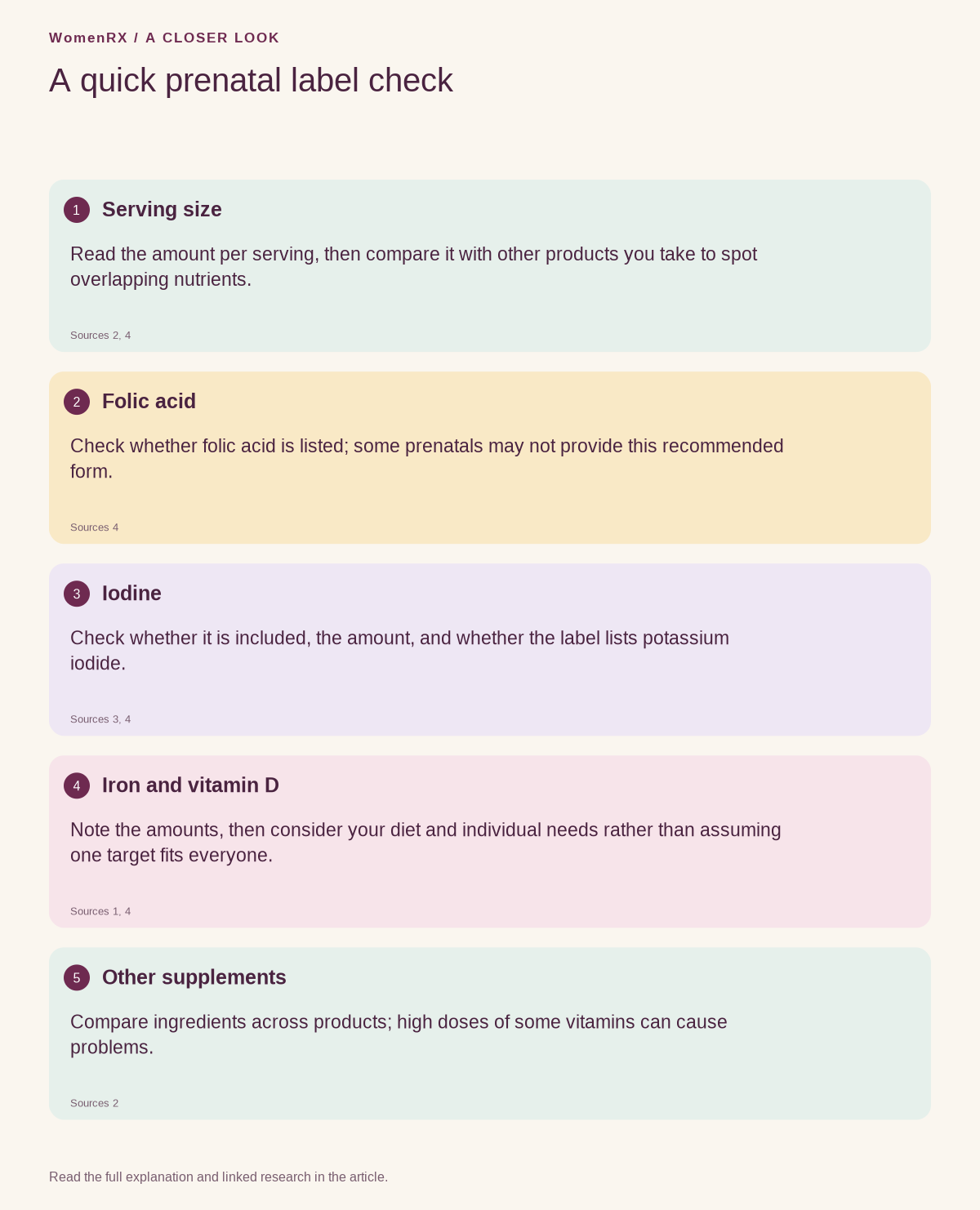
A quick prenatal label check
Serving size: Read the amount per serving, then compare it with other products you take to spot overlapping nutrients.24
Folic acid: Check whether folic acid is listed; some prenatals may not provide this recommended form.4
Iodine: Check whether it is included, the amount, and whether the label lists potassium iodide.34
Iron and vitamin D: Note the amounts, then consider your diet and individual needs rather than assuming one target fits everyone.14
Other supplements: Compare ingredients across products; high doses of some vitamins can cause problems.2
Read the figure as text
Compare what the serving supplies, what may be missing, and what depends on your stage or personal circumstances.- Serving size: Read the amount per serving, then compare it with other products you take to spot overlapping nutrients.24
- Folic acid: Check whether folic acid is listed; some prenatals may not provide this recommended form.4
- Iodine: Check whether it is included, the amount, and whether the label lists potassium iodide.34
- Iron and vitamin D: Note the amounts, then consider your diet and individual needs rather than assuming one target fits everyone.14
- Other supplements: Compare ingredients across products; high doses of some vitamins can cause problems.2
More questions, answered
Does every prenatal vitamin contain iodine?
No. Some prenatal supplements do not contain iodine, so check the Supplement Facts panel rather than assuming it is included. 4
Is the iodine amount on the label the full amount I need each day?
Not necessarily. The 150-microgram supplement recommendation cited by the NIH differs from the total daily recommended intake, which is 220 micrograms during pregnancy and 290 micrograms during lactation. 3
Sources you can check
- Pregnancy | Pregnant | Prenatal Care | MedlinePlusAccessed 2026-09-25Return to first citation
- Vitamins: MedlinePlusAccessed 2026-09-25Return to first citation
- Iodine - Health Professional Fact SheetAccessed 2026-09-25Return to first citation
- Dietary Supplements and Life Stages: Pregnancy - Health Professional Fact SheetAccessed 2026-09-25Return to first citation