How to Read a Prenatal Vitamin Label
Check folic acid timing and iodine content, then use the label to spot overlaps rather than assume every prenatal has the same formula.
If you’re planning pregnancy, ask about folic acid before you conceive: getting enough before and during pregnancy helps prevent major birth defects of the brain or spine. On a prenatal label, check the serving size and amounts of folic acid, iron, iodine, and vitamin D. Some prenatals omit iodine. The amounts on the label need to be considered alongside your food, other supplements, and any existing care plan. 4 2
Start with folic acid timing
If you’re trying to conceive, ask about folic acid before a positive test. Getting enough before and during pregnancy can prevent major birth defects of the baby’s brain or spine. 4
There isn’t one standard prenatal formula. Products differ in the nutrients they include and their amounts, so the product name alone won’t tell you what’s inside. Bring the label to a prenatal visit, especially if you already take a multivitamin or separate supplements. 5
A quick pass through the label
Check the serving size first, then note the amount listed for each nutrient per serving. Compare those entries with your other supplements so you can see where ingredients overlap. High doses of some vitamins can cause problems; a longer ingredient list isn’t automatically a reason to take more. 3
Folic acid: Find the entry and note the amount. The key timing point is to ask about folic acid before pregnancy as well as during it. If you’ve been given a specific plan, compare the label with that plan rather than guessing from the product name. The amount on one label won’t show how much you’re getting from another supplement or fortified foods. 4
Iodine: Check whether it’s included; some, but not all, prenatal supplements contain iodine. For adults, the recommended daily intake during pregnancy is 220 micrograms from all sources combined. That’s a total-intake reference, not an amount to look for in the supplement alone. Seafood, eggs, and dairy provide iodine; plant-based milk alternatives tend to contain relatively little. If you eat few or none of those foods, mention that when reviewing the label. 2
Iron: Note the amount and whether it appears in another supplement you take. Pregnancy increases the need for iron, but that fact doesn’t establish how much iron you need from a prenatal or whether you should add more. If you have a test result or an existing iron plan, use it in the discussion rather than judging the label in isolation. 1
Vitamin D: Record the amount if it’s listed and include any separate vitamin D product in your comparison. A label shows what that product supplies; it doesn’t, by itself, tell you whether you need an additional supplement. High doses of some vitamins can cause problems, so avoid treating a second product as an automatic upgrade. 3
A prenatal label can reveal omissions and overlaps. It isn’t a pass-or-fail test for folic acid, iron, or vitamin D amounts; your other supplements and existing care plan also matter.
Look at the full combination
Food can contribute to iodine intake, and the amount varies across foods. Dairy, seafood, and eggs are sources; people who eat few or none of these foods, including many vegans, may be more likely to have inadequate iodine intake. Iodized salt is another source, but specialty salts such as sea salt and kosher salt are not usually iodized. People who eat a vegetarian diet may also need a vitamin B12 supplement. Those are reasons to discuss your eating pattern, not to assume you need every nutrient as a separate product. 2 3
If a medical condition, test result, or previous care plan has already changed what you take, put that information next to the label amounts. The label can reveal a mismatch or overlap with a plan; it cannot interpret a test result or settle whether an ingredient suits your condition.
Bring your supplement list, medicine list, and the prenatal label to a prenatal clinician or pharmacist. MedlinePlus advises checking before starting or stopping medicines, including over-the-counter medicines and dietary or herbal supplements. Whether a particular medicine fits with your prenatal needs a review of the specific combination, not a guess based on the label alone. 1
A practical question to ask is: “Does this product overlap with anything else I take, and does my diet or existing care plan change what I need from it?” That keeps the conversation focused on the whole combination rather than the front of the bottle.
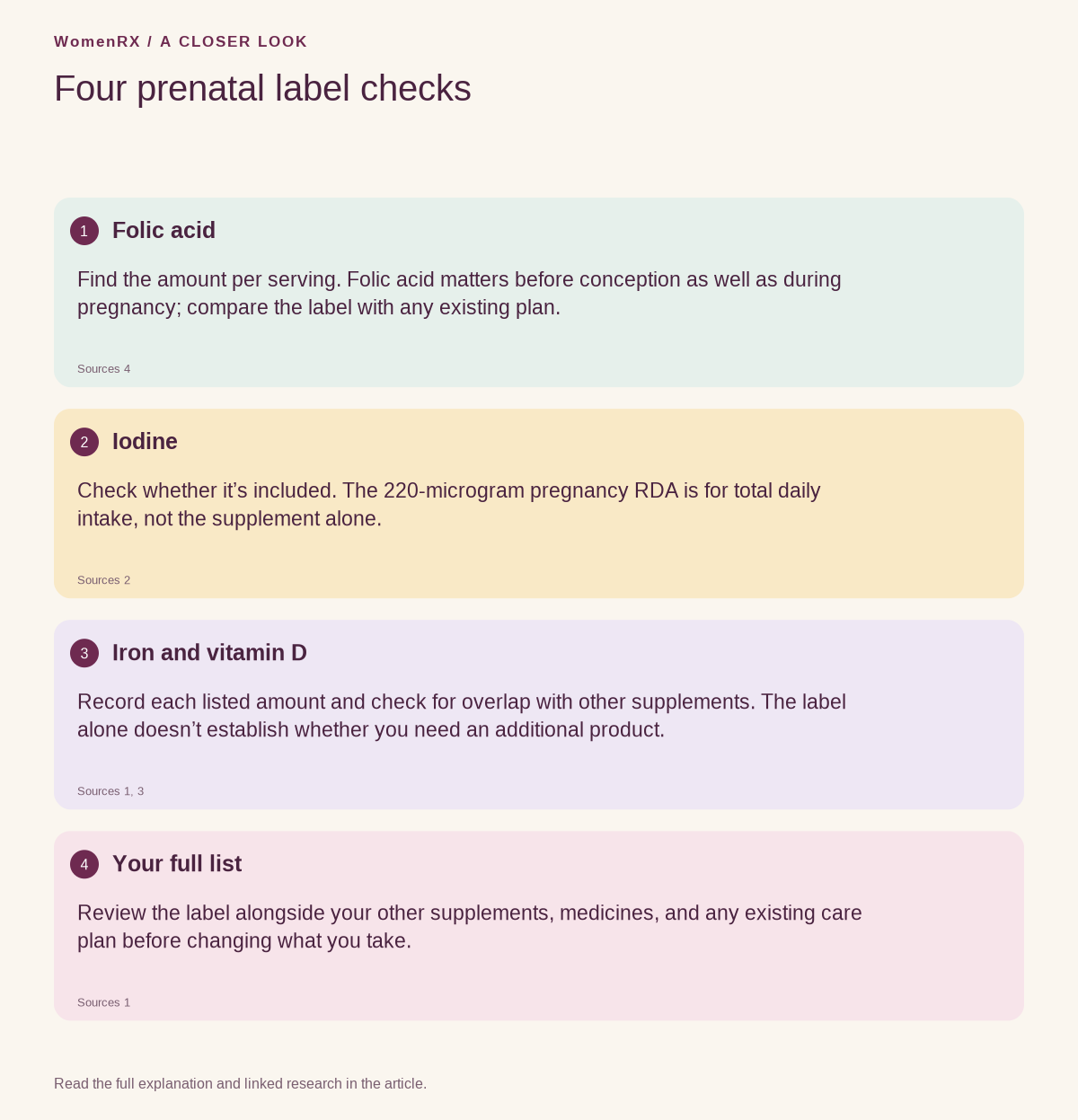
Four prenatal label checks
Folic acid: Find the amount per serving. Folic acid matters before conception as well as during pregnancy; compare the label with any existing plan.4
Iodine: Check whether it’s included. The 220-microgram pregnancy RDA is for total daily intake, not the supplement alone.2
Iron and vitamin D: Record each listed amount and check for overlap with other supplements. The label alone doesn’t establish whether you need an additional product.13
Your full list: Review the label alongside your other supplements, medicines, and any existing care plan before changing what you take.1
Read the figure as text
Use these checks to identify what a product supplies, where products overlap, and which questions need your diet or existing care plan for context.- Folic acid: Find the amount per serving. Folic acid matters before conception as well as during pregnancy; compare the label with any existing plan.4
- Iodine: Check whether it’s included. The 220-microgram pregnancy RDA is for total daily intake, not the supplement alone.2
- Iron and vitamin D: Record each listed amount and check for overlap with other supplements. The label alone doesn’t establish whether you need an additional product.13
- Your full list: Review the label alongside your other supplements, medicines, and any existing care plan before changing what you take.1
More questions, answered
Does every prenatal vitamin contain iodine?
No. Some prenatal supplements contain iodine and some do not, so check the actual label rather than assuming it’s included. 2
Can I take a prenatal vitamin with my usual medicines?
The answer depends on what you take; the prenatal label alone can’t establish compatibility. Bring the product and your medication list to a prenatal clinician or pharmacist for review before starting or stopping medicines or supplements. 1
Sources you can check
- Pregnancy | Pregnant | Prenatal Care | MedlinePlusAccessed 2026-09-25Return to first citation
- Iodine - Health Professional Fact SheetAccessed 2026-09-25Return to first citation
- Vitamins: MedlinePlusAccessed 2026-09-25Return to first citation
- Folic Acid: MedlinePlusAccessed 2026-09-25Return to first citation
- Prenatal vitamin intake in first month of pregnancy and DNA methylation in cord blood and placenta in two prospective cohorts.Dou JF, Middleton LYM, Zhu Y, Benke KS, Feinberg JI, Croen LA, Hertz-Picciotto I, Newschaffer CJ, LaSalle JM, Fallin D, Schmidt RJ, Bakulski KM. · Epigenetics & chromatin · 2022Return to first citation