Should You Keep Taking a Prenatal Vitamin After Birth?
Whether you’re breastfeeding, why you started the vitamin, and what else you take matter more than the word on the bottle.
You don’t automatically need to switch from a prenatal to a postnatal vitamin after birth. If you’re breastfeeding, check iodine: the recommended total intake is higher during lactation than during pregnancy. Whether to continue your current product depends on your diet, any deficiency or specific recommendation, and whether another supplement would duplicate its ingredients. 1 3
First, separate recovery from breastfeeding
A vitamin can serve different purposes after birth. You might be taking one to help cover a dietary gap, or because a clinician identified a deficiency. Breastfeeding adds another consideration: some nutrient needs change during lactation. Neither the word prenatal nor postnatal tells you whether a product fits those needs.
The physical changes of postpartum recovery don’t point to a particular vitamin on their own. Bleeding and other changes can occur after birth, but they don’t establish whether you need iron or another supplement. If you were advised to take something for a specific reason, such as a measured deficiency, find out whether that recommendation still applies before replacing it with a general multivitamin. 1 2
If you’re breastfeeding, look closely at iodine
The NIH Office of Dietary Supplements lists a recommended dietary allowance for iodine of 290 micrograms per day during lactation, compared with 220 micrograms per day during pregnancy. That’s total intake from food and supplements, not an amount to add in a pill. Iodine is present in human milk. 3
Food choices affect the calculation. Seafood and eggs are iodine sources, while the amount in dairy varies. Plant-based milk alternatives generally contain relatively little iodine, and seaweed can vary widely. For example, if you’ve replaced dairy with a plant-based drink, it’s worth checking both your usual foods and your vitamin label rather than assuming your iodine intake stayed the same. That’s a reason to review your intake, not a reason to add iodine automatically. 3
If you aren’t breastfeeding, the lactation-specific iodine recommendation isn’t the basis for your supplement choice. Your diet and any existing reason for supplementation still matter. 1 3
How to decide whether to keep, switch, or add
Start with the vitamin you already own. Look at its ingredient amounts, then set it beside any postnatal vitamin or separate nutrient supplement you’re considering. A new bottle may contain some of the same ingredients. MedlinePlus notes that supplements can be useful in some circumstances, but high doses of some vitamins can cause problems. 1
These questions make a product comparison more useful:
- Why am I taking my current vitamin? Is it for a documented deficiency, a dietary gap, or a recommendation made during pregnancy?
- Am I breastfeeding? If so, how do my usual foods and current product contribute to iodine intake? 3
- What would change if I switched? Compare the ingredient names and amounts in both products, including iodine, iron, and vitamin D. A product’s category name doesn’t show whether those amounts suit you.
- Would I be taking two products at once? Check for overlapping ingredients before adding a postnatal vitamin to a prenatal or another supplement. 1
If you were given a specific supplement plan, bring the labels to the clinician who recommended it and ask which parts still apply. That’s a more precise question than asking whether a postnatal vitamin is generally “better.”
What research does, and doesn’t, show
Supplements can improve measured nutrient levels without proving that every woman needs the same formula. A systematic review of trials in low- and middle-income countries found improvements in some maternal nutrient measures, while effects on infant nutrient status were inconsistent. It also identified uncertainty about the best supplement combinations, amounts, and timing. Those findings don’t identify a best prenatal or postnatal product for an individual woman in the US. 5
In a randomized trial in Delhi, researchers assessed blood samples from 600 mother-infant pairs at six months postpartum. Mothers assigned to an intervention had higher levels of several measured nutrients than those in the comparison group. But the intervention provided both food and micronutrient tablets, so it cannot tell you what the tablets alone would have done. 4
The practical distinction is this: breastfeeding gives you a specific reason to review iodine intake, while a known deficiency or dietary gap gives you a reason to review the nutrient involved. Neither reason requires you to buy a product simply because it says postnatal. 1 3
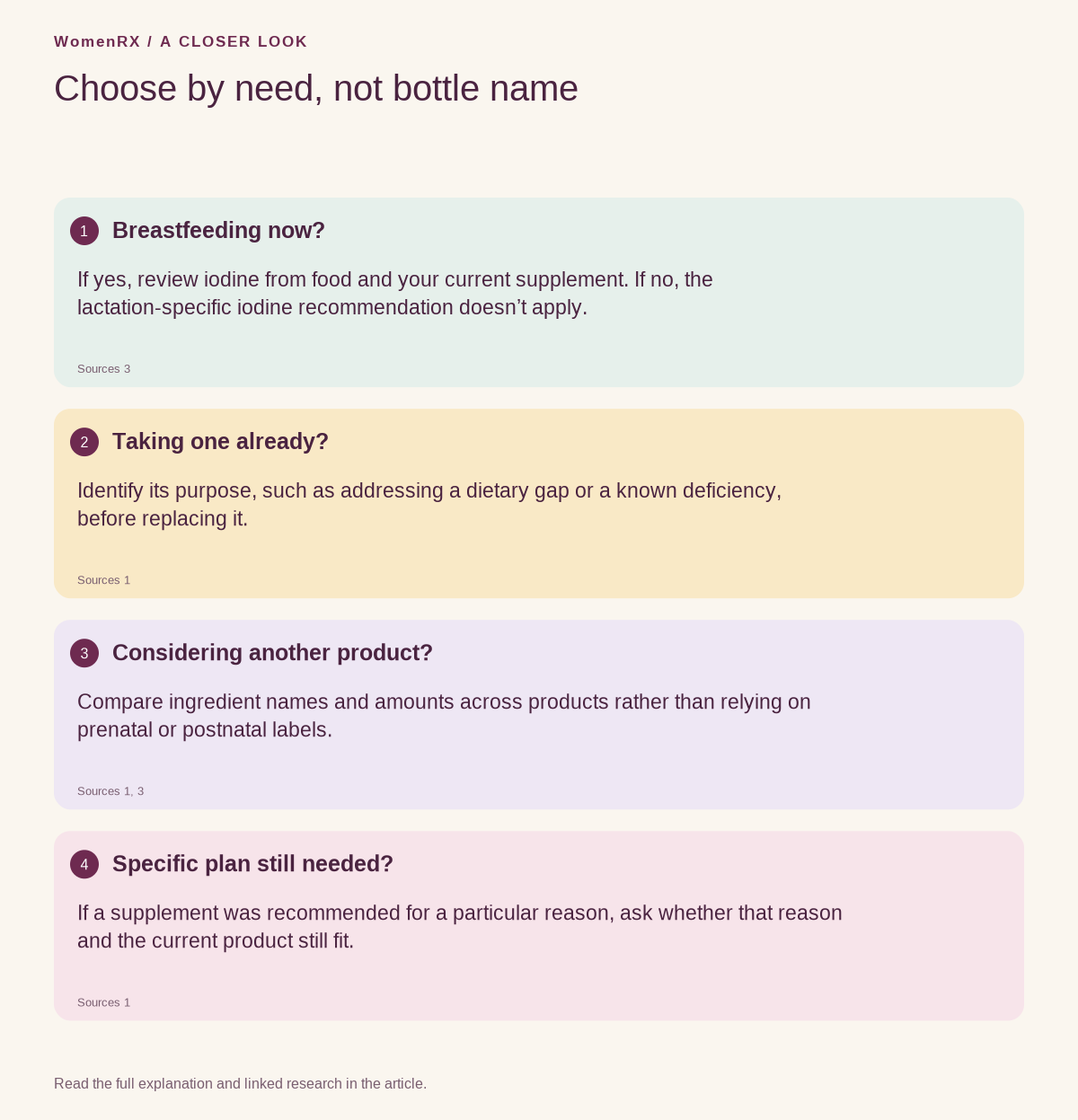
Choose by need, not bottle name
Breastfeeding now?: If yes, review iodine from food and your current supplement. If no, the lactation-specific iodine recommendation doesn’t apply.3
Taking one already?: Identify its purpose, such as addressing a dietary gap or a known deficiency, before replacing it.1
Considering another product?: Compare ingredient names and amounts across products rather than relying on prenatal or postnatal labels.13
Specific plan still needed?: If a supplement was recommended for a particular reason, ask whether that reason and the current product still fit.1
Read the figure as text
Follow the question that applies to you before deciding whether to keep, switch, or add a supplement.- Breastfeeding now?: If yes, review iodine from food and your current supplement. If no, the lactation-specific iodine recommendation doesn’t apply.3
- Taking one already?: Identify its purpose, such as addressing a dietary gap or a known deficiency, before replacing it.1
- Considering another product?: Compare ingredient names and amounts across products rather than relying on prenatal or postnatal labels.13
- Specific plan still needed?: If a supplement was recommended for a particular reason, ask whether that reason and the current product still fit.1
More questions, answered
Does breastfeeding automatically mean I need an iodine supplement?
No. The lactation recommendation covers iodine from food and supplements together. Review your usual iodine sources and any vitamin you already take before deciding whether an additional product makes sense. 3
Sources you can check
- Vitamins: MedlinePlusAccessed 2026-09-25Return to first citation
- Postpartum Care: MedlinePlusAccessed 2026-09-25Return to first citation
- Iodine - Health Professional Fact SheetAccessed 2026-09-25Return to first citation
- Impact of nutritional and multiple micronutrients supplementation to lactating mothers 6 months postpartum on the maternal and infant micronutrient status: a randomised controlled trial in Delhi, India.Manapurath R, Chowdhury R, Upadhyay RP, Bose B, Devi S, Dwarkanath P, Kurpad AV, Bhandari N, Taneja S. · Public health nutrition · 2024Return to first citation
- Effects of vitamin and multiple micronutrient supplementation for pregnant and/or lactating women on maternal and infant nutritional status in low- and middle-income countries: a systematic review and meta-analysis.Shinde S, Yelverton CA, Yussuf M, Nurhussien L, Wang D, Fawzi WW. · Advances in nutrition (Bethesda, Md.) · 2025Return to first citation