Iodine in Food: Can Your Diet Meet Your Needs?
Many diets can provide iodine, but the amount depends on which foods you eat and how they’re produced.
Yes, food can meet iodine needs, but it isn’t easy to tell from a food list alone because iodine varies in dairy, bread, seafood, and seaweed. The recommended amount is 150 mcg daily for adults, 220 mcg during pregnancy, and 290 mcg while breastfeeding. Review your usual iodine sources and, if pregnant or breastfeeding, check whether your prenatal vitamin contains iodine before adding a separate supplement. 1
Start with the sources you actually eat
Iodine helps your body make thyroid hormones. During pregnancy and early infancy, enough iodine also matters for growth and development. For adults, the recommended dietary allowance is 150 micrograms (mcg) a day. It rises to 220 mcg during pregnancy and 290 mcg while breastfeeding. 1
You don’t need to eat one particular food to reach those amounts. In the U.S., useful sources include dairy, fish and other seafood, eggs, and iodized table salt. For example, a cup of milk or a ¾-cup serving of plain Greek yogurt has about 84-87 mcg, while a 3-ounce serving of baked cod has about 146 mcg. One-quarter teaspoon of iodized table salt has about 78 mcg. These are approximate values, not a guarantee for every product or serving. 1
That makes the most useful first step a quick review of your ordinary meals: Do you regularly have dairy, eggs, seafood, or salt specifically labeled iodized? Several modest sources can add up. If your routine rarely includes any of them, your intake may be less predictable, but that alone doesn’t prove you’re deficient.
Why the same food can provide different amounts
Iodine content depends partly on where food comes from and how it’s made. Dairy iodine varies with farming practices, including iodine added to animal feed and sanitizing methods. Bread may provide substantial iodine if made with iodate dough conditioners, but most bread does not necessarily contain them. Ingredient lists may name those conditioners, while iodine itself usually isn’t required on the Nutrition Facts label. 1
Food-composition modeling across 16 countries also found that estimated iodine from a largely plant-based reference diet differed by country, in part because some countries use iodized salt in bread and others do not. That analysis modeled diets rather than measuring what individuals actually ate, but it illustrates why food-supply practices matter. 2
Salt is another place where the label matters. Iodized table salt contains iodine; sea, kosher, and Himalayan salts usually don’t unless labeled iodized. And most salt in U.S. processed foods is not iodized. Don’t add more salt just to get iodine. If you already use salt, check its label rather than assuming a specialty salt provides iodine. 1
Plant-based or dairy-free doesn’t automatically mean deficient
A plant-based or dairy-free diet can still include iodine, but some familiar substitutes are not reliable stand-ins: soy and almond beverages generally contain relatively little iodine, and most fruits and vegetables are poor sources. The iodine in plants also varies with soil, fertilizer, and irrigation. A diet with few animal foods may call for a closer look at specific sources, not an assumption that you’re deficient. 1
Seaweed can contain iodine, but it’s a particularly unpredictable way to estimate intake. The amount differs greatly by species and product; measured commercial seaweeds ranged from 16 to 2,984 mcg per gram. Treat seaweed as a variable food source, not a dependable daily measuring tool. 1
Pregnancy and breastfeeding call for a closer check
Needs are higher during pregnancy and breastfeeding, and food estimates can be especially hard to interpret because of natural variation. U.S. survey data found that pregnant women’s median urinary iodine levels varied across survey periods; these are group measurements, not a way to diagnose an individual. A spot urine result should not be treated as a personal pass-or-fail test. 1
If you’re pregnant or breastfeeding, look at the iodine amount on your prenatal vitamin’s label. Some prenatal supplements contain iodine and some do not. If yours has none, or you’re unsure how your usual diet fits with it, ask your prenatal care team whether you need a change before adding a separate iodine product. Kelp supplements can also have highly variable iodine amounts. 1
A practical review doesn’t require perfect food tracking: list the iodine-containing foods you regularly eat, check whether your salt is iodized, and inspect the prenatal label if you use one. That gives you a more useful starting point than guessing from a single meal or relying on an unmarked salt.
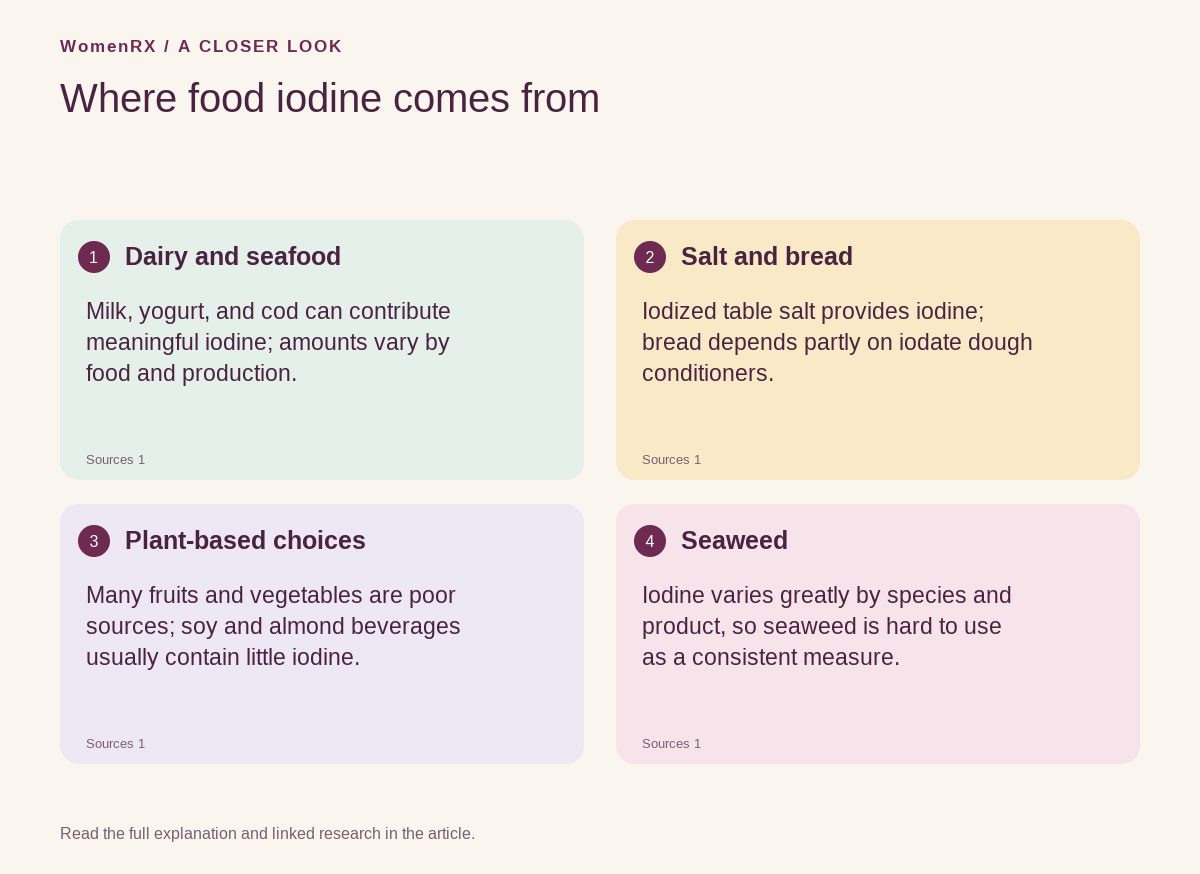
Where food iodine comes from
Dairy and seafood: Milk, yogurt, and cod can contribute meaningful iodine; amounts vary by food and production.1
Salt and bread: Iodized table salt provides iodine; bread depends partly on iodate dough conditioners.1
Plant-based choices: Many fruits and vegetables are poor sources; soy and almond beverages usually contain little iodine.1
Seaweed: Iodine varies greatly by species and product, so seaweed is hard to use as a consistent measure.1
Read the figure as text
Compare common sources and the details that make their iodine contribution more or less predictable.- Dairy and seafood: Milk, yogurt, and cod can contribute meaningful iodine; amounts vary by food and production.1
- Salt and bread: Iodized table salt provides iodine; bread depends partly on iodate dough conditioners.1
- Plant-based choices: Many fruits and vegetables are poor sources; soy and almond beverages usually contain little iodine.1
- Seaweed: Iodine varies greatly by species and product, so seaweed is hard to use as a consistent measure.1
Sources you can check
- Iodine - Health Professional Fact SheetAccessed 2026-09-25Return to first citation
- Eating within planetary boundaries - a cross-country analysis of iodine provision from the EAT-Lancet diet.Nicol K, Nugent AP, Woodside JV, Hart KH, Lynch K, Mangan N, Bath SC. · NPJ science of food · 2025Return to first citation