Could You Be Low in Iodine?
Your usual foods and life stage offer better clues about iodine intake than thyroid symptoms alone.
Iodine helps your body make thyroid hormones, but feeling unwell or having an abnormal thyroid test doesn’t establish iodine deficiency. 3 Start with your usual foods, whether the salt you use is iodized, and whether you’re pregnant or breastfeeding. Those details can guide a discussion about intake and thyroid testing without assuming that an iodine supplement is the answer. 2 4
Look at the pattern, not a list of symptoms
Iodine is one ingredient your thyroid needs to make hormones. Too little can interfere with that process, but too much can affect thyroid function as well. That’s why thyroid-related symptoms aren’t a reliable way to decide whether you need more iodine. Even an abnormal thyroid result tells you about thyroid function, not necessarily why it changed. 3
Your usual food pattern is a more useful starting point. Dairy, eggs, fish, and shellfish can contribute iodine. If you avoid several of these foods, particularly on a vegan diet, it’s worth checking what other sources you have. Some plant-based alternatives aren’t fortified with iodine, so check the product label rather than assuming a milk alternative replaces dairy as an iodine source. A food pattern can raise a question about intake; it can’t diagnose deficiency. 2 4
Also check the label on the salt you already use. Is it iodized? This is another clue about your usual intake, not a reason to add more salt to your food. If you take a prenatal vitamin, multivitamin, kelp product, or other supplement, note whether it contains iodine. 2 4
Pregnancy and breastfeeding make intake more consequential
Iodine needs rise during pregnancy as thyroid hormone production increases and the kidneys clear more iodine. Needs are also higher during breastfeeding. If you’re planning a pregnancy, pregnant, or breastfeeding, bring your food and supplement pattern into the conversation early, especially if you have a thyroid condition or are already receiving thyroid care. 3 4
The concern isn’t hypothetical, but research on groups of people can’t predict an individual outcome. In an observational study of 1,211 mother-child pairs, lower iodine status in the first trimester was associated with lower vocabulary scores at age 15. Lower full-scale IQ was reported in the group classified as having severe iodine deficiency. The study cannot show that iodine status caused either outcome. 2
More iodine isn’t automatically safer. Excess intake can disrupt thyroid function, including fetal thyroid function. If you’re pregnant, discuss supplements before starting one rather than adding iodine or kelp to address a suspected shortfall on your own. 3 1
What can testing answer?
A thyroid blood test and an iodine measurement ask different questions. Thyroid measures such as TSH and free T4 help describe how the thyroid is functioning; they don’t, by themselves, establish that low iodine intake caused a finding. In the pregnancy cohort described above, first-trimester urinary iodine status did not correlate with maternal thyroid function. 5 2
Iodine measurements need their own interpretation. The pregnancy cohort used urinary iodine-to-creatinine ratios to study associations with later outcomes; it did not test whether one urine result accurately diagnoses deficiency in an individual. Separately, a cross-sectional study of 1,197 pregnant women in Hubei Province, China, found associations between serum iodine and thyroid measures. Its authors concluded that serum iodine could be a useful indicator of individual iodine status in their studied population. That finding doesn’t establish how to use a serum iodine result to make testing decisions for an individual in the United States. 2 5
If testing comes up, the practical question is: What would this result help us decide? Share your usual iodine sources, supplement labels, life stage, and any thyroid findings. Together, those details give a result more meaning than a symptom-based guess or a test name alone.
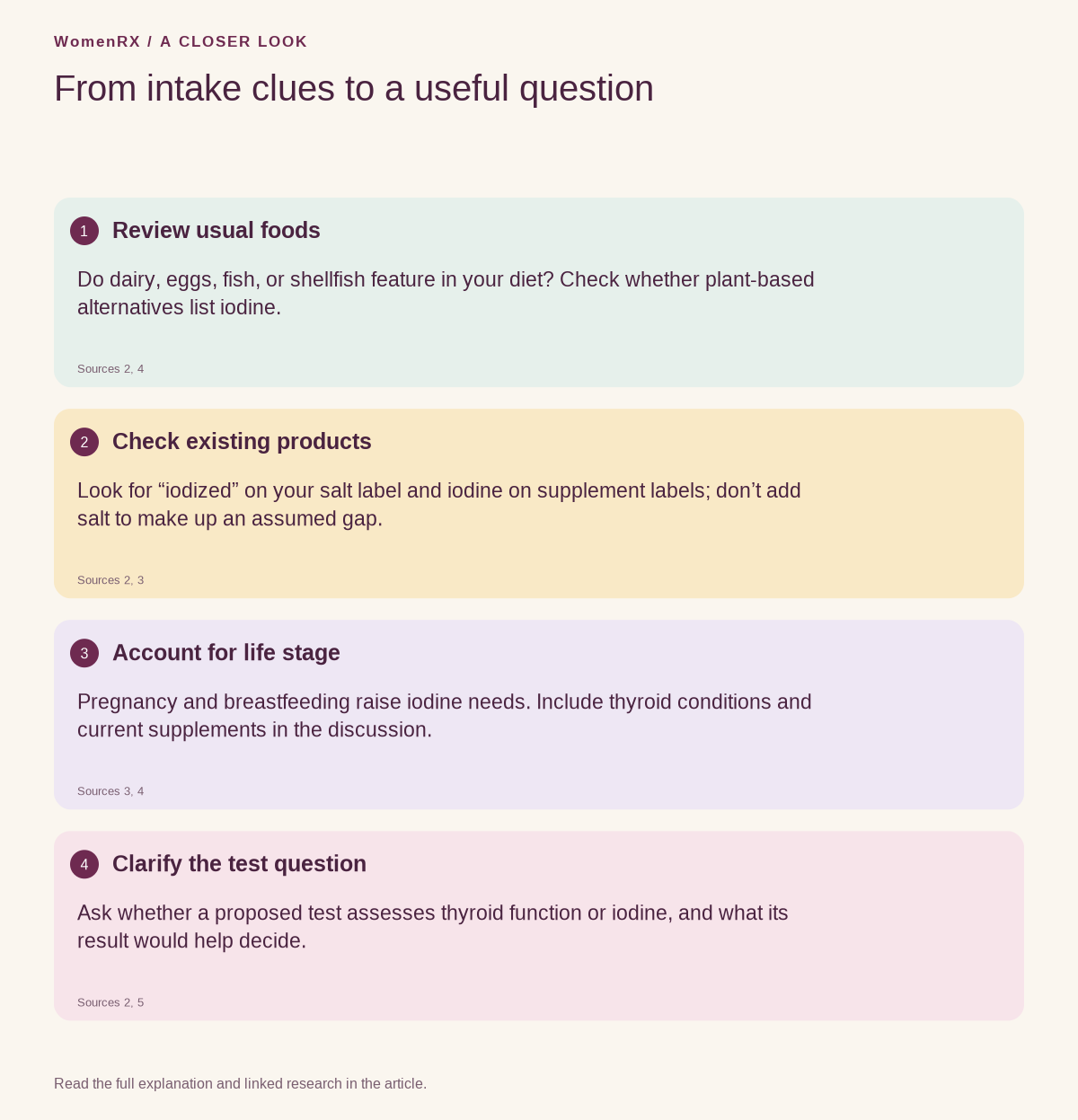
From intake clues to a useful question
Review usual foods: Do dairy, eggs, fish, or shellfish feature in your diet? Check whether plant-based alternatives list iodine.24
Check existing products: Look for “iodized” on your salt label and iodine on supplement labels; don’t add salt to make up an assumed gap.23
Account for life stage: Pregnancy and breastfeeding raise iodine needs. Include thyroid conditions and current supplements in the discussion.34
Clarify the test question: Ask whether a proposed test assesses thyroid function or iodine, and what its result would help decide.25
Read the figure as text
A way to assess whether iodine intake deserves attention without treating a symptom or test result as a diagnosis.- Review usual foods: Do dairy, eggs, fish, or shellfish feature in your diet? Check whether plant-based alternatives list iodine.24
- Check existing products: Look for “iodized” on your salt label and iodine on supplement labels; don’t add salt to make up an assumed gap.23
- Account for life stage: Pregnancy and breastfeeding raise iodine needs. Include thyroid conditions and current supplements in the discussion.34
- Clarify the test question: Ask whether a proposed test assesses thyroid function or iodine, and what its result would help decide.25
More questions, answered
Should I take iodine if I don’t eat dairy or seafood?
Avoiding both can leave fewer common iodine sources in your diet, but it doesn’t prove you’re deficient. Check other foods, fortification labels, iodized salt use, and supplements you already take. If you’re pregnant or have a thyroid condition, discuss that full picture before adding an iodine product; excess iodine can affect thyroid function too. 2 4 3
Sources you can check
- Pregnancy and Medicines | MedlinePlusAccessed 2026-09-25Return to first citation
- Iodine deficiency in the first pregnancy trimester and intelligence in adolescence.Keestra SM, Königs M, van Welie N, Dreyer K, Oosterlaan J, Mijatovic V, Roseboom TJ, Finken MJJ. · European journal of nutrition · 2026Return to first citation
- Critical Role of Iodine and Thyroid Hormones During Pregnancy.Moreno-Reyes R, Fuentes Peña C, Nuñez JF, Sánchez MB, Carvajal JJ, Roble K, Mendoza-León MJ, Rangel-Ramírez MA, Opazo MC, Lay MK, Riedel CA, Guzmán-Gutierrez E, Mackern-Oberti JP, ... · International journal of molecular sciences · 2025Return to first citation
- What Endocrinologists Should Know About Iodine: Population Deficiency, Individual Excess and Misinformation in the United Kingdom.Taylor PN, Prentice M, Bath S, Combet E, Schoenmakers N, Smith VE, Gibb FW, Zammitt N, Okosieme O, Boelaert K, Lazarus J, Vanderpump M. · Clinical endocrinology · 2026Return to first citation
- Serum Iodine Concentration as a Biomarker for Individual Iodine Nutrition and Thyroid Function in Pregnant Women: A Cross-Sectional Study in Hubei Province.Xu M, Dai X, Wang Z, Guo C, Zhang B, Guo H. · Public health nutrition · 2026Return to first citation