Could Low Potassium Explain Symptoms, and When Is It Urgent?
Muscle weakness or cramps can have many causes, so a blood test, not symptoms or a supplement trial, is what can confirm low potassium.
Low potassium can be associated with muscle weakness or cramps, but those symptoms don’t tell you your potassium level or why it changed. A blood test is needed to check it. Severe or rapidly worsening weakness, or palpitations, deserve urgent assessment because very low potassium can affect heart rhythm. Don’t start potassium on your own: too much can also be dangerous.
Muscle weakness or cramps may make you wonder about potassium, especially after vomiting or another illness. But symptoms alone can’t confirm low potassium, also called hypokalemia, and they can’t show what caused it. A blood test is the key next step. Potassium that is too low can affect muscles and, in severe cases, the heart’s rhythm. 4 5
What symptoms can, and can’t, tell you
Weakness and muscle cramps have appeared in reports of people with low potassium, including a woman with severe potassium loss and marked muscle weakness. But individual cases can show what is possible, not how often a symptom occurs or whether potassium is the likely explanation for you. 4 7
Palpitations are a different reason to take symptoms seriously. A case report described an abnormal heart rhythm alongside low potassium that improved after hospital treatment. That doesn’t mean palpitations are usually caused by low potassium, but it does show why significant palpitations should not be managed by guessing or taking a supplement at home. 5
The test checks the level; follow-up looks for the cause
A blood test measures potassium directly. If it’s low, the next question is why. Vomiting can contribute to potassium loss; kidney-related losses are another possibility. The distinction may require a clinician to consider other blood results and, in some situations, urine testing. 3
If low potassium persists or returns, the cause matters. For example, case reports describe primary aldosteronism, a hormone-related condition associated with high blood pressure, in people with low potassium and muscle weakness. Those cases don’t mean that most low potassium is caused by this condition, but they illustrate why recurring or unexplained results may need more than potassium replacement alone. 4 6
When to seek urgent assessment
Seek urgent medical assessment for severe or quickly worsening weakness, or for palpitations, rather than waiting to see whether a supplement helps. Very low potassium has been reported with serious muscle injury, and low potassium has also been associated with an abnormal heart rhythm in a case report. These reports illustrate potential risks; they don’t establish a symptom-based threshold or let you estimate your potassium level at home. 4 5
If you’ve had vomiting or another source of fluid loss and feel unwell, contact a care team promptly for advice about whether testing is appropriate. If you’re pregnant, ask for individualized advice about symptoms, fluid loss, and medicines rather than assuming pregnancy itself means you’re more likely to be low in potassium.
Why self-treating can backfire
Potassium that is too high can also be dangerous. The risk can increase when potassium supplements or potassium-containing salt substitutes are used with certain medicines, including ACE inhibitors, ARBs, or potassium-sparing diuretics. Kidney problems can also affect the body’s ability to regulate potassium. 1 2
So don’t use a potassium supplement or salt substitute to treat suspected low potassium without medical advice, particularly if you have kidney disease or take medicines that affect potassium. If a blood test shows a low level, the right response depends on both the result and its cause.
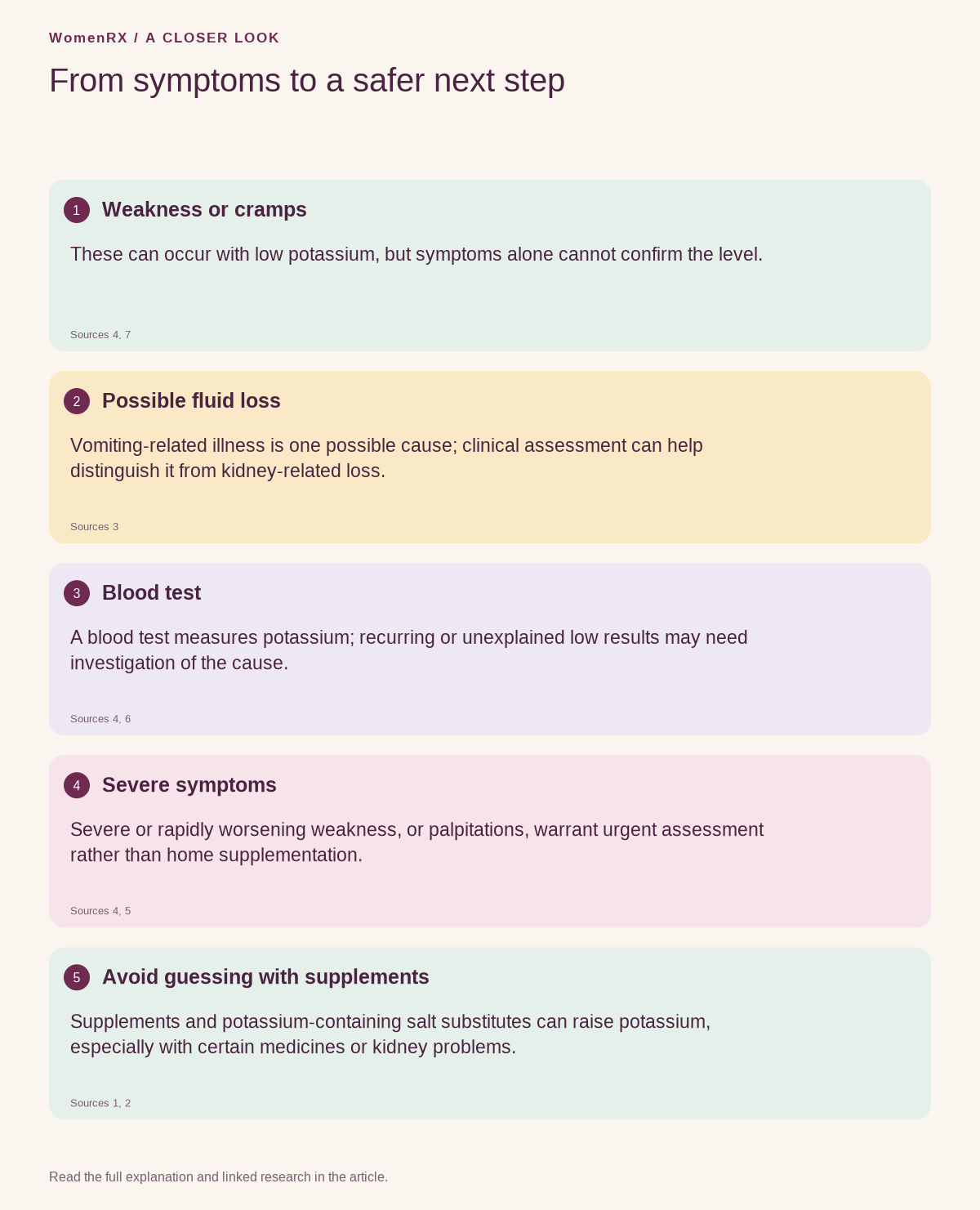
From symptoms to a safer next step
Weakness or cramps: These can occur with low potassium, but symptoms alone cannot confirm the level.47
Possible fluid loss: Vomiting-related illness is one possible cause; clinical assessment can help distinguish it from kidney-related loss.3
Blood test: A blood test measures potassium; recurring or unexplained low results may need investigation of the cause.46
Severe symptoms: Severe or rapidly worsening weakness, or palpitations, warrant urgent assessment rather than home supplementation.45
Avoid guessing with supplements: Supplements and potassium-containing salt substitutes can raise potassium, especially with certain medicines or kidney problems.12
Read the figure as text
Symptoms can prompt action, but a blood test confirms the potassium level and follow-up helps identify the cause.- Weakness or cramps: These can occur with low potassium, but symptoms alone cannot confirm the level.47
- Possible fluid loss: Vomiting-related illness is one possible cause; clinical assessment can help distinguish it from kidney-related loss.3
- Blood test: A blood test measures potassium; recurring or unexplained low results may need investigation of the cause.46
- Severe symptoms: Severe or rapidly worsening weakness, or palpitations, warrant urgent assessment rather than home supplementation.45
- Avoid guessing with supplements: Supplements and potassium-containing salt substitutes can raise potassium, especially with certain medicines or kidney problems.12
More questions, answered
Can I tell if my potassium is low from symptoms?
No. Weakness or cramps can occur with low potassium, but symptoms alone can’t confirm the level or identify the cause. A blood test is needed. 4 7
Can a potassium supplement hurt me if my level isn’t low?
Yes. Potassium that is too high can be dangerous, and supplements or potassium-containing salt substitutes may raise that risk with some medicines, including ACE inhibitors, ARBs, and potassium-sparing diuretics. 1
Sources you can check
- An Overview of Clinically Imperative and Pharmacodynamically Significant Drug Interactions of Renin-Angiotensin-Aldosterone System (RAAS) Blockers.Mohamed Pakkir Maideen N, Balasubramanian R, Muthusamy S, Nallasamy V. · Current cardiology reviews · 2022Return to first citation
- Predicting the risk of hyperkalemia in patients with chronic kidney disease starting lisinopril.Johnson ES, Weinstein JR, Thorp ML, Platt RW, Petrik AF, Yang X, Anderson S, Smith DH. · Pharmacoepidemiology and drug safety · 2010Return to first citation
- Investigating the role of urinary electrolyte parameters in the differential diagnosis of hypokalemia.Lin W, Ying J, Liu X, Mou L. · Clinical nephrology · 2026Return to first citation
- Primary Aldosteronism Presenting as Dropped Head Syndrome With Hypokalemic Rhabdomyolysis: A Case Report.Kao YC, Liang YC, Du YF, Ou HY. · Case reports in endocrinology · 2026Return to first citation
- Paroxysmal Atrial Tachycardia With Atrioventricular Block: A Report of Two Cases.Kuridze N, Etsadashvili K, Tchanturia S, Betsuashvili S, Kavtaradze T. · Case reports in medicine · 2026Return to first citation
- A Diagnostic Pitfall of Primary Aldosteronism Presenting as Recurrent Quadriparesis: A Case Report.Shakir J, Benyamin J, Iqbal MU, Sohail A, Mazhar A, Abdullah HM, Habib E, Danaf N. · Clinical case reports · 2026Return to first citation
- Hypokalemic Periodic Paralysis in a Young Woman With Mast Cell Activation Syndrome: A Case Report of an Atypical Presentation Associated With an Ultra-Rare CACNA1S Variant.Moradi A, Aboutaleb Y, Noreen S, Sahyouni A, Sharma H, Oyesanmi O, Kahane IM, Lin Y, Toka HR. · Clinical case reports · 2026Return to first citation