Burning Mouth in Perimenopause: What Else Could Explain It?
A burning mouth may appear during the menopause transition, but what you can see and what else has changed offer better clues about where to start.
A burning or sore mouth can happen during perimenopause, but that timing doesn’t prove hormones are the cause. Burning mouth syndrome describes recurring oral burning when an examination and relevant testing find no other explanation. Start with a dentist for a visible mouth change or possible dental irritation; if dryness, medication changes, or other health concerns stand out, your usual clinician is another sensible first stop. 1 3 7

Burning is a symptom, not yet a diagnosis
Your mouth may feel hot, sore, tingly, or unusually sensitive even when you can’t see anything wrong. Burning mouth syndrome (BMS) is the name for recurring oral burning or altered sensation when an examination and relevant tests haven’t identified another cause. It often affects the tongue and can come with a dry feeling or a change in taste. A sore, patch, or other visible change calls for an examination rather than an assumption that it’s BMS. 1 3 7
The timing can be confusing. A 2025 review describes BMS in women in perimenopause or postmenopause, and a 2026 systematic review found an association with menopause. But the studies don’t establish that hormonal changes directly cause burning in a particular woman. Much of the research concerns menopause broadly or postmenopause, so it cannot tell you how likely a new burning sensation is to be caused by perimenopause specifically. 1 3
Clues that point beyond hormones
A dry feeling or altered taste. These can occur alongside burning. Menopause-related changes have been associated with dry mouth, but a dry feeling alone doesn’t identify its cause or establish BMS. Tell the person examining you if eating or speaking has become uncomfortable, too. 1 2 4
Something local to the mouth. Think about where the burning is and what preceded it. For example, discomfort near a denture or after dental work gives a dentist a different place to start than burning across an otherwise normal-looking tongue. Dentures, dental procedures, gum problems, and habits such as clenching or grinding have all been reported in connection with oral burning or BMS. That doesn’t mean any one of them is the cause without an examination. 1
Medicines or another health condition. Chronic medication use and thyroid conditions have been associated with BMS; reviews also discuss diabetes and nutritional deficiencies among possible contributors to a burning sensation. A medication list and any recent changes can help your clinician assess the whole picture. Burning by itself doesn’t tell you that you need a vitamin supplement: a suspected deficiency needs to be assessed rather than guessed at. 1 7
Irritants and the pattern of pain. Some people report worse symptoms with acidic, spicy, or strongly flavored foods. If you notice a consistent connection, you can avoid what aggravates your mouth while you seek an explanation. Also note whether the sensation comes and goes or keeps returning. Pain sensitivity, sleep, and stress can be part of this complex picture, but they shouldn’t be used to dismiss the symptom. 1 3
Choose a first stop based on what’s happening
Start with a dentist if you can see a sore, patch, or gum change, or if the burning seems tied to a tooth, dental work, or an appliance. An oral examination can look for a local explanation. No visible change? If the burning persists or returns, a dentist can still examine areas you may not be able to assess yourself. BMS is considered only after other identifiable causes have been evaluated. 3 7
Start with your usual clinician if dryness comes with broader health concerns, or if a medicine change or an existing condition seems relevant. A dentist or clinician can help decide whether further assessment for a medical or nutritional contributor makes sense. You don’t have to determine the cause before making the appointment. 1 3 7
Seek emergency care instead of a routine appointment if mouth symptoms begin after eating a suspected allergen and you have breathing difficulty. Severe food-allergic reactions can involve breathing problems and anaphylaxis; this is a different situation from ongoing unexplained oral burning. 5 6
For a routine visit, a few concrete details are more useful than trying to label the problem yourself: where it burns, when it began, what you can see, whether your mouth feels dry or your taste has changed, and whether dental work or a medication change came before it. Those details help direct an examination without assuming perimenopause explains everything. 1 3
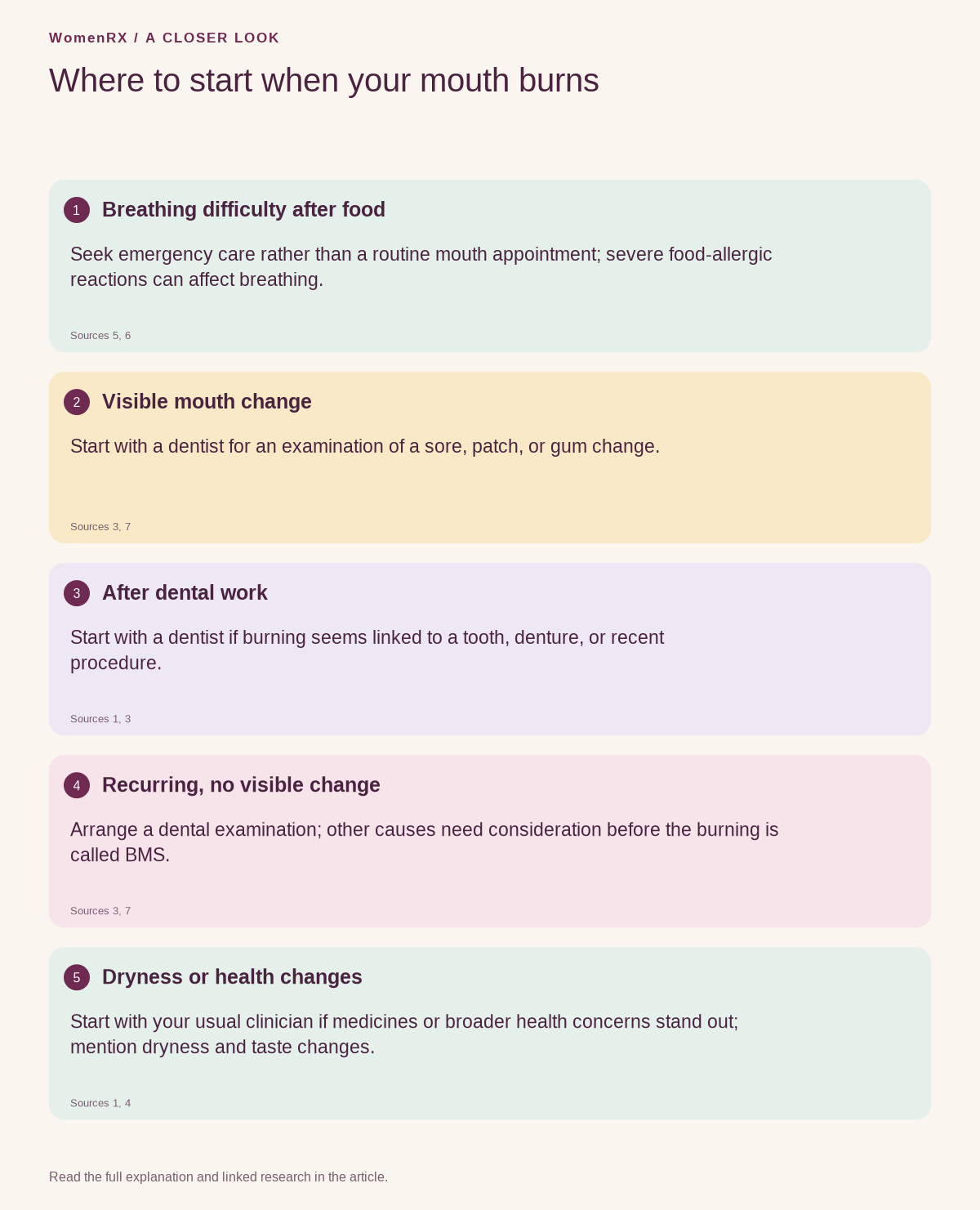
Where to start when your mouth burns
Breathing difficulty after food: Seek emergency care rather than a routine mouth appointment; severe food-allergic reactions can affect breathing.56
Visible mouth change: Start with a dentist for an examination of a sore, patch, or gum change.37
After dental work: Start with a dentist if burning seems linked to a tooth, denture, or recent procedure.13
Recurring, no visible change: Arrange a dental examination; other causes need consideration before the burning is called BMS.37
Dryness or health changes: Start with your usual clinician if medicines or broader health concerns stand out; mention dryness and taste changes.14
Read the figure as text
Follow the symptom that changes your next step; these routes are not a diagnosis.- Breathing difficulty after food: Seek emergency care rather than a routine mouth appointment; severe food-allergic reactions can affect breathing.56
- Visible mouth change: Start with a dentist for an examination of a sore, patch, or gum change.37
- After dental work: Start with a dentist if burning seems linked to a tooth, denture, or recent procedure.13
- Recurring, no visible change: Arrange a dental examination; other causes need consideration before the burning is called BMS.37
- Dryness or health changes: Start with your usual clinician if medicines or broader health concerns stand out; mention dryness and taste changes.14
More questions, answered
Does a burning mouth mean I have a vitamin deficiency?
No. A nutritional deficiency is one possible contributor to oral burning, not a diagnosis you can make from the sensation alone. An assessment can help determine whether testing for a deficiency is relevant. 1 7
Will hormone therapy treat burning mouth?
It isn’t a reliable treatment established by this research. A 2024 review reports improvement in some studies of oral discomfort, but also describes research in which hormone therapy did not prevent or improve painful-mouth or dry-mouth sensations. Those mixed findings aren’t a reason to assume hormones are the cause of your symptoms. 4
Sources you can check
- Exploring the association between menopause and burning mouth syndrome: an updated review.Qaderi K, Eghdampour F, Mallah MA, Kalhor M, Ghasemi H, Fallahnia N, Sohrabi Z. · BMC oral health · 2026Return to first citation
- The Silent Shift of Menopause: The Intersection between Salivary Glands, Oral Cavity Status, and Cardiovascular Health.Lourenço SV, Florezi GP, Pelissari C, Hojaij FC, Otoch JP, Ramires JAF. · Arquivos brasileiros de cardiologia · 2026Return to first citation
- Challenges of Diagnosis and Management of Burning Mouth Syndrome: A Literature Review.Almeida NLM, Oliveira GM, Santos CF, Lara VS, Cardoso CL. · Current aging science · 2025Return to first citation
- Menopause and Oral Health: Clinical Implications and Preventive Strategies.Shrivastava S. · Journal of mid-life health · 2024Return to first citation
- Basophil Activation Test (BAT) for Diagnosing LTP Food Allergy: Where Do We Stand Now? A Systematic Review.Kosztulska B, Grześk-Kaczyńska M, Rydzyńska M, Bartuzi Z, Ukleja-Sokołowska N. · International journal of molecular sciences · 2025Return to first citation
- [Diagnosis of soybean and peanut allergen components: identification of major components and clinical management strategies].Chen YY, Luo WT, Zhang JL, Sun BQ. · Zhonghua yu fang yi xue za zhi [Chinese journal of preventive medicine] · 2024Return to first citation
- Burning mouth syndrome: a review and update.Silvestre FJ, Silvestre-Rangil J, López-Jornet P. · Revista de neurologia · 2015Return to first citation