Burning Mouth in Midlife: Is It Linked to Perimenopause?
Burning or unusually sensitive mouth symptoms can occur around menopause, but they don’t identify the cause or prove that hormones are responsible.
Menopause has been associated with burning mouth syndrome, but research hasn’t established that hormone changes cause it or that burning mouth is a specific sign of perimenopause. Dry mouth, oral irritation or dental issues, medicines, and health conditions such as diabetes or thyroid disease are among other possibilities. The pattern of symptoms and an examination can help separate a primary pain syndrome from an identifiable cause. 1 2
A menopause connection, not a menopause test
A burning, prickling, tender, or unusually sensitive mouth can happen during midlife. Research has found an association between menopause and burning mouth syndrome (BMS), a persistent oral burning or unusual sensation that occurs without an identifiable mouth abnormality. But an association doesn’t establish that menopause caused the symptom, and burning mouth isn’t a reliable way to tell whether you’re in perimenopause. 1
The evidence also doesn’t neatly separate perimenopause from postmenopause. A 2026 systematic review found that menopause was associated with BMS across studies with different designs, but concluded that no single cause could be identified. The review describes BMS as multifactorial, with uncertainty about how the proposed contributors fit together. 1
An earlier review of menopause and oral health found that controlled studies were scarce. It reported that hormone therapy doesn’t necessarily prevent or relieve oral symptoms, so a burning mouth by itself isn’t a reason to assume hormone treatment will help. 2
What else could make your mouth burn?
The key distinction is whether there’s an identifiable explanation for the burning. Primary BMS describes persistent symptoms without an identifiable clinical or laboratory abnormality. When a possible cause is found, the burning may instead be considered secondary to that cause. The sensation alone can’t sort these out. 1 4
Possible contributors fall into a few overlapping groups:
- Mouth and dental factors: dry mouth, dentures, gum or other oral health problems, irritation, habits such as clenching, or symptoms that began after dental work have been reported in BMS research. These are associations, not proof that any one factor is responsible for an individual’s symptoms. 1 3
- Medicines and health conditions: chronic medication use, diabetes, hypothyroidism, nutritional deficiencies, and reflux have been reported as possible associations or secondary factors. A review also describes oral burning alongside conditions such as diabetes and thyroid disease. 1 4
- Pain, stress, and sensitivity: anxiety, depression, stressful events, poor sleep, and heightened pain sensitivity have been associated with BMS. These findings don’t mean the pain is imagined or that stress is necessarily its cause. 1
- Foods and other irritants: smoking, alcohol, and acidic, spicy, or strongly flavored foods have been reported as symptom aggravators for some people. 1
These categories can overlap. For example, someone may have a dry mouth and a medication change at the same time as a menopause transition. Noticing that timing is useful, but timing alone doesn’t prove which factor is driving the sensation.
What to notice before an assessment
A dentist or medical clinician may need to distinguish an oral problem from a broader health or medication-related contributor. It helps to describe where the sensation is, whether it is constant or comes and goes, and whether you also notice dryness, altered taste, tingling, or numbness. BMS can involve more than burning, including changes in taste and dry mouth. 1
Also note whether you see a change inside your mouth; whether symptoms followed dental work or a new dental appliance; whether a medicine was started or changed; and whether certain foods seem to aggravate it. Mention relevant known conditions, such as diabetes or thyroid disease, and any recent findings related to nutrition. These details can help guide what should be examined or considered, without assuming that menopause is the explanation. 1 3 4
If an examination or testing identifies a cause, the symptom may be addressed in relation to that finding rather than labeled primary BMS. If no cause is identified, the clinician can consider whether the symptom pattern fits BMS. The available research points to several possible contributors, not one menopause-specific mechanism or a proven hormone-based remedy. 1 2
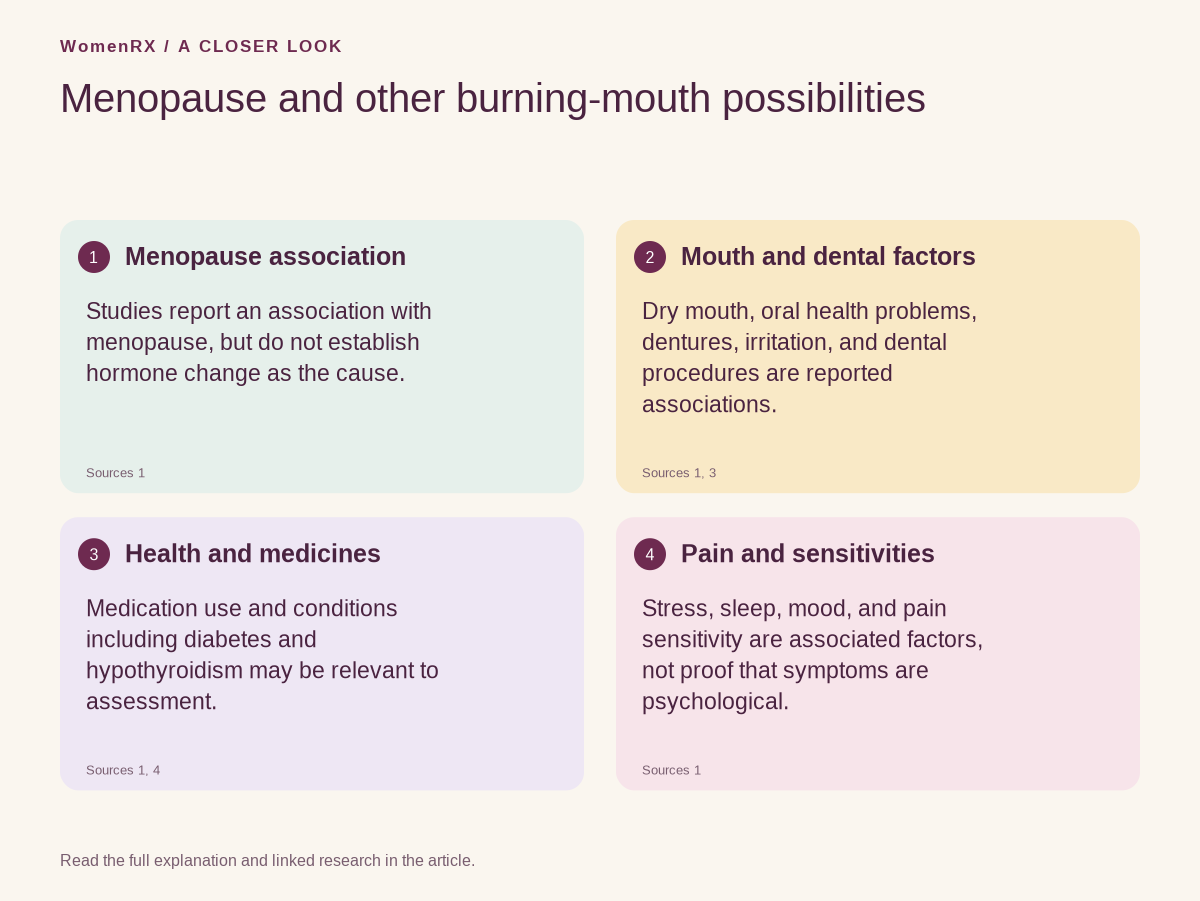
Menopause and other burning-mouth possibilities
Menopause association: Studies report an association with menopause, but do not establish hormone change as the cause.1
Mouth and dental factors: Dry mouth, oral health problems, dentures, irritation, and dental procedures are reported associations.13
Health and medicines: Medication use and conditions including diabetes and hypothyroidism may be relevant to assessment.14
Pain and sensitivities: Stress, sleep, mood, and pain sensitivity are associated factors, not proof that symptoms are psychological.1
Read the figure as text
Burning mouth can occur around menopause, but the symptom alone cannot identify its cause. These categories show why assessment looks beyond the life stage.- Menopause association: Studies report an association with menopause, but do not establish hormone change as the cause.1
- Mouth and dental factors: Dry mouth, oral health problems, dentures, irritation, and dental procedures are reported associations.13
- Health and medicines: Medication use and conditions including diabetes and hypothyroidism may be relevant to assessment.14
- Pain and sensitivities: Stress, sleep, mood, and pain sensitivity are associated factors, not proof that symptoms are psychological.1
More questions, answered
Does burning mouth mean I’m in perimenopause?
No. Burning mouth has been associated with menopause, but it is not specific to perimenopause and can have oral, medication-related, or broader health explanations. The research summarized in a systematic review doesn’t establish a single cause. 1
Does hormone therapy reliably relieve burning mouth?
The evidence cited in a review of menopause and oral health does not show that hormone therapy necessarily prevents or helps oral symptoms. Burning mouth alone therefore doesn’t establish that hormone treatment will help. 2
Sources you can check
- Exploring the association between menopause and burning mouth syndrome: an updated review.Qaderi K, Eghdampour F, Mallah MA, Kalhor M, Ghasemi H, Fallahnia N, Sohrabi Z. · BMC oral health · 2026Return to first citation
- The menopause and oral health.Meurman JH, Tarkkila L, Tiitinen A. · Maturitas · 2009Return to first citation
- The Role of Stress in Burning Mouth Syndrome Triggered by Dental Treatments: A Two-Step Hypothesis.Lebel A, Lescaille G, Alajbeg I, Alajbeg I, Boucher Y. · Journal of oral rehabilitation · 2025Return to first citation
- Evaluation of serum neuron specific enolase levels among patients with primary and secondary burning mouth syndrome.Kishore J, Shaikh F, Zubairi AM, Mirza S, Alqutub MN, AlMubarak AM, Abduljabbar T, Vohra F. · Cephalalgia : an international journal of headache · 2022Return to first citation