Burning Mouth Symptoms: When to Get Checked
Ongoing mouth burning deserves an evaluation because menopause is one possible association, not an explanation you can assume.
If burning, tingling, dryness, or altered taste keeps returning, arrange an evaluation with a dentist or medical clinician. Burning mouth syndrome is diagnosed only when persistent symptoms have no identifiable cause on examination or appropriate investigation. Before considering it, a clinician may review oral health, dry mouth, medicines, and selected health conditions. Menopause is associated with burning mouth symptoms, but it does not establish the cause in an individual woman. 1 2 3
Persistent burning is a reason to look for a cause
A burning or tingling tongue, lips, gums, or palate can feel unsettling, especially if your mouth looks normal. If the sensation persists or keeps coming back, a dental or medical evaluation can help check whether something identifiable is contributing. You don’t need to decide for yourself that it’s burning mouth syndrome before making that appointment.
Burning mouth syndrome (BMS) describes ongoing oral burning or altered sensation when there isn’t a visible cause. One commonly used definition describes symptoms recurring daily for more than two hours a day for more than three months, without a clinically evident cause. That duration helps define the syndrome; it isn’t a reason to wait three months before seeking an assessment if symptoms are bothering you. 2 4
Why menopause doesn’t settle the question
BMS is reported more often in women, and studies have associated it with menopause. But the research describes associations, not proof that hormonal changes cause a particular woman’s symptoms. A systematic review found several possible links, including oral health issues, dry mouth, medication use, and health or psychological factors, while concluding that no single cause could be identified. 1
Menopause may also coincide with dry mouth or taste changes, which are worth mentioning in their own right. The practical point is that a midlife timing can be relevant history, but it shouldn’t replace an oral examination or a review of other possible contributors. 5
What an evaluation may cover
A useful assessment starts with the pattern of symptoms and a look inside your mouth. BMS is considered when burning persists without an identifiable lesion or other cause, so finding a visible change may point toward a different explanation that needs attention. Symptoms limited to one side also deserve careful assessment: a small retrospective report raised concern about mistaking unilateral pain for BMS, though it cannot tell us how often that happens. 2 3
Your dentist or clinician may ask about:
- Where and when it burns: tongue, lips, palate, or more than one area; whether it is daily, constant, or intermittent.
- Other sensations: dryness, tingling, numbness, or changes in taste.
- Recent dental work and oral health: procedures, dentures, gum problems, or habits that irritate the mouth.
- Dry mouth and medicines: when dryness began, and whether any medicines might be contributing to dryness or burning. Reviews identify medication use and dry mouth among factors associated with BMS or considered when excluding other causes. Don’t stop a prescribed medicine on your own; bring an up-to-date medication list instead. 1 4
- Relevant health history: for example, thyroid disease, diabetes, or possible nutritional deficiencies. These are among the conditions or secondary factors discussed in reviews of BMS assessment, but they don’t explain every case. 1 3 4
- Menstrual stage and menopause symptoms: whether you’re in perimenopause or postmenopause, and whether dry mouth or taste changes are happening too.
Depending on your symptoms and examination, a clinician may consider whether any further checks are appropriate. The aim is to look for a plausible local or medical cause before labeling unexplained burning as BMS, not to assume that everyone needs the same set of tests. A review of diagnostic challenges emphasizes a thorough history to help identify secondary factors. 3
When to arrange a visit
Make an appointment if the burning is persistent, recurring, affecting eating or daily comfort, or accompanied by ongoing dryness or altered taste. A dentist is a practical starting point for checking oral tissues, teeth, gums, and possible irritants. A medical clinician may also be helpful when medication effects, dry mouth, or a broader health condition could be involved. The two perspectives can complement each other when the cause isn’t clear. 1 3
If you notice a visible change, such as a sore or other area that looks different, mention it and ask to have it examined rather than assuming the symptom is BMS. Classic BMS is defined by burning without a clinically evident causative lesion. 2 4
A short note can make the conversation easier
Before your visit, jot down when the symptoms began, where they occur, whether they are constant or come and go, and any changes in taste or mouth dryness. Add recent dental procedures, medication changes, and relevant health or menopause history. This gives the clinician a clearer starting point without requiring you to track every sensation or identify the cause yourself. 1 2 3
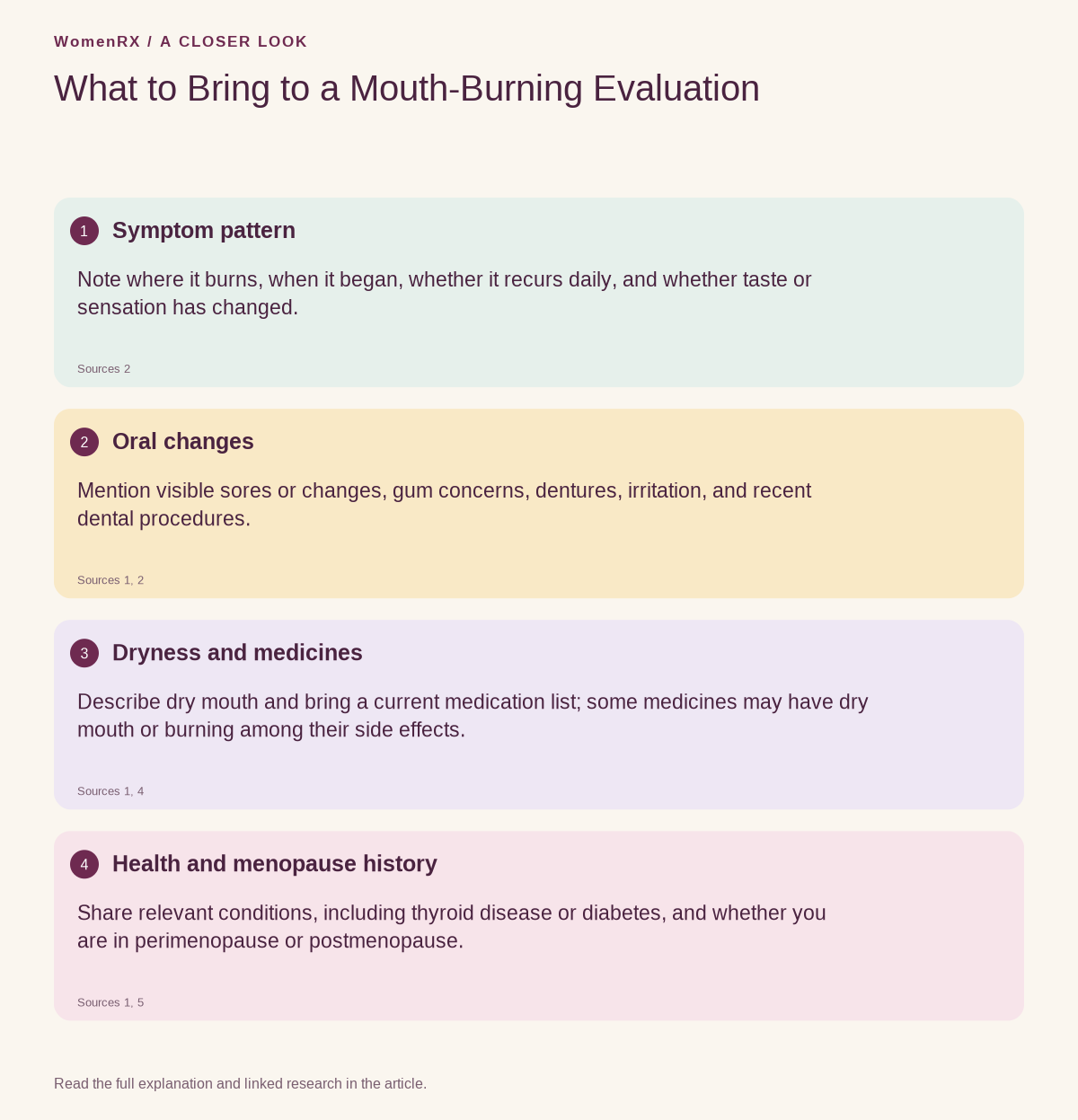
What to Bring to a Mouth-Burning Evaluation
Symptom pattern: Note where it burns, when it began, whether it recurs daily, and whether taste or sensation has changed.2
Oral changes: Mention visible sores or changes, gum concerns, dentures, irritation, and recent dental procedures.12
Dryness and medicines: Describe dry mouth and bring a current medication list; some medicines may have dry mouth or burning among their side effects.14
Health and menopause history: Share relevant conditions, including thyroid disease or diabetes, and whether you are in perimenopause or postmenopause.15
Read the figure as text
These details can help a dentist or medical clinician consider oral, medication-related, and selected health contributors before deciding whether symptoms fit BMS.- Symptom pattern: Note where it burns, when it began, whether it recurs daily, and whether taste or sensation has changed.2
- Oral changes: Mention visible sores or changes, gum concerns, dentures, irritation, and recent dental procedures.12
- Dryness and medicines: Describe dry mouth and bring a current medication list; some medicines may have dry mouth or burning among their side effects.14
- Health and menopause history: Share relevant conditions, including thyroid disease or diabetes, and whether you are in perimenopause or postmenopause.15
More questions, answered
Does burning mouth mean I have burning mouth syndrome?
No. Burning is a symptom, while BMS refers to persistent oral burning without an identifiable cause. An assessment helps distinguish it from other oral or health-related contributors. 2 3
Can menopause cause burning in the mouth?
Menopause has been associated with BMS and other oral symptoms, but the association doesn’t show that menopause is the cause of an individual woman’s burning. Oral health, dry mouth, medicines, and other health factors may also be relevant. 1 5
Sources you can check
- Exploring the association between menopause and burning mouth syndrome: an updated review.Qaderi K, Eghdampour F, Mallah MA, Kalhor M, Ghasemi H, Fallahnia N, Sohrabi Z. · BMC oral health · 2026Return to first citation
- The Role of Stress in Burning Mouth Syndrome Triggered by Dental Treatments: A Two-Step Hypothesis.Lebel A, Lescaille G, Alajbeg I, Alajbeg I, Boucher Y. · Journal of oral rehabilitation · 2025Return to first citation
- Challenges of Diagnosis and Management of Burning Mouth Syndrome: A Literature Review.Almeida NLM, Oliveira GM, Santos CF, Lara VS, Cardoso CL. · Current aging science · 2025Return to first citation
- Comparison of Salivary Opiorphin in Burning Mouth Syndrome and Healthy Subjects and Its Correlation With Psychiatric Disorders.Dalirsani Z, Amirchaghmaghi M, Semnani MM, Talebi M, Hashemy SI, Shakeri MT, Taghizadeh A. · Clinical and experimental dental research · 2024Return to first citation
- The Silent Shift of Menopause: The Intersection between Salivary Glands, Oral Cavity Status, and Cardiovascular Health.Lourenço SV, Florezi GP, Pelissari C, Hojaij FC, Otoch JP, Ramires JAF. · Arquivos brasileiros de cardiologia · 2026Return to first citation