Burning Mouth During Perimenopause: What to Check
Menopause may be one factor in mouth burning, but visible irritation, dry mouth, medicines, and other health issues can also matter.
Burning or sore mouth during perimenopause isn’t automatically caused by falling estrogen. Menopause has been associated with burning mouth symptoms, but research hasn’t established it as the cause, and oral health issues, dryness, chronic medication use, and other health conditions may also be involved. Visible changes call for an oral examination; persistent burning without visible changes may need a broader assessment. 3
First, look at what you can see
A burning feeling is a symptom, not a diagnosis. Notice whether your tongue, gums, palate, or cheeks look different, or whether you mainly feel burning, tingling, altered taste, or dryness without an obvious change. Burning mouth syndrome (BMS) describes a persistent burning or unusual sensation without an identifiable cause on examination and investigation. One commonly used definition describes symptoms lasting more than two hours a day, recurring daily for more than three months. That definition helps distinguish BMS from a short-lived irritation; it isn’t a reason to wait months before getting a new or concerning mouth change checked. 2
If you can see a sore, patch, swelling, or other change, start with a dentist or oral health professional who can examine it. A visible change doesn’t fit the usual definition of primary BMS, which is defined by the absence of an evident causal lesion. It may point to a local or other cause that needs its own assessment. 2 Regular dental care is part of looking after oral health. 1
When the mouth looks normal, check the pattern
BMS often affects the tongue, especially its front portion, and can come with altered taste or a feeling of dry mouth. Some people experience a burning sensation even when the mouth doesn’t look dry. So dryness is worth mentioning, but it doesn’t by itself explain the burning or prove BMS. 3
Make a short note of when the feeling happens, where it is, whether it comes and goes, and whether eating, drinking, or a particular product seems to change it. This isn’t a diagnostic test. It gives a dentist or clinician a clearer picture of the pattern and of any changes over time.
Consider menopause, but don’t stop there
A 2026 systematic review of 22 studies found an association between BMS and menopause, among other factors. The studies included different designs, such as cross-sectional and case-control research, so an association can’t show that menopause caused the symptoms. The review also described links with oral health issues, dry mouth, chronic medication use, endocrine conditions, and other factors. It concluded that no single cause could be definitively identified. Menopause is a possible part of the picture, not a complete explanation. 3
Some review authors have proposed that hormonal changes could affect oral tissues or sensation. But the evidence described in that review does not establish estrogen decline as the cause of burning, or show that treating menopause-related hormone changes will resolve it. Don’t assume hormone therapy is a treatment for mouth burning based on the timing alone. 3
A practical checklist for an assessment
Before you go, consider these four questions:
- What can I see? Note any change in the tongue, gums, palate, or cheeks, and when it began.
- Does my mouth feel dry? Mention dryness separately from burning, along with any taste changes.
- What medicines do I take? Bring an up-to-date list, including medicines you take regularly. Chronic medication use has been associated with BMS, but that doesn’t establish that a particular medicine is responsible. Don’t stop a medicine on your own; ask whether it could be contributing and whether there are safe options. 3
- What else changed? Mention recent dental work, oral habits, or other health conditions. Dental procedures and parafunctional habits are among the local factors discussed in the menopause review. 3
A dentist is a sensible first stop when there’s a visible oral change, dental discomfort, or a possible link to dental work or oral habits. If the mouth looks normal but burning persists, or dryness, medicines, or wider health issues may be involved, a primary care clinician can help assess those possibilities; a dentist or oral medicine specialist may also be part of the evaluation. The goal is to distinguish a local, treatable source from persistent burning without an apparent lesion, rather than labeling every mouth symptom as menopause or BMS.
What treatment evidence can and can’t tell you
Treatment depends on what the assessment finds. For BMS itself, a 2026 systematic review of capsaicin included four studies and 218 participants, 182 of them women. It found reductions in reported pain, but rated the evidence low or very low certainty and noted that the studies didn’t establish a consistent treatment approach. That’s a reason to discuss options rather than assume one remedy works for everyone. 2
The useful next step is to describe both the sensation and what your mouth looks like, then review dryness, medicines, dental factors, and other health conditions. Menopause may be relevant, but it shouldn’t crowd out those other checks.
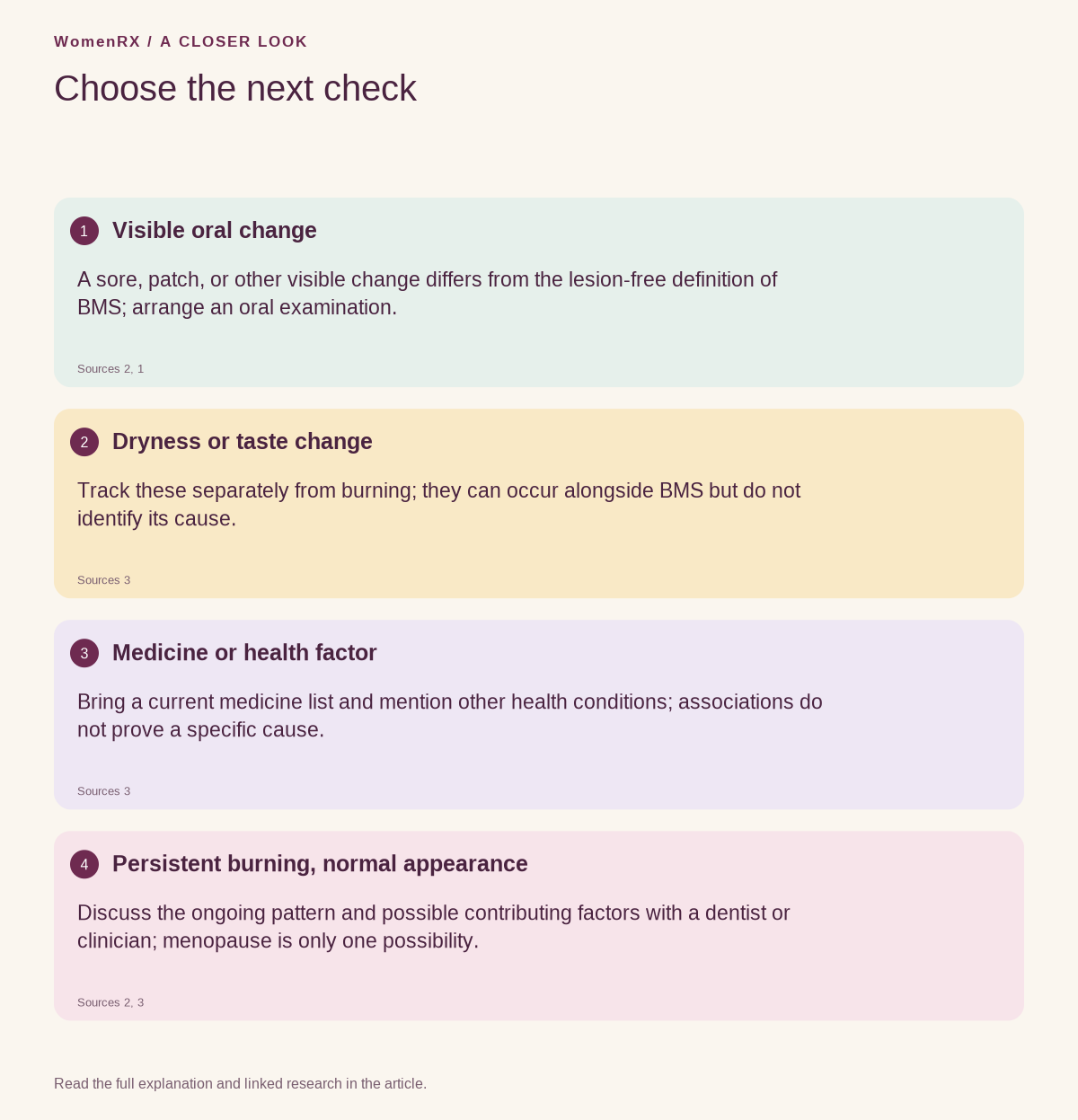
Choose the next check
Visible oral change: A sore, patch, or other visible change differs from the lesion-free definition of BMS; arrange an oral examination.21
Dryness or taste change: Track these separately from burning; they can occur alongside BMS but do not identify its cause.3
Medicine or health factor: Bring a current medicine list and mention other health conditions; associations do not prove a specific cause.3
Persistent burning, normal appearance: Discuss the ongoing pattern and possible contributing factors with a dentist or clinician; menopause is only one possibility.23
Read the figure as text
The visible appearance and pattern of mouth symptoms can help point toward a useful first assessment, without diagnosing the cause.- Visible oral change: A sore, patch, or other visible change differs from the lesion-free definition of BMS; arrange an oral examination.21
- Dryness or taste change: Track these separately from burning; they can occur alongside BMS but do not identify its cause.3
- Medicine or health factor: Bring a current medicine list and mention other health conditions; associations do not prove a specific cause.3
- Persistent burning, normal appearance: Discuss the ongoing pattern and possible contributing factors with a dentist or clinician; menopause is only one possibility.23
More questions, answered
Does burning mouth during perimenopause mean my estrogen is low?
No. Menopause has been associated with burning mouth symptoms, but the research does not establish estrogen decline as the cause. Other oral, medication-related, and health factors may be involved. 3
Can burning mouth syndrome happen when my mouth looks normal?
Yes. BMS is defined as persistent oral burning or an unusual sensation without an identifiable cause on examination and investigation. A visible change, however, needs assessment as a possible separate cause. 2
Sources you can check
- Dental Health: MedlinePlusAccessed 2026-09-25Return to first citation
- Is Capsaicin Effective in Relieving the Symptoms of Burning Mouth Syndrome? A Systematic Review.de Andrade Silva AP, Dos Santos IWR, da Silva ZA, Frazão DR, Matos-Sousa JM, Melo WWP, Lima RR, de Souza-Rodrigues RD. · Journal of oral rehabilitation · 2026Return to first citation
- Exploring the association between menopause and burning mouth syndrome: an updated review.Qaderi K, Eghdampour F, Mallah MA, Kalhor M, Ghasemi H, Fallahnia N, Sohrabi Z. · BMC oral health · 2026Return to first citation