Burning Mouth Around Menopause: What to Check First
A burning tongue can occur around menopause, but checking for dryness, irritation, and other treatable causes is more useful than assuming hormones are responsible.
Burning or altered taste around menopause doesn’t automatically mean you have burning mouth syndrome. Dry mouth, oral infection or irritation, medication use, and nutritional or endocrine problems can also be involved. If the symptom persists or keeps returning, a dental examination is a useful first step. Avoiding foods that clearly worsen the burning may help while you find out what’s behind it. 3 5
Start with what you’re feeling and what you can see
Oral burning can feel like a scalded tongue even when you haven’t eaten anything hot. It may come with tingling, an altered taste, or a dry feeling. The tongue is a common site, but the gums and roof of the mouth can be affected too. These details help describe the problem; none identifies its cause on its own. 3
Look for a change you can point to, such as an irritated area or a problem where a denture touches your mouth. A visible change calls for an oral examination rather than an assumption that the burning is part of menopause. Burning mouth syndrome (BMS) describes recurring burning or unusual oral sensations without a clinically evident problem that explains them. A review defines primary BMS as symptoms recurring daily for more than three months without evident causative lesions. That definition isn’t a reason to wait three months before getting help. 4 5
Dryness, irritation, and unexplained burning are different clues
A dry feeling can accompany BMS, so it doesn’t automatically mean dryness is the whole explanation. Dry mouth can also be part of a broader oral-health problem. An examination can help distinguish a mouth that looks healthy despite burning from one with irritation, infection, or a denture-related problem that needs attention. 3 5
Medication use is another factor worth reviewing. Nutritional deficiencies and conditions including diabetes and thyroid disease are among the possible contributors described in reviews of oral burning. More than one factor may be present, so finding one possible contributor doesn’t always settle the question. If a dental examination doesn’t explain persistent symptoms, a medical visit can consider these broader possibilities in light of your health history. 3 5
Where menopause fits
BMS is reported more often in postmenopausal women, and hormonal changes have been proposed as a contributor. The research also links it with oral-health issues, medication use, sleep and pain-related factors, and other health conditions. No single cause has been definitively identified. Menopause may be relevant to your symptoms, but the timing alone can’t tell you why your mouth burns or whether hormone therapy would relieve it. 3 4
What may help while you get it checked
Notice whether a particular food makes the burning worse. Studies summarized in a systematic review report worsening with acidic, spicy, or strongly flavored foods in some people. Avoiding a food that reliably sets off your symptoms is a reasonable comfort step. It won’t tell you whether you have BMS, and it won’t address an infection, denture problem, or other underlying cause. 3
Arrange a dental or oral-health assessment if the burning or taste change persists or keeps coming back, especially if you can see a mouth change or suspect a denture or dental problem. You don’t need to decide whether it’s BMS first. If no local explanation is found, medical evaluation may help sort through medications, nutritional factors, and other health conditions. 1 3 5
When recurring burning remains unexplained after assessment, BMS may be considered. Research suggests nerve-related pain processes can be involved, which helps explain why a mouth can burn without a visible sore. A review describes possible benefit from topical clonazepam for some people with a peripheral nerve-related pattern, but it doesn’t establish that the treatment will work for everyone. Clonazepam can cause drowsiness and dependence, so it isn’t a do-it-yourself remedy for oral burning. 4 2
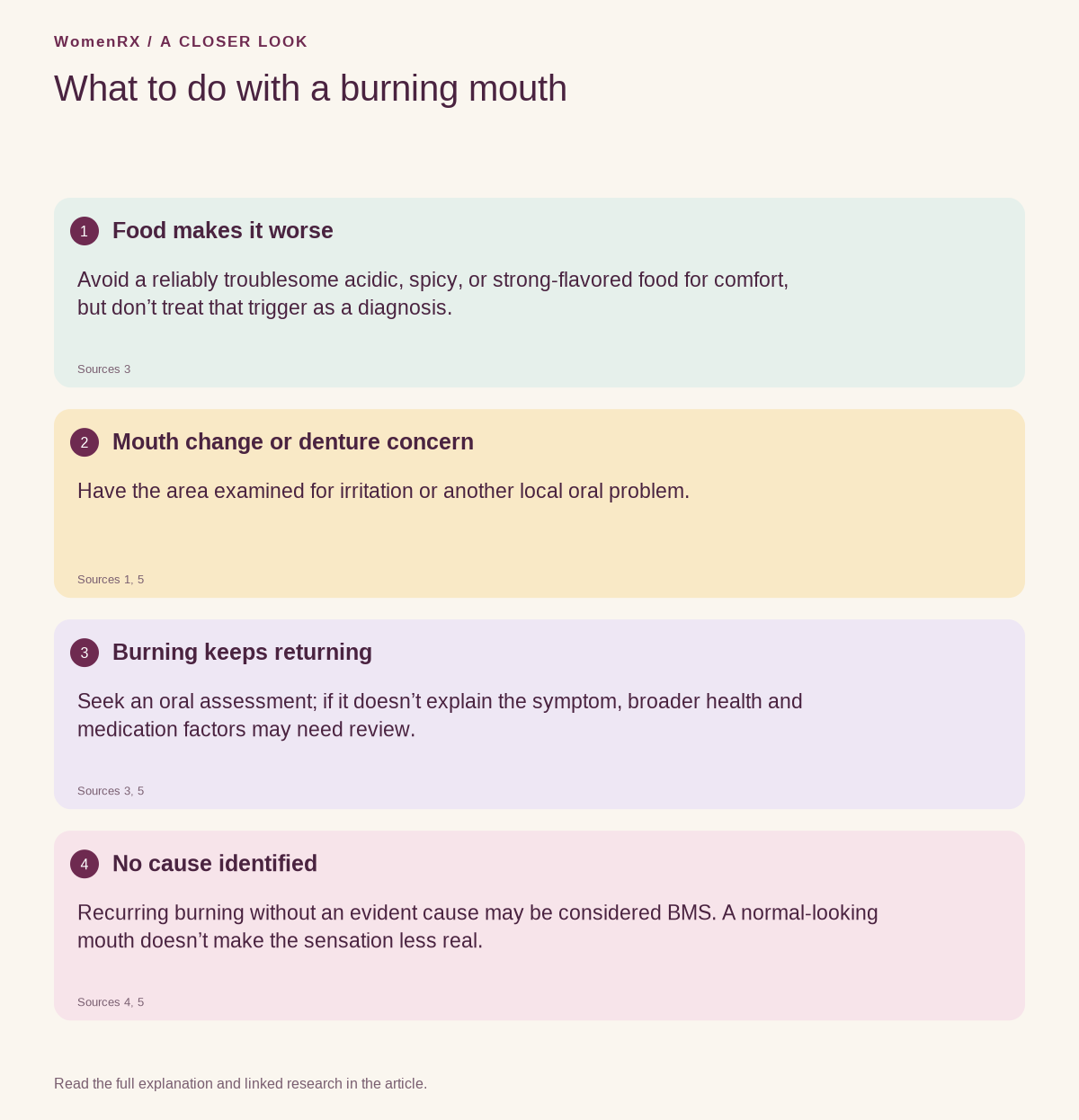
What to do with a burning mouth
Food makes it worse: Avoid a reliably troublesome acidic, spicy, or strong-flavored food for comfort, but don’t treat that trigger as a diagnosis.3
Mouth change or denture concern: Have the area examined for irritation or another local oral problem.15
Burning keeps returning: Seek an oral assessment; if it doesn’t explain the symptom, broader health and medication factors may need review.35
No cause identified: Recurring burning without an evident cause may be considered BMS. A normal-looking mouth doesn’t make the sensation less real.45
Read the figure as text
Different clues point to different next steps; more than one may apply.- Food makes it worse: Avoid a reliably troublesome acidic, spicy, or strong-flavored food for comfort, but don’t treat that trigger as a diagnosis.3
- Mouth change or denture concern: Have the area examined for irritation or another local oral problem.15
- Burning keeps returning: Seek an oral assessment; if it doesn’t explain the symptom, broader health and medication factors may need review.35
- No cause identified: Recurring burning without an evident cause may be considered BMS. A normal-looking mouth doesn’t make the sensation less real.45
More questions, answered
Can my mouth feel dry even if the burning is BMS?
Yes. A dry feeling and taste changes can accompany BMS. Dryness doesn’t confirm the diagnosis, though; an oral examination can look for other problems that might explain the burning. 3 4 5
Sources you can check
- Dental Health: MedlinePlusAccessed 2026-09-25Return to first citation
- About clonazepam - NHSAccessed 2026-09-25Return to first citation
- Exploring the association between menopause and burning mouth syndrome: an updated review.Qaderi K, Eghdampour F, Mallah MA, Kalhor M, Ghasemi H, Fallahnia N, Sohrabi Z. · BMC oral health · 2026Return to first citation
- Is burning mouth syndrome a neuropathic pain condition?Jääskeläinen SK. · Pain · 2018Return to first citation
- Burning mouth syndrome: will better understanding yield better management?Maltsman-Tseikhin A, Moricca P, Niv D. · Pain practice : the official journal of World Institute of Pain · 2007Return to first citation