Is menopause linked to a burning mouth?
Burning mouth syndrome is reported more often around and after menopause, but hormone changes are only one possible part of the picture.
Yes, there’s a reported link: burning mouth syndrome is more common in peri- and postmenopausal women, and researchers are studying how hormones may affect oral pain. That doesn’t mean estrogen decline caused your burning. Oral and systemic conditions or deficiencies may explain similar symptoms; if your mouth also feels dry, medicines may be relevant to discuss. 1 2 3
A link, but not a simple cause
Burning mouth syndrome (BMS) describes persistent burning pain when an oral examination and appropriate investigation don’t find an identifiable cause. The burning may affect the tongue, lips, or other parts of the mouth. Altered taste and a dry-mouth feeling can occur alongside it. BMS is reported more often in middle-aged and older women, particularly around and after menopause, but it isn’t exclusive to them. 2 3 4
That pattern makes hormones worth considering, not blaming automatically. Estrogen can influence nerves and receptors involved in pain, but research describes effects that may either increase or reduce pain signaling. Scientists are still working out whether and how those mechanisms contribute to BMS in women. “Less estrogen causes burning” is more certain than the human evidence allows. 7
For example, a study of rats whose ovaries were removed found changes in tongue nerve fibers and in their response to a pain-related irritant. It offers a clue about a possible mechanism. It cannot show that menopause causes burning mouth in a woman, or predict whether changing her hormone levels would help. 6
Burning is a symptom; BMS is what remains unexplained
The distinction matters because a sore or burning mouth can have an identifiable explanation even if it began during perimenopause. Reviews describe local oral factors, systemic conditions, psychological factors, and, in some patients, vitamin or zinc deficiency as possibilities to assess. Primary BMS is considered when an appropriate assessment hasn’t found a cause. These categories aren’t something you need to sort out on your own, and psychological factors don’t mean the pain isn’t real. 2 3
Dryness can add another piece of information. In a study of 118 perimenopausal gynecology outpatients in Japan, reported dry mouth was associated with several factors, including the number of medications taken and psychotropic medication use. The study was about dry mouth, not the cause of BMS. It doesn’t show that those medicines caused burning, but it helps explain why a medication history is useful when dryness is part of what you’re feeling. 1
If the burning persists, a dentist or clinician can examine your mouth and consider whether your symptoms point toward an identifiable oral or broader health cause. It helps to describe where the burning is, whether your mouth feels dry, whether food tastes different, and whether you’ve noticed visible changes. Mention any medicines you take, particularly if dryness is also present. Burning, altered taste, and dryness can occur with BMS, but symptoms alone don’t establish that diagnosis. 1 3
Does the hormone link change treatment?
Not enough to make hormone therapy a proven treatment for mouth burning. An older Cochrane review included one hormone-replacement trial among nine BMS treatment trials; that trial did not demonstrate a significant reduction in symptoms. The reviewers also found that the studies were small or methodologically limited, so the result isn’t proof that hormone therapy could never help. It does leave its benefit for BMS uncertain. 4
Menopause hormone therapy has established uses, including treatment of bothersome hot flashes, but decisions about it depend on a woman’s circumstances and the therapy’s benefits and risks. A burning mouth by itself shouldn’t be taken as evidence that you need estrogen. The more useful first question is whether there’s an identifiable reason your mouth burns or feels dry. 3 5
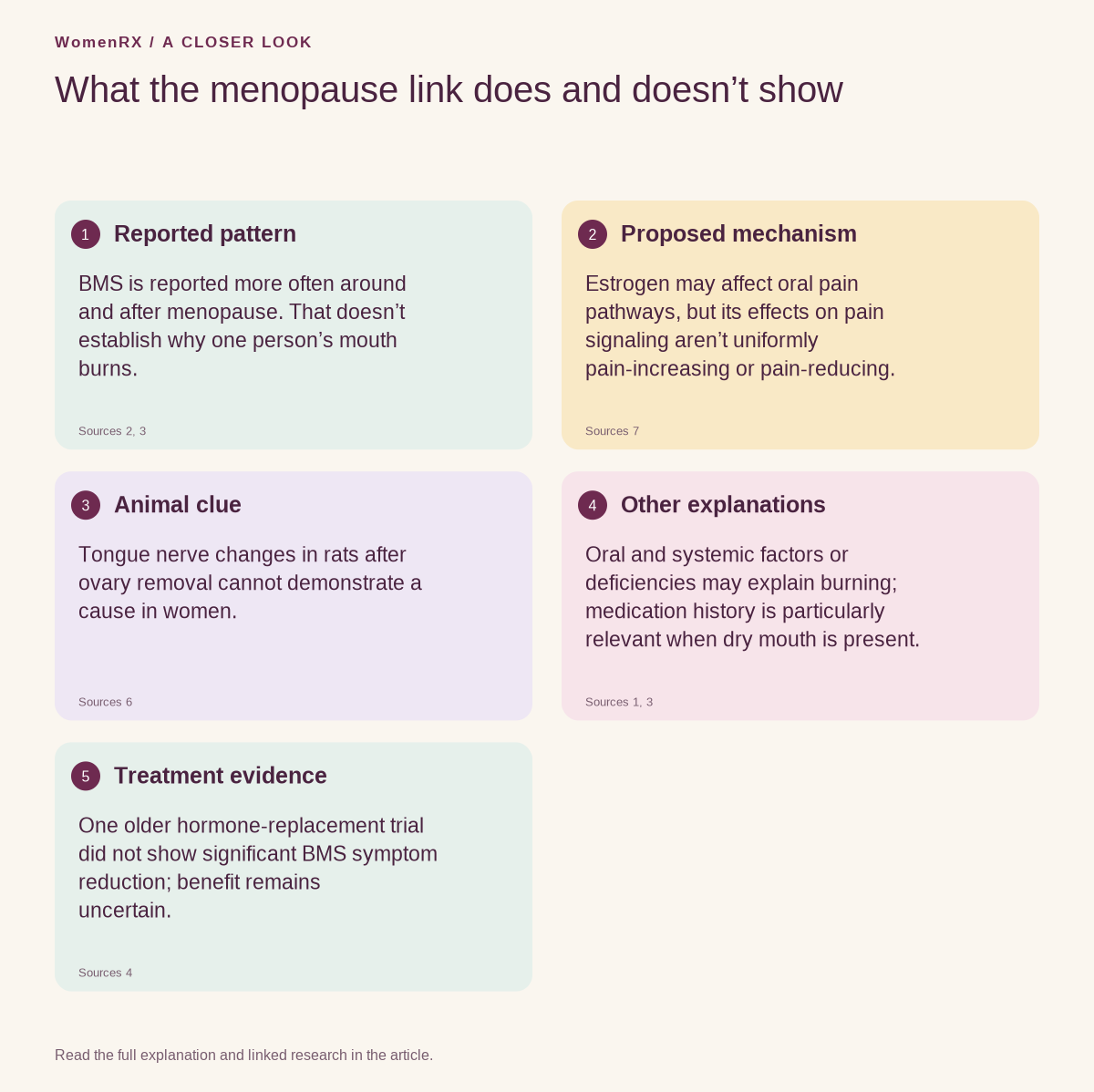
What the menopause link does and doesn’t show
Reported pattern: BMS is reported more often around and after menopause. That doesn’t establish why one person’s mouth burns.23
Proposed mechanism: Estrogen may affect oral pain pathways, but its effects on pain signaling aren’t uniformly pain-increasing or pain-reducing.7
Animal clue: Tongue nerve changes in rats after ovary removal cannot demonstrate a cause in women.6
Other explanations: Oral and systemic factors or deficiencies may explain burning; medication history is particularly relevant when dry mouth is present.13
Treatment evidence: One older hormone-replacement trial did not show significant BMS symptom reduction; benefit remains uncertain.4
Read the figure as text
The evidence is strongest for a reported pattern, while the cause of an individual woman’s burning still needs assessment.- Reported pattern: BMS is reported more often around and after menopause. That doesn’t establish why one person’s mouth burns.23
- Proposed mechanism: Estrogen may affect oral pain pathways, but its effects on pain signaling aren’t uniformly pain-increasing or pain-reducing.7
- Animal clue: Tongue nerve changes in rats after ovary removal cannot demonstrate a cause in women.6
- Other explanations: Oral and systemic factors or deficiencies may explain burning; medication history is particularly relevant when dry mouth is present.13
- Treatment evidence: One older hormone-replacement trial did not show significant BMS symptom reduction; benefit remains uncertain.4
More questions, answered
Does a dry mouth mean I have burning mouth syndrome?
No. A dry-mouth feeling can accompany BMS, but dryness also occurs in other circumstances. In a study of perimenopausal women, it was associated with factors including medication use. BMS is considered when persistent burning remains unexplained after appropriate assessment. 1 3
Sources you can check
- Factors associated with xerostomia in perimenopausal women.Shinohara C, Ito K, Takamatsu K, Ogawa M, Kajii Y, Nohno K, Sugano A, Funayama S, Katakura A, Nomura T, Inoue M. · The journal of obstetrics and gynaecology research · 2021Return to first citation
- An updated review on pathophysiology and management of burning mouth syndrome with endocrinological, psychological and neuropathic perspectives.Imamura Y, Shinozaki T, Okada-Ogawa A, Noma N, Shinoda M, Iwata K, Wada A, Abe O, Wang K, Svensson P. · Journal of oral rehabilitation · 2019Return to first citation
- Burning mouth syndrome: a review and update.Sun A, Wu KM, Wang YP, Lin HP, Chen HM, Chiang CP. · Journal of oral pathology & medicine : official publication of the International Association of Oral Pathologists and the American Academy of Oral Pathology · 2013Return to first citation
- Interventions for the treatment of burning mouth syndrome.Zakrzewska JM, Forssell H, Glenny AM. · The Cochrane database of systematic reviews · 2005Return to first citation
- The 2022 hormone therapy position statement of The North American Menopause Society.“The 2022 Hormone Therapy Position Statement of The North American Menopause Society” Advisory Panel. · Menopause (New York, N.Y.) · 2022Return to first citation
- Effects of ovariectomy of rat on tongue neuropathy: Relevance to burning mouth syndrome.Kobayashi M, Okada-Ogawa A, Imamura Y, Shinozuka H, Noma N, Iwata K, Shinoda M. · Journal of dental sciences · 2026Return to first citation
- Estrogen-dependent regulation of transient receptor potential vanilloid 1 (TRPV1) and P2X purinoceptor 3 (P2X3): Implication in burning mouth syndrome.Seol SH, Chung G. · Journal of dental sciences · 2022Return to first citation