New Acne Around Menopause: What to Check First
A midlife breakout may be influenced by hormones, but the spots themselves and their severity offer a better guide to your next step.
Acne can continue from earlier years or first appear in adulthood, including after menopause. Hormonal changes may contribute, but the timing of a breakout can’t establish its cause or predict how long it will last. Look for a pattern that fits acne, such as blackheads or whiteheads alongside inflamed spots. Deep, painful lesions, an unclear pattern, or acne that’s affecting your wellbeing deserve an assessment. 312
First, look at the spots
A new breakout on your chin during perimenopause might feel unmistakably hormonal. Before settling on that explanation, look at what’s actually happening on your skin. Acne can include blackheads or whiteheads, inflamed bumps, pus-filled spots, and sometimes deeper nodules or cysts. Adult women can have a mix of these lesions. Blackheads aren’t trapped dirt, so scrubbing harder won’t clean them out. 13
That mix gives you a useful starting point, not an at-home diagnosis. If what you’re calling acne is mainly a patch of redness or irritation, or the bumps don’t seem to fit the spot types above, ask for an assessment rather than assuming a menopause-related breakout. The distinction matters because choosing an acne treatment before you know what you’re treating may not address the problem.
Pay particular attention to deep, painful lumps. Cysts are a severe form of acne and carry a greater risk of permanent scarring. Severe acne, acne on the chest or back, or spots that are making you feel very low or anxious are reasons to seek clinical advice. So is acne that hasn’t improved with pharmacy treatment. 12
What menopause timing can and can’t tell you
Adult acne may persist from adolescence or begin later, including after menopause. During the menopausal transition, estrogen declines and androgens can become relatively more prominent. Androgens influence oil-producing glands, while blocked follicles and inflammation also contribute to acne. That makes hormonal change a plausible part of the story, not proof of the cause of any one breakout. 3
Nor does acne mean your androgen levels must be high. A review of adult female acne reports that most affected women have normal serum androgen levels; sensitivity within the skin may also matter. If you’re still having periods, a pattern of flares around them is worth mentioning when discussing treatment, but it doesn’t turn the spots into a hormone test. 32
There isn’t a useful countdown to start from the day a breakout appears or from your final period. Menopause timing alone can’t predict how long your acne will last. Treatment offers a more useful timeframe to discuss: it can take several months for acne symptoms to improve. 32
Match the next step to your skin
If you have a few spots and the pattern looks like acne, start gently. Wash with a mild cleanser and lukewarm water, no more than twice a day. More washing can irritate skin, and squeezing spots or trying to dig out blackheads can make acne worse and cause scarring. If dryness is a problem, a fragrance-free, water-based moisturizer may help. 1
For mild acne, a pharmacist can help you consider an over-the-counter treatment such as benzoyl peroxide. If it isn’t helping, or the acne is moderate or severe, an assessment can help you choose a different approach. Ask what the proposed treatment is meant to address, how irritation would be handled, and when you should expect to reassess whether it’s helping. 12
Prescription options include topical retinoids, which help prevent dead skin cells from building up in follicles. They can cause irritation or stinging and aren’t suitable during pregnancy because of a risk of birth defects. If pregnancy is possible for you, bring that up before choosing a treatment. Azelaic acid is another option described in acne guidance when benzoyl peroxide or topical retinoids are particularly irritating or painful. 2
Hormonal treatments can help some women with acne, especially when spots flare around periods, but that doesn’t make them the automatic choice for a new midlife breakout. Whether you’re still cycling or are postmenopausal changes the treatment conversation. Start with the spot pattern, the risk of scarring, how your skin tolerates treatment, and your circumstances rather than menopause timing alone. 23
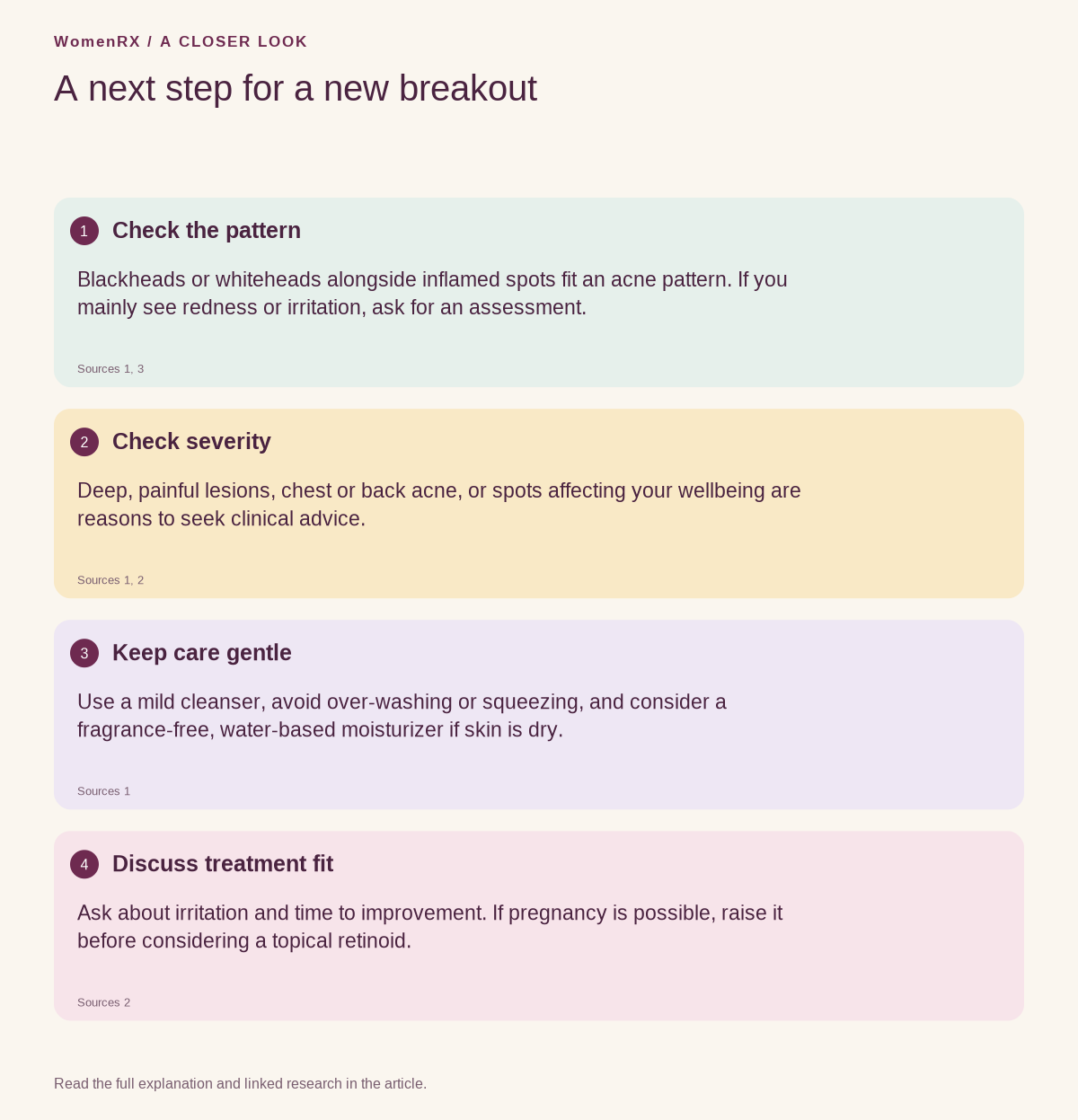
A next step for a new breakout
Check the pattern: Blackheads or whiteheads alongside inflamed spots fit an acne pattern. If you mainly see redness or irritation, ask for an assessment.13
Check severity: Deep, painful lesions, chest or back acne, or spots affecting your wellbeing are reasons to seek clinical advice.12
Keep care gentle: Use a mild cleanser, avoid over-washing or squeezing, and consider a fragrance-free, water-based moisturizer if skin is dry.1
Discuss treatment fit: Ask about irritation and time to improvement. If pregnancy is possible, raise it before considering a topical retinoid.2
Read the figure as text
Move from what the spots look like to how much help they need, then consider which treatments fit your skin and circumstances.- Check the pattern: Blackheads or whiteheads alongside inflamed spots fit an acne pattern. If you mainly see redness or irritation, ask for an assessment.13
- Check severity: Deep, painful lesions, chest or back acne, or spots affecting your wellbeing are reasons to seek clinical advice.12
- Keep care gentle: Use a mild cleanser, avoid over-washing or squeezing, and consider a fragrance-free, water-based moisturizer if skin is dry.1
- Discuss treatment fit: Ask about irritation and time to improvement. If pregnancy is possible, raise it before considering a topical retinoid.2
Sources you can check
- Acne - NHSAccessed 2026-09-25Return to first citation
- Acne - Treatment - NHSAccessed 2026-09-25Return to first citation
- Unveiling the Nuances of Adult Female Acne: A Comprehensive Exploration of Epidemiology, Treatment Modalities, Dermocosmetics, and the Menopausal Influence.Dias da Rocha MA, Saint Aroman M, Mengeaud V, Carballido F, Doat G, Coutinho A, Bagatin E. · International journal of women's health · 2024Return to first citation