Retinol and Topical Retinoids for Acne and Photoaging
A retinol product and an acne retinoid may share a family name, but the better choice depends on what you’re treating and how your skin tolerates it.
If you’re comparing a retinol product with a prescribed acne retinoid, start with your goal. Tretinoin and adapalene are established acne treatments; retinol has evidence for fine wrinkles, but that doesn’t establish it as an interchangeable breakout treatment. Tazarotene is described as high-potency and more irritating, while percentages across different ingredients don’t provide a reliable strength ranking. 2 3 7
Start with the problem you want to treat
Retinoid is a family name, not a promise that every product works the same way. If your main concern is clogged pores and breakouts, tretinoin and adapalene are established topical acne treatments. They help keep dead skin cells from building up inside hair follicles, where that buildup contributes to blocked pores. Retinol’s photoaging evidence does not show how it compares with these medicines for acne. 2 3
A retinol product and a prescribed acne treatment aren’t interchangeable simply because both are retinoids. UK NHS guidance lists tretinoin and adapalene among prescription acne treatments, but that UK classification does not establish the access status of either ingredient in the US. 2
If your concern is visible sun damage, the comparison changes. A 2025 review combining 23 randomized trials with 3,905 participants found evidence that retinol and tretinoin improved fine wrinkles; it also found a benefit for tazarotene on coarse wrinkles. Those are findings for particular outcomes, not proof that one ingredient is the best choice for every face or that every product containing it performs alike. The review noted limited racial diversity, possible commercial bias, and variation in how skin changes were assessed. 3
Adapalene belongs in the acne conversation first. In the photoaging review, its direct comparison with placebo for fine wrinkles did not reach statistical significance. That doesn’t erase its established use for acne; it shows why findings for one goal shouldn’t be borrowed to promise results for another. 2 3
What “strength” can and can’t tell you here
Retinol and tretinoin are classified as natural retinoids; adapalene and tazarotene are synthetic retinoid analogues. A review describes tazarotene as high-potency, with greater irritation risk, and notes that formulation can affect tolerability. 7
A percentage gives the concentration of one ingredient, not a reliable strength comparison with another. Nor does prescription status, by itself, tell you how an ingredient will perform for acne or wrinkles. For acne, look to acne-treatment evidence; for visible sun damage, look to photoaging evidence. Then weigh irritation and formulation. 2 3 7
For example, if a few spots are the issue, benzoyl peroxide is another topical acne option described in treatment guidance. If acne is moderate or severe, or an initial treatment isn’t working, the next choice may involve an acne medicine rather than a more ambitious retinol label. 2
Irritation is part of the comparison
Topical retinoids can sting or irritate skin. A photoaging review’s comparison of adverse events found an intermediate risk for retinol, a relatively favorable profile for tretinoin, and the greatest risk for tazarotene. These study-level findings cannot predict your reaction to a particular product. An acne review also describes greater irritation risk with tazarotene. 2 3 7
The NHS guidance lists mild irritation and stinging as common effects of topical retinoids, but it does not provide a comparable irritation ranking for adapalene against retinol, tretinoin, and tazarotene. 2
A mild cleanser and a fragrance-free moisturizer are more useful companions to an irritating acne treatment than repeated scrubbing. Acne guidance warns that frequent washing can worsen irritation; a review of supportive skincare found that moisturizers and related products may improve tolerability when used alongside topical retinoids. Guidance also advises avoiding excessive sun and UV exposure while using topical retinoids. 1 2 5
Pregnancy: keep topical and oral retinoids separate
The precaution for topical retinoids is to avoid them during pregnancy. That advice does not mean an accidental topical exposure has been shown to cause a birth defect. A 2026 systematic review found no statistically significant increase in major congenital malformations or spontaneous abortion after first-trimester topical-retinoid exposure, but its result was driven mainly by one large registry study. A Nordic cohort likewise found no increased malformation risk among infants exposed in the first trimester; because it included pregnancies resulting in birth, it could miss some outcomes. These findings offer context for an exposure that has already happened, not a reason to start or continue a topical retinoid during pregnancy. 2 4 6
The pregnancy studies do not establish the safety of every individual ingredient or retail retinol formula. They also must not be applied to oral isotretinoin: oral and topical use are different exposures, and oral isotretinoin has established serious pregnancy risks. If you’re pregnant, planning a pregnancy, or have used a topical retinoid before realizing you were pregnant, identify the exact product when discussing what to use next with your care team. 4 6
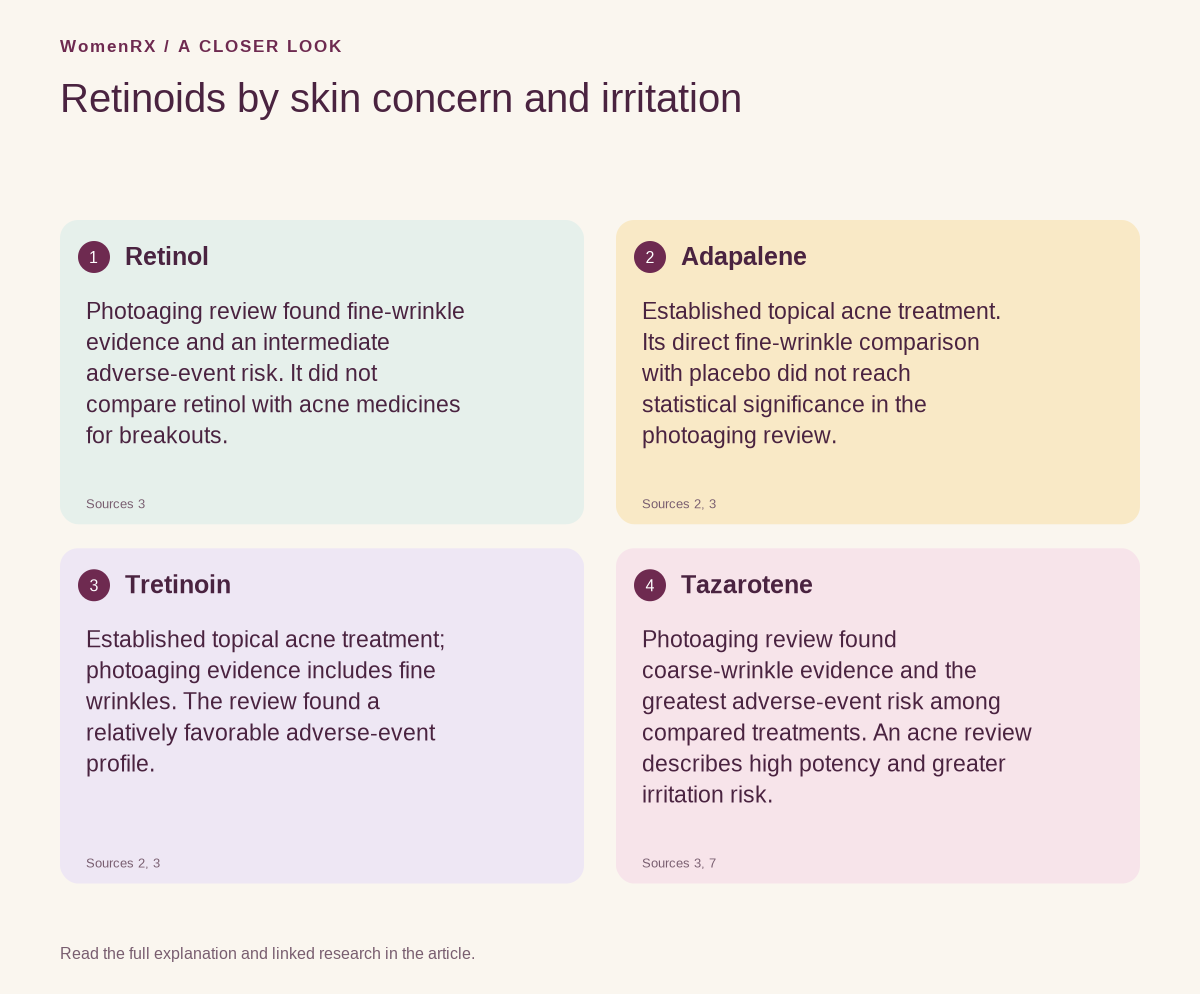
Retinoids by skin concern and irritation
Retinol: Photoaging review found fine-wrinkle evidence and an intermediate adverse-event risk. It did not compare retinol with acne medicines for breakouts.3
Adapalene: Established topical acne treatment. Its direct fine-wrinkle comparison with placebo did not reach statistical significance in the photoaging review.23
Tretinoin: Established topical acne treatment; photoaging evidence includes fine wrinkles. The review found a relatively favorable adverse-event profile.23
Tazarotene: Photoaging review found coarse-wrinkle evidence and the greatest adverse-event risk among compared treatments. An acne review describes high potency and greater irritation risk.37
Read the figure as text
Compare each ingredient by the outcome studied or treated and by reported irritation. A percentage on one ingredient isn’t a strength score for another.- Retinol: Photoaging review found fine-wrinkle evidence and an intermediate adverse-event risk. It did not compare retinol with acne medicines for breakouts.3
- Adapalene: Established topical acne treatment. Its direct fine-wrinkle comparison with placebo did not reach statistical significance in the photoaging review.23
- Tretinoin: Established topical acne treatment; photoaging evidence includes fine wrinkles. The review found a relatively favorable adverse-event profile.23
- Tazarotene: Photoaging review found coarse-wrinkle evidence and the greatest adverse-event risk among compared treatments. An acne review describes high potency and greater irritation risk.37
Sources you can check
- Acne - NHSAccessed 2026-09-25Return to first citation
- Acne - Treatment - NHSAccessed 2026-09-25Return to first citation
- Comparative efficacy of topical interventions for facial photoaging: a network meta-analysis.Lin L, Chen X, Liu C, Wang Q, Lian W, Xu X, Guo Y, Zhong H, Zhong J, Zhao N, Cheng W, Shu P, Xu Z. · Scientific reports · 2025Return to first citation
- Topical retinoids and risk of major congenital malformations and spontaneous abortion: a systematic review and meta-analysis.Alali AB, Alhammad FA, Almohammed Saleh JA, Alshaikh SB, Alshayeb ZK, Al Nujaidi AJ, Albinsaleh AA, Almutawah MR, Alhodibi MH, Albesher MA. · Frontiers in drug safety and regulation · 2026Return to first citation
- Integrating Dermocosmetics Into Acne Care in Latin America.Troielli P, Moreno J, Cortes A, Cardenas P, Kerob D, Gamarra A, Dreno B. · Journal of cosmetic dermatology · 2026Return to first citation
- Topical retinoid use in women of reproductive age and risk of major congenital malformations in exposed pregnancies: a Nordic cohort study.Refsum E, Furu K, Cesta CE, Nørgaard M, Wittström F, Zoega H, Ulrichsen SP, Cohen JM. · The British journal of dermatology · 2026Return to first citation
- Topical Retinoids in Acne Vulgaris and Acne Scars-From Monotherapy to Combining Regimens.Tobiasz A, Jankowska-Konsur A, Nowicka D. · Pharmaceuticals (Basel, Switzerland) · 2026Return to first citation