Topical Tretinoin: Acne Benefits and Pregnancy Questions
Tretinoin can help treat acne, while pregnancy and breastfeeding call for a separate, individualized safety conversation.
Topical tretinoin is used for acne because it helps keep dead skin cells from building up in hair follicles. It can irritate skin and increase sun sensitivity, so use the product as prescribed and follow its skin-care precautions. If you’re planning pregnancy, pregnant, or breastfeeding, ask your prescriber about your specific treatment: human safety evidence for topical use in pregnancy is limited. 2 4 5
What tretinoin can do for acne
Tretinoin is a topical retinoid used to treat acne. Topical retinoids help prevent dead skin cells from building up inside hair follicles, where blockages can contribute to breakouts. Improvement can take time, and the treatment may cause irritation. 4
Hormonal changes during the menstrual cycle or pregnancy can contribute to acne episodes. That explains why breakouts may change at different life stages, but it doesn’t tell us whether tretinoin works differently for women. The treatment guidance describes topical retinoids as acne treatments but does not report sex-stratified outcome estimates, so it can’t establish whether their efficacy differs by sex. 3 4
Keep the routine simple and follow your product’s directions
Topical retinoids are usually applied once a day before bed to the areas of the face affected by acne. The acne-treatment guidance says to apply them 20 minutes after washing. Follow the directions for your own prescription, since products can differ. For the topical cream described in its product instructions, that means gently cleansing the skin, letting it dry for 20 to 30 minutes before application, and keeping the cream away from the eyes, mouth, nose creases, and other mucous membranes. Those details may vary by product, so don’t assume another person’s routine is right for yours. 2 4
Redness and peeling can occur, and topical retinoids may cause irritation or stinging. If irritation becomes troublesome, the cream instructions allow for using it less often or temporarily stopping, depending on the reaction. Ask your prescriber how to handle irritation with your particular prescription. Use extra care if you have eczema, since tretinoin can cause severe irritation on eczematous skin. 2 4
Treated skin may be more vulnerable to sunlight. Minimize sun and tanning-lamp exposure; when you can’t avoid being outdoors, the cream instructions recommend sunscreen and protective clothing over treated areas. Don’t apply it to sunburned skin until it has fully recovered. 2
Pregnancy changes the decision
Topical tretinoin’s pregnancy safety has not been established in human studies. A review reports relatively low systemic exposure from topical retinoids, but the amount of exposure that could affect fetal development is unknown. Reports of topical tretinoin exposure during pregnancy have not established whether the medicine affected fetal development. That uncertainty is a reason to discuss use with your prescriber, not proof that exposure caused harm. 2 5
If you’re planning pregnancy, pregnant, or think you may be pregnant, ask your prescriber before starting or continuing tretinoin. If you used it before realizing you were pregnant, share the product and timing with your prescriber; the available evidence does not support assuming that harm occurred. The topical cream instructions specifically advise speaking with a physician if you’re pregnant, might be pregnant, or are nursing. 2 5
One distinction can prevent unnecessary confusion: tretinoin capsules are used for a blood cancer and carry a serious embryo-fetal toxicity warning. That oral treatment is not the same product or use as topical acne cream, and its warning does not quantify the risks of topical exposure. 1 2
Breastfeeding is a separate question
Pregnancy advice doesn’t automatically settle whether topical tretinoin is appropriate while breastfeeding. The cream instructions advise speaking with a physician before use while nursing, and a review of topical acne medicines notes that relevant lactation studies are lacking. Ask your prescriber to weigh your treatment needs against this evidence gap rather than assuming the answer is identical to the pregnancy recommendation. 2 6
The useful decision is specific to your situation: how much acne is affecting you, how your skin is tolerating treatment, and whether you’re planning pregnancy, pregnant, or breastfeeding. Those details can shape a treatment plan without implying that tretinoin has a unique benefit for women.
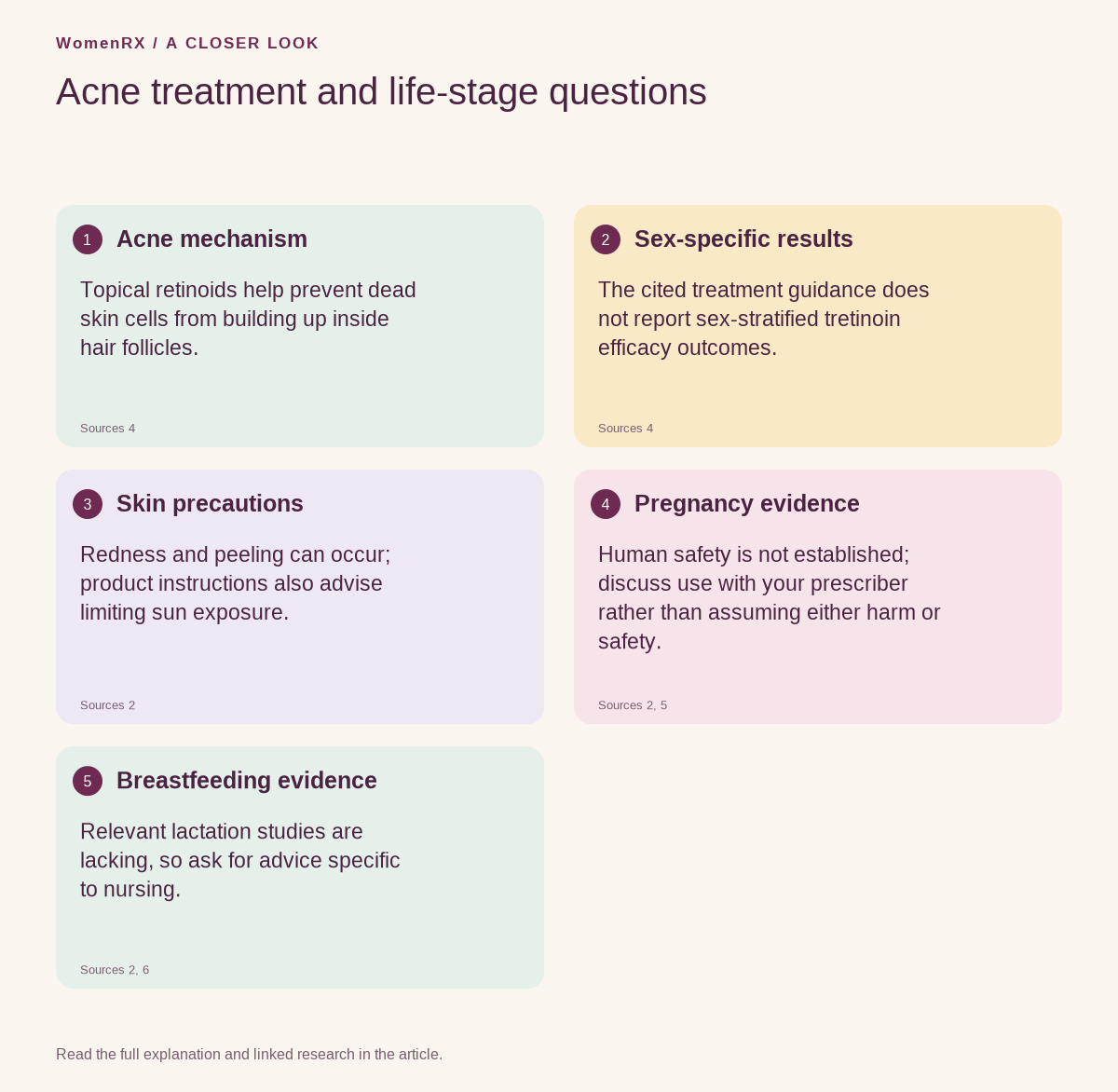
Acne treatment and life-stage questions
Acne mechanism: Topical retinoids help prevent dead skin cells from building up inside hair follicles.4
Sex-specific results: The cited treatment guidance does not report sex-stratified tretinoin efficacy outcomes.4
Skin precautions: Redness and peeling can occur; product instructions also advise limiting sun exposure.2
Pregnancy evidence: Human safety is not established; discuss use with your prescriber rather than assuming either harm or safety.25
Breastfeeding evidence: Relevant lactation studies are lacking, so ask for advice specific to nursing.26
Read the figure as text
These are related but separate parts of a tretinoin decision: what the topical treatment does, what to expect on skin, and where reproductive-safety evidence is limited.- Acne mechanism: Topical retinoids help prevent dead skin cells from building up inside hair follicles.4
- Sex-specific results: The cited treatment guidance does not report sex-stratified tretinoin efficacy outcomes.4
- Skin precautions: Redness and peeling can occur; product instructions also advise limiting sun exposure.2
- Pregnancy evidence: Human safety is not established; discuss use with your prescriber rather than assuming either harm or safety.25
- Breastfeeding evidence: Relevant lactation studies are lacking, so ask for advice specific to nursing.26
More questions, answered
Does topical tretinoin exposure mean a pregnancy has been harmed?
No conclusion like that is supported by the available evidence. Human safety has not been established, and reports of topical tretinoin exposure have not shown whether fetal development was affected. Tell your prescriber what product you used and when so you can discuss your situation. 2 5
Can I use tretinoin while breastfeeding?
The topical cream instructions advise speaking with a physician before use while nursing, and a review notes that relevant lactation studies are lacking. Ask for advice specific to breastfeeding rather than assuming pregnancy guidance answers the question. 2 6
Sources you can check
- TRETINOIN CAPSULE [PAR HEALTH USA, LLC] | US prescribing information and patient instructionsAccessed 2026-09-25Return to first citation
- TRETINOIN CREAM [REDPHARM DRUG] | US prescribing information and patient instructionsAccessed 2026-09-25Return to first citation
- Acne - NHSAccessed 2026-09-25Return to first citation
- Acne - Treatment - NHSAccessed 2026-09-25Return to first citation
- Use of Topical Tazarotene for the Treatment of Acne Vulgaris in Pregnancy: A Literature Review.Han G, Wu JJ, Del Rosso JQ. · The Journal of clinical and aesthetic dermatology · 2020Return to first citation
- Topical acne drugs: review of clinical properties, systemic exposure, and safety.Akhavan A, Bershad S. · American journal of clinical dermatology · 2003Return to first citation