Prescription Tretinoin Cream: Uses, Benefits, and Risks
Tretinoin cream has an established role in acne care, but its familiar skin-renewal language shouldn’t be mistaken for proof of every anti-aging claim.
Prescription tretinoin cream is labeled to treat acne vulgaris. Topical retinoids help prevent dead skin cells from building up in hair follicles, one contributor to blocked pores. Redness and peeling are possible local reactions, and treated skin may be more susceptible to sunlight. The acne indication is established; the product labeling does not establish long-term safety or effectiveness for other skin conditions. 1 2 4
The clearest use: acne
Tretinoin cream is a prescription topical retinoid labeled in the US for acne vulgaris. It is intended for acne-affected areas, rather than as a spot treatment for an unrelated mark or skin growth. The cream is the medication’s vehicle, or formulation; the word “cream” alone doesn’t tell you that it will be gentler or more effective than another formulation. 1 2
Acne can involve dead skin cells collecting inside hair follicles and contributing to blocked pores. Topical retinoids, including tretinoin, help prevent that buildup. This addresses one part of acne, not every factor involved in the condition. Scrubbing harder won’t clear a follicle blockage, and frequent washing or rough scrubbing may irritate skin. 3 4
A useful expectation to discuss is that acne treatment may take time. General acne guidance says many treatments take two to three months to start working; that’s a broad estimate, not a promise about how quickly tretinoin will work for you. 4
What the trade-off can look like
Redness and peeling are possible reactions reported for tretinoin cream. In some sensitive people, reactions can be more severe, including excessive redness, swelling, blistering, or crusting. These are possible effects, not a sign that you need to push through worsening irritation. Product labeling says the treatment may need to be used less often, paused, or stopped if irritation warrants it. 1 2
The label also advises caution with other topical medicines and with abrasive or strongly drying soaps, cleansers, and cosmetics. It calls for particular caution with products containing sulfur, resorcinol, or salicylic acid. If you already use acne or exfoliating products, include them in the prescribing conversation so the full routine can be considered. 1 2
Keep tretinoin away from the eyes, mouth, and mucous membranes. Tretinoin has also been reported to make some people more susceptible to sunlight. Product labeling advises minimizing sun exposure and using sunscreen and protective clothing when exposure can’t be avoided. It advises waiting until sunburn has fully recovered before using the cream, and notes that wind or cold may also irritate treated skin. 1 2
Photoaging claims need a separate conversation
Tretinoin is discussed in connection with skin aging, but a biological rationale or a marketing phrase such as “active renewal” is not proof that an acne cream improves every sign of photoaging. The prescribing information establishes acne as the indication and says long-term safety and effectiveness for other disorders have not been established. If your main goal is wrinkles, uneven tone, or another aging concern, ask whether the specific cream is intended for that use and what outcome is realistic. 1 2
If pregnancy is possible or planned
Bring up pregnancy or plans to become pregnant before starting tretinoin. Product information reports fetal toxicity in rabbits exposed to topical tretinoin at a dose associated with higher systemic exposure than the maximum human exposure adjusted for body surface area. That animal finding does not tell us the risk from topical use in a human pregnancy. Ask the prescriber whether tretinoin is appropriate for your situation and what alternatives might fit. 2
This is a relevant prescribing consideration, not evidence that tretinoin has different skin effects in women generally.
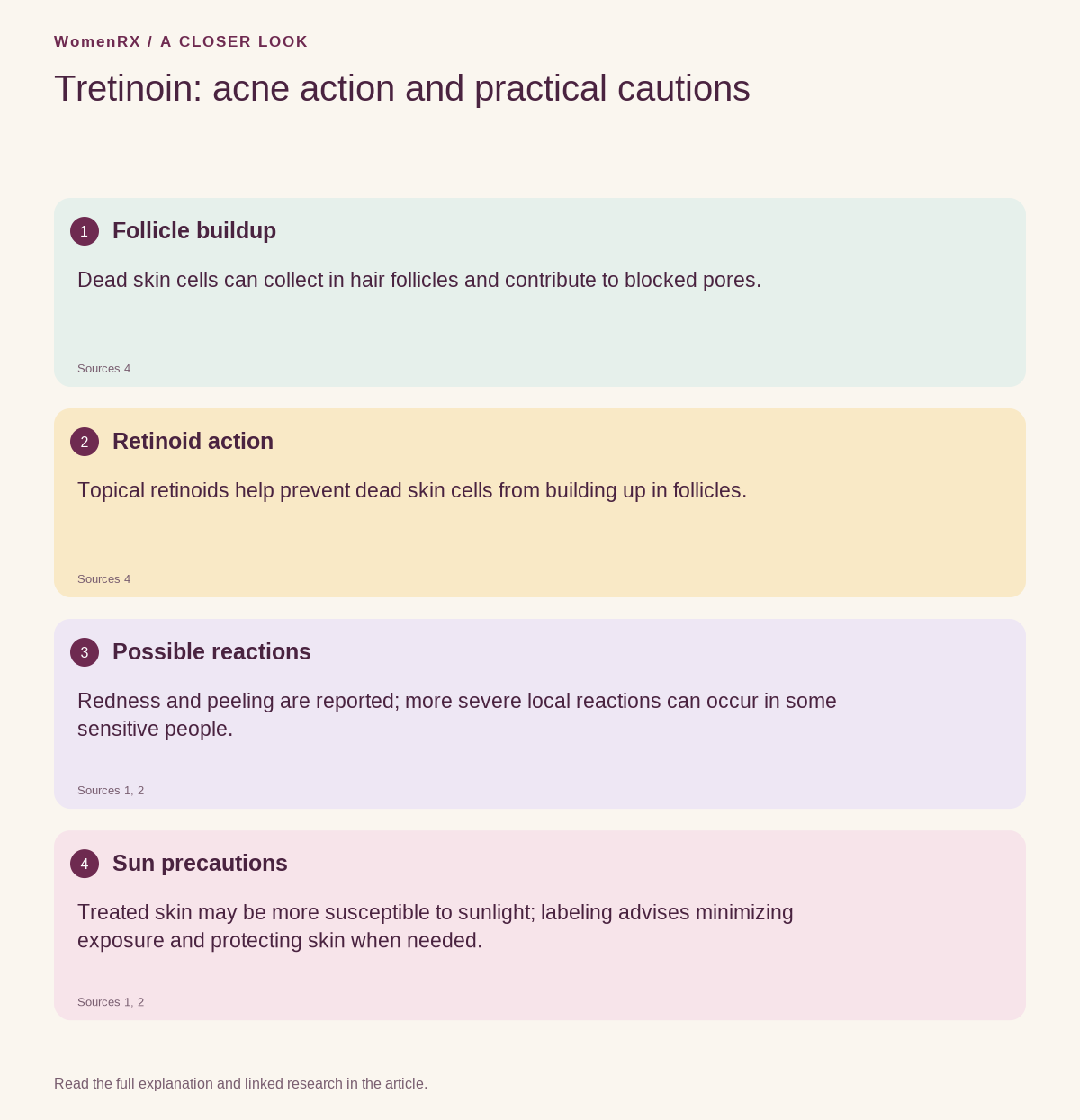
Tretinoin: acne action and practical cautions
Follicle buildup: Dead skin cells can collect in hair follicles and contribute to blocked pores.4
Retinoid action: Topical retinoids help prevent dead skin cells from building up in follicles.4
Possible reactions: Redness and peeling are reported; more severe local reactions can occur in some sensitive people.12
Sun precautions: Treated skin may be more susceptible to sunlight; labeling advises minimizing exposure and protecting skin when needed.12
Read the figure as text
This diagram separates tretinoin’s follicle-related acne action from reported local reactions and product-label sun precautions.- Follicle buildup: Dead skin cells can collect in hair follicles and contribute to blocked pores.4
- Retinoid action: Topical retinoids help prevent dead skin cells from building up in follicles.4
- Possible reactions: Redness and peeling are reported; more severe local reactions can occur in some sensitive people.12
- Sun precautions: Treated skin may be more susceptible to sunlight; labeling advises minimizing exposure and protecting skin when needed.12
More questions, answered
Can tretinoin be combined with other acne products?
Some topical medicines and harsh or drying skin products may add to irritation. Product labeling specifically advises caution with sulfur, resorcinol, and salicylic acid products, so share your current routine when discussing a prescription. 1 2
Does peeling show that tretinoin is working?
Peeling is a possible local reaction, but the product information does not present it as a measure of acne improvement. If irritation is significant, the label describes reducing use, pausing, or stopping treatment depending on the reaction. 1 2
Sources you can check
- TRETINOIN CREAM [REDPHARM DRUG] | US prescribing information and patient instructionsAccessed 2026-09-25Return to first citation
- TRETINOIN GEL TRETINOIN CREAM [PADAGIS US LLC] | US prescribing information and patient instructionsAccessed 2026-09-25Return to first citation
- Acne - NHSAccessed 2026-09-25Return to first citation
- Acne - Treatment - NHSAccessed 2026-09-25Return to first citation