How to Check Your Tretinoin Prescription
Topical tretinoin directions depend on the product and why you’re using it, so check the label rather than borrowing someone else’s schedule.
Before applying tretinoin, confirm the product is topical, then match its form, strength, treatment area, and frequency to your own prescription. One US cream label directs once-daily evening use, but that direction belongs to that product, not every tretinoin prescription. If anything on the label is unclear, ask your pharmacist or prescriber before changing how you use it. 2
Start with the product, not the percentage
Tretinoin can come in different forms, and a strength by itself doesn’t tell you how to use your prescription. First check that the container says topical and identifies the form, such as cream or gel. Then compare the strength and directions on the pharmacy label with the instructions you remember receiving. If they don’t match, pause and ask the pharmacist or prescriber which directions to follow.
This distinction matters because tretinoin capsules are a different, oral medicine used for a different condition. Their dosing and safety instructions do not apply to acne cream or gel. 12
Read the directions as a set
Check four details together: which product, where it goes, how often to apply it, and how much to use. A US label for one 0.025% tretinoin cream says to apply it once daily before bed, using enough to lightly cover the acne-affected area. That’s an example of product-specific directions, not a universal dose or schedule. 2
General acne guidance also describes topical retinoids as commonly applied once a day at bedtime and sparingly to affected areas. But your own label and prescriber’s directions take priority; don’t increase the frequency or switch the treatment area based on general advice online. 3
If the container, pharmacy label, and instructions seem inconsistent, ask the pharmacist to check the exact product and prescription. Useful questions include: “Is this the cream or gel my prescriber intended?” and “Should I apply it to the whole acne-affected area or only individual spots?” A pharmacist can help clarify the written directions without guessing at a dose.
Apply only where directed
For the acne cream described on the US label, the intended area is skin where acne lesions appear. The label says to keep it away from the eyes, mouth, corners of the nose, and mucous membranes. It also says to cleanse the area before applying the medication. Follow the specific instructions for your product, especially if you were prescribed tretinoin for a reason other than acne. 2
Don’t assume that a stronger percentage means you should use less often, or that a lower percentage means you should use it more often. Strength, formulation, reason for treatment, and your prescriber’s plan belong together. A review of photoaging trials found that the tretinoin strengths and treatment approaches varied across studies, which also cautions against treating one schedule as a standard for every use. 4
If your skin gets very irritated
Dryness, redness, or peeling can make it hard to follow a topical treatment. The US cream label warns that tretinoin can cause local redness and peeling; it says that when irritation warrants it, use may be made less frequent or temporarily stopped. Ask your prescriber or pharmacist what change is appropriate for your product and reaction rather than increasing, decreasing, or restarting on your own. 2
Contact the prescriber about marked redness, swelling, blistering, or crusting. The label also advises particular caution on skin affected by eczema. 2
Pregnancy or planning a pregnancy
If you’re pregnant, trying to become pregnant, or might be pregnant, raise that with the prescriber before starting or continuing topical tretinoin. The oral tretinoin capsule label contains serious pregnancy warnings, but those directions are for oral treatment and should not be applied directly to a topical prescription. The topical cream label includes animal reproductive findings; the information here doesn’t establish the risk of topical use in human pregnancy. Ask for advice specific to your product and situation. 12
A quick label check
Before the next application, make sure you can answer: Is this the topical product prescribed for me? What area should I treat? How often does my prescription say to apply it? What amount or coverage does its label describe? If any answer is unclear, check with the pharmacist or prescriber instead of filling in the blank with a general online routine.
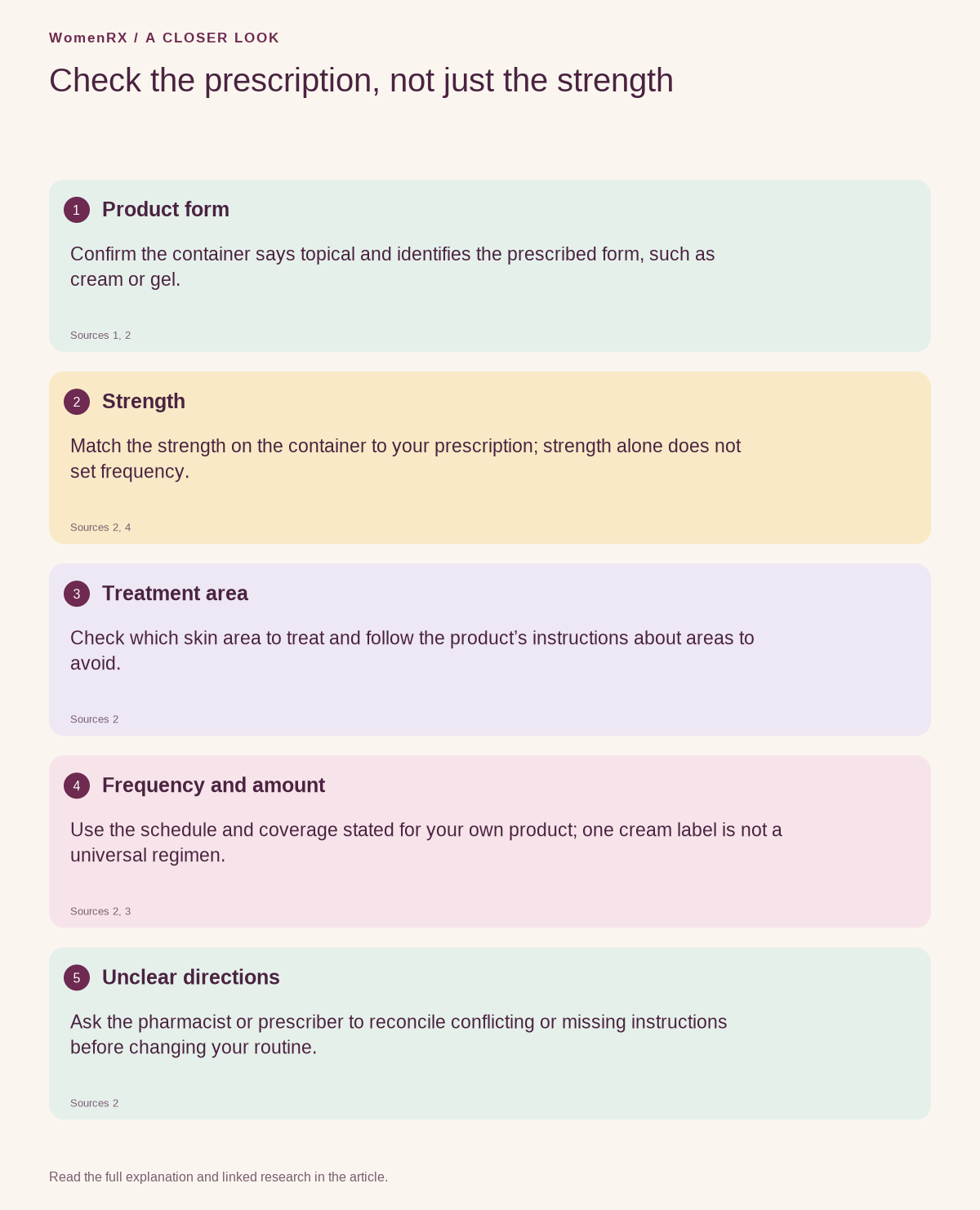
Check the prescription, not just the strength
Product form: Confirm the container says topical and identifies the prescribed form, such as cream or gel.12
Strength: Match the strength on the container to your prescription; strength alone does not set frequency.24
Treatment area: Check which skin area to treat and follow the product’s instructions about areas to avoid.2
Frequency and amount: Use the schedule and coverage stated for your own product; one cream label is not a universal regimen.23
Unclear directions: Ask the pharmacist or prescriber to reconcile conflicting or missing instructions before changing your routine.2
Read the figure as text
Use these label details together; if one is missing or conflicts with your instructions, ask the pharmacist or prescriber to clarify.- Product form: Confirm the container says topical and identifies the prescribed form, such as cream or gel.12
- Strength: Match the strength on the container to your prescription; strength alone does not set frequency.24
- Treatment area: Check which skin area to treat and follow the product’s instructions about areas to avoid.2
- Frequency and amount: Use the schedule and coverage stated for your own product; one cream label is not a universal regimen.23
- Unclear directions: Ask the pharmacist or prescriber to reconcile conflicting or missing instructions before changing your routine.2
More questions, answered
Can I use my friend’s tretinoin directions if the strength is the same?
No. Matching strengths don’t guarantee matching products or instructions. Check your own product and pharmacy label, and ask a pharmacist or prescriber about any uncertainty. 2
Does an oral tretinoin warning tell me what to do with topical tretinoin?
No. Oral capsules and topical skin products are different formulations with different directions. If pregnancy is possible, discuss your topical prescription with its prescriber rather than applying capsule instructions to it. 12
Sources you can check
- TRETINOIN CAPSULE [PAR HEALTH USA, LLC] | US prescribing information and patient instructionsAccessed 2026-09-25Return to first citation
- TRETINOIN CREAM [REDPHARM DRUG] | US prescribing information and patient instructionsAccessed 2026-09-25Return to first citation
- Acne - Treatment - NHSAccessed 2026-09-25Return to first citation
- Topical tretinoin for treating photoaging: A systematic review of randomized controlled trials.Sitohang IBS, Makes WI, Sandora N, Suryanegara J. · International journal of women's dermatology · 2022Return to first citation