Tretinoin Gel or Cream: What Should Guide Your Choice?
The carrier and strength both matter, but the product label alone can’t tell you which version your skin will tolerate better.
Tretinoin gel and cream contain the same active ingredient, but their base ingredients and available strengths can differ by product. Those differences may affect how a formula feels, yet they don’t establish that gel is always harsher or cream always gentler. Compare the exact strength and vehicle you were prescribed, and discuss irritation or pregnancy concerns with your prescriber rather than switching based on skin type alone. 1 2

The difference is in the vehicle, not the active ingredient
Tretinoin is the active medicine in both forms. The vehicle is the base that carries it onto your skin. In one US product label, gel contains alcohol and hydroxypropyl cellulose, while the cream is a hydrophilic mixture that includes water, fatty ingredients, and emulsifiers. Ingredients differ between manufacturers, so check the label for your specific prescription rather than assuming every gel or cream is identical. 2
A gel may feel different from a cream, but ingredients alone can’t predict your individual response. Both forms can cause redness, peeling, or irritation. The gel-and-cream product information says irritation may warrant using the medicine less frequently or pausing or stopping it, with changes guided by the prescriber. Eczematous skin can be especially prone to severe irritation. 2
Strength can change the comparison
“Gel versus cream” isn’t a useful comparison unless you also know the strength. One product label lists gel strengths of 0.01% and 0.025%, and cream strengths of 0.025%, 0.05%, and 0.1%. These are examples from a specific label, not a complete list of every product. A comparison across different strengths could reflect the amount of tretinoin, the vehicle, or both. 2
That’s why a general rule such as “gel is stronger” or “cream is milder” can mislead. The ingredient list and concentration on your own prescription are more useful than the format name by itself.
What clinical comparisons can and can’t tell you
A randomized trial compared adapalene gel with tretinoin cream. The treatments had equivalent acne outcomes over 10 weeks, and adapalene was better tolerated. But because the active retinoid differed as well as the formulation, that study can’t show whether tretinoin gel or tretinoin cream is more tolerable. It also doesn’t establish which tretinoin form works better for you. 4
The reported trial results don’t provide a women-specific or skin-tone-specific comparison of tretinoin gel and cream. There’s no reason to assume that being a woman, having oily skin, or having dry skin by itself determines the right vehicle. Your past response, the exact product and strength, and how irritated your skin becomes are more useful points to bring into the decision.
A practical way to compare your prescription
Before asking to change formulations, check the exact strength and ingredients on your tube or pharmacy label. Then describe what’s happening: for example, whether your main issue is persistent stinging, peeling, a formula that feels uncomfortable, or trouble following the prescribed routine. Those details help distinguish a possible vehicle preference from irritation that may need a change in how often you use the medicine or a different plan. The product labeling specifically says that changes to the vehicle, concentration, or frequency should be monitored for skin response and tolerance. 1
Follow the directions for your own prescription. The cited product labels describe bedtime use, but your prescriber’s instructions for your product should guide you. Avoid layering on irritating or abrasive skin products without checking first: tretinoin labeling cautions about combinations with drying cleansers and cosmetics, alcohol-rich products, and preparations containing sulfur, resorcinol, or salicylic acid. 2
Pregnancy is not a reason to choose one vehicle
If you’re pregnant, planning a pregnancy, or might become pregnant, bring tretinoin use up with your prescriber. A review of topical retinoids reports relatively low systemic exposure but says the exposure level that could affect human pregnancy is unknown; reports involving topical tretinoin do not clearly establish whether fetal development was affected. That uncertainty doesn’t show that gel is safer than cream, so don’t use a formulation change as a workaround. 3
The useful question isn’t simply “Which one is better?” It’s “Which exact product and strength fits my treatment plan and what my skin is doing?”
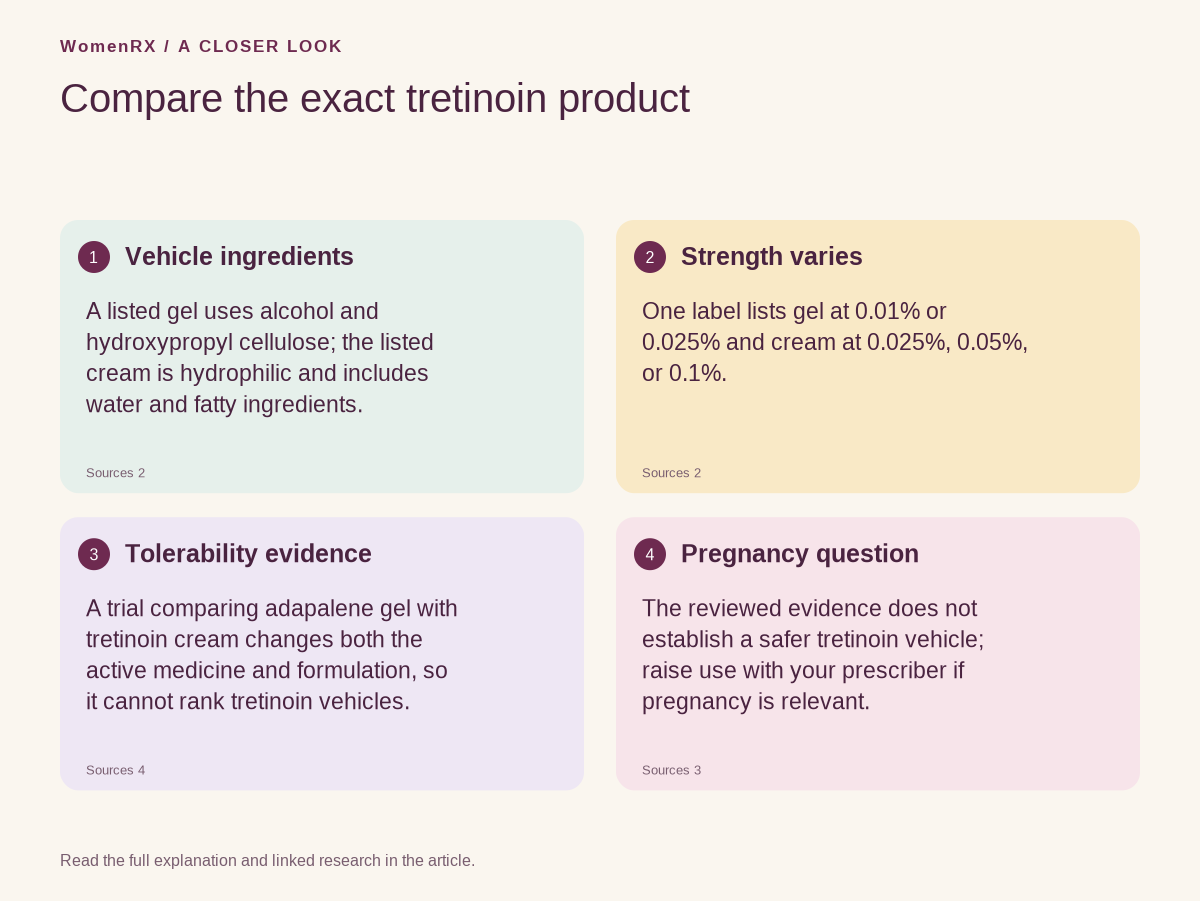
Compare the exact tretinoin product
Vehicle ingredients: A listed gel uses alcohol and hydroxypropyl cellulose; the listed cream is hydrophilic and includes water and fatty ingredients.2
Strength varies: One label lists gel at 0.01% or 0.025% and cream at 0.025%, 0.05%, or 0.1%.2
Tolerability evidence: A trial comparing adapalene gel with tretinoin cream changes both the active medicine and formulation, so it cannot rank tretinoin vehicles.4
Pregnancy question: The reviewed evidence does not establish a safer tretinoin vehicle; raise use with your prescriber if pregnancy is relevant.3
Read the figure as text
The format name is only one part of the decision. Check the vehicle, strength, evidence, and personal context together.- Vehicle ingredients: A listed gel uses alcohol and hydroxypropyl cellulose; the listed cream is hydrophilic and includes water and fatty ingredients.2
- Strength varies: One label lists gel at 0.01% or 0.025% and cream at 0.025%, 0.05%, or 0.1%.2
- Tolerability evidence: A trial comparing adapalene gel with tretinoin cream changes both the active medicine and formulation, so it cannot rank tretinoin vehicles.4
- Pregnancy question: The reviewed evidence does not establish a safer tretinoin vehicle; raise use with your prescriber if pregnancy is relevant.3
More questions, answered
Does oily skin mean I should choose tretinoin gel?
Not by itself. The product ingredients can differ, but the available information doesn’t establish a rule that oily skin responds better to gel or dry skin to cream. Compare the exact product and strength, and factor in how your skin tolerates it. 2
Can I switch from cream to gel if I’m irritated?
A different vehicle is one possible topic to discuss, but irritation can also relate to strength, frequency, or other products used on your skin. Tretinoin labeling says changes to vehicle, concentration, or frequency should be monitored for response and tolerance; don’t assume a switch will automatically solve the problem. 1 2
Sources you can check
- TRETINOIN CREAM [REDPHARM DRUG] | US prescribing information and patient instructionsAccessed 2026-09-25Return to first citation
- TRETINOIN GEL TRETINOIN CREAM [PADAGIS US LLC] | US prescribing information and patient instructionsAccessed 2026-09-25Return to first citation
- Use of Topical Tazarotene for the Treatment of Acne Vulgaris in Pregnancy: A Literature Review.Han G, Wu JJ, Del Rosso JQ. · The Journal of clinical and aesthetic dermatology · 2020Return to first citation
- Randomised, controlled trial of the efficacy and safety of adapalene gel 0.1% and tretinoin cream 0.05% in patients with acne vulgaris.Cunliffe WJ, Danby FW, Dunlap F, Gold MH, Gratton D, Greenspan A. · European journal of dermatology : EJD · 2002Return to first citation