Adult Acne in Women: Treatment and When to Look Deeper
Treat the acne you have, and pay attention to menstrual, hair, or voice changes that might call for a closer look.
Adult acne doesn’t automatically mean you have a hormone disorder. Treatment depends on the kinds of spots you have, whether they’re leaving scars, and what your skin tolerates. Benzoyl peroxide, topical retinoids, and azelaic acid are options. A flare before your period can happen without an underlying condition; irregular periods, new coarse hair growth, or voice changes make a focused evaluation more relevant. 2 3 4 5

A period flare isn’t the whole story
Acne starts when oil and dead skin cells block hair follicles. Hormones can affect oil production, so you might notice more spots before your period or during pregnancy. But acne also runs in families, and it can persist from adolescence or first appear in adulthood. A monthly flare tells you something about your pattern, not whether your androgen levels are high. 2 3 5
That distinction matters when you’re choosing what to do next. Acne alone doesn’t establish that blood androgen levels are elevated, and the clinical features that predict elevated results remain uncertain. Earlier research cited by a study of women with acne found that acne severity scores did not correlate with serum androgen levels. The study itself involved women who had already undergone hormone testing, so its selected group can’t establish who should be tested among all women with acne. 6
Pick a treatment by what it does and what you can tolerate
If you have blackheads, whiteheads, or inflamed spots, a topical treatment may be a reasonable place to start. Benzoyl peroxide helps reduce acne-related bacteria and can improve both clogged pores and inflamed spots. Its tradeoffs are dryness or irritation, plus a bleaching effect on fabric and hair. 1 4
Adapalene and tretinoin are topical retinoids. They help prevent dead skin cells from building up in follicles. Azelaic acid is another option, particularly if benzoyl peroxide or a retinoid feels too irritating. These choices aren’t interchangeable for everyone: the spots you have and how your skin responds both matter. 4
Give a treatment time to show what it can do. Improvement may take several months, so not seeing a quick change doesn’t necessarily mean it has failed. Picking or squeezing spots can increase the chance of scarring. 3 4
If you’re pregnant or planning a pregnancy, make that part of the treatment decision before starting or changing a product. Guidance on benzoyl peroxide says it can usually be used during pregnancy but recommends checking whether it’s suitable for you. That guidance doesn’t answer the pregnancy question for every other acne treatment. 1
For acne that needs more than a topical approach, a clinician can discuss prescription options. A combined oral contraceptive is one option for some women, but contraception preferences and pregnancy plans belong in that conversation. It isn’t the automatic answer to adult acne or to a premenstrual flare. 4
When other changes deserve attention
Acne alone, even acne that first appears in adulthood, doesn’t establish polycystic ovary syndrome (PCOS). In adults, PCOS assessment considers a combination of features, including ovulation patterns and signs of androgen excess, while excluding other possible causes. 7
Tell a clinician if acne comes with irregular or absent periods, new coarse facial or body hair, male-pattern scalp hair loss, or a voice change. Those details can help determine whether an evaluation for androgen excess or another condition makes sense. They don’t identify a cause on their own. 5 7
In the study’s own group of 86 females who had already undergone hormone testing, excess hair growth and acne on the trunk were associated with elevated androgen results. The selected, small group cannot tell us whom to test among all women with acne. 6
It’s also worth mentioning a medicine change if your acne is new or worsening. Steroid medicines and lithium, for example, are among the possible acne triggers listed in clinical guidance. 2
Don’t wait for deeper acne to leave a scar
Painful nodules or cysts, developing scars, or acne that is making you feel very low or anxious are reasons to seek care rather than keep switching products. Deeper lesions carry a greater scarring risk, and treatment can be adjusted to the severity of your acne. 3 4
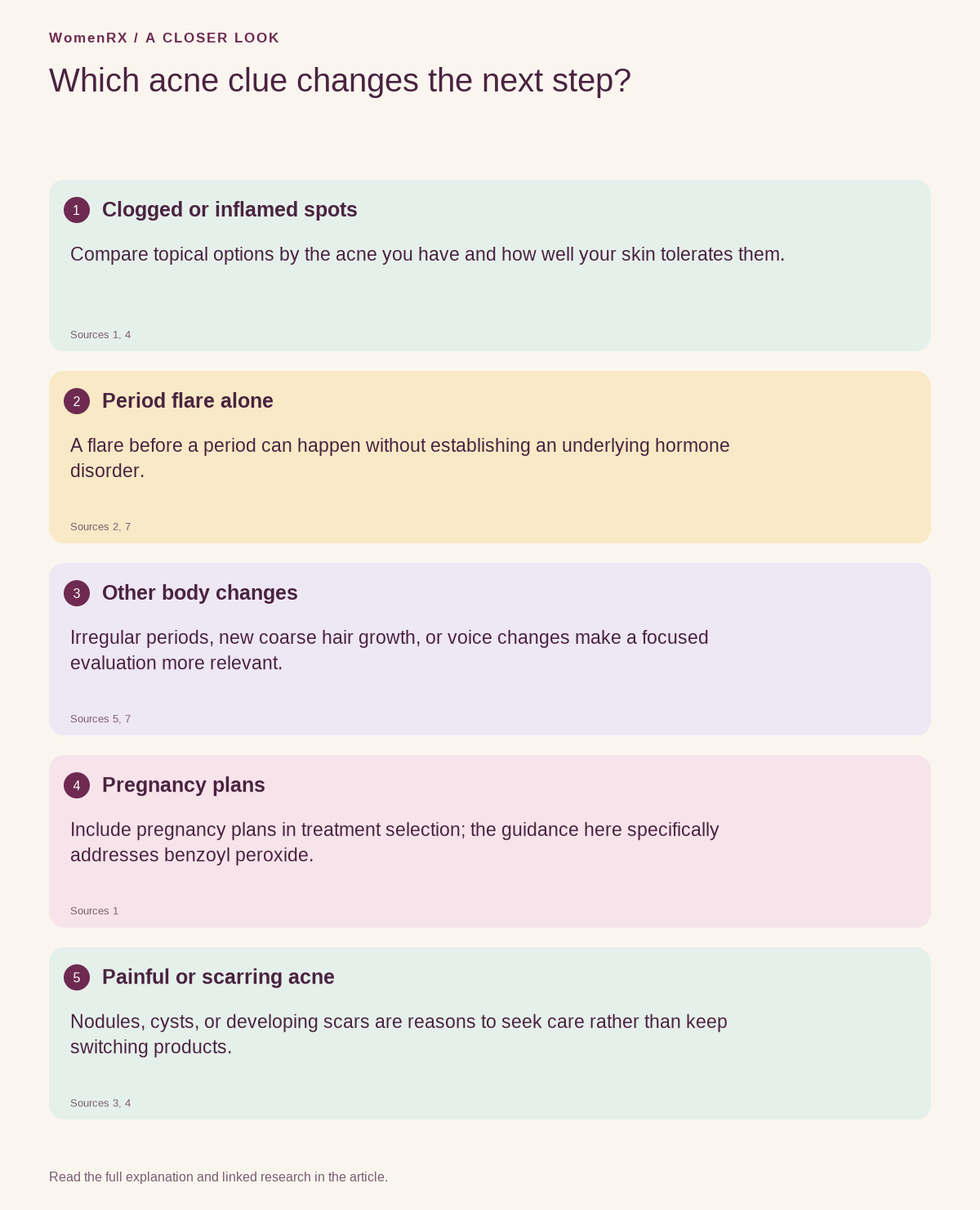
Which acne clue changes the next step?
Clogged or inflamed spots: Compare topical options by the acne you have and how well your skin tolerates them.14
Period flare alone: A flare before a period can happen without establishing an underlying hormone disorder.27
Other body changes: Irregular periods, new coarse hair growth, or voice changes make a focused evaluation more relevant.57
Pregnancy plans: Include pregnancy plans in treatment selection; the guidance here specifically addresses benzoyl peroxide.1
Painful or scarring acne: Nodules, cysts, or developing scars are reasons to seek care rather than keep switching products.34
Read the figure as text
Read each branch as a separate decision point, not a diagnostic test.- Clogged or inflamed spots: Compare topical options by the acne you have and how well your skin tolerates them.14
- Period flare alone: A flare before a period can happen without establishing an underlying hormone disorder.27
- Other body changes: Irregular periods, new coarse hair growth, or voice changes make a focused evaluation more relevant.57
- Pregnancy plans: Include pregnancy plans in treatment selection; the guidance here specifically addresses benzoyl peroxide.1
- Painful or scarring acne: Nodules, cysts, or developing scars are reasons to seek care rather than keep switching products.34
More questions, answered
Does acne before my period mean I have PCOS?
No. Some women have premenstrual acne flares. PCOS assessment considers other features too, particularly ovulation patterns and signs of androgen excess. Mention irregular periods or new coarse facial or body hair if they’re happening alongside the acne. 2 7
Does every woman with adult acne need hormone tests?
Acne alone doesn’t establish that androgen levels are high. Menstrual changes, excess hair growth, and other changes give a clinician more useful context for deciding whether a focused evaluation is warranted. 5 7
Sources you can check
- Benzoyl peroxide: a medicine to treat acne - NHSAccessed 2026-09-25Return to first citation
- Acne - Causes - NHSAccessed 2026-09-25Return to first citation
- Acne - NHSAccessed 2026-09-25Return to first citation
- Acne - Treatment - NHSAccessed 2026-09-25Return to first citation
- Unveiling the Nuances of Adult Female Acne: A Comprehensive Exploration of Epidemiology, Treatment Modalities, Dermocosmetics, and the Menopausal Influence.Dias da Rocha MA, Saint Aroman M, Mengeaud V, Carballido F, Doat G, Coutinho A, Bagatin E. · International journal of women's health · 2024Return to first citation
- The clinical predictors of biochemical hyperandrogenemia and its relation to treatment resistance in women with acne.Altunel CT, Tatlıcan S. · Postepy dermatologii i alergologii · 2025Return to first citation
- Polycystic Ovary Syndrome: Pathophysiology, Presentation, and Treatment With Emphasis on Adolescent Girls.Witchel SF, Oberfield SE, Peña AS. · Journal of the Endocrine Society · 2019Return to first citation