Why Acne Can Appear or Persist in Your 40s
Acne in midlife can reflect several overlapping influences, and a breakout by itself doesn’t prove you have a hormone disorder.
Acne can persist into adulthood or return as hormone levels change, including around menstrual cycles and perimenopause. Hormones can contribute to blocked pores, but age or acne alone can’t identify the cause. Notice whether breakouts track with your cycle, a medicine or contraception change, and whether they’re painful or scarring. Those details can help guide skincare choices and a treatment conversation. 2 3 5
Acne in your 40s can feel unexpected, especially if your skin was clear for years. It doesn’t necessarily mean your skin is dirty, that you’re doing something wrong, or that you have a hormone disorder. Adult acne can persist from earlier years or begin later, and more than one factor may be involved. 2 6
What may be behind a midlife breakout
Acne develops when hair follicles become blocked. Hormones can thicken the lining of a follicle, contributing to that blockage; menstrual-cycle changes and pregnancy can also bring acne flares. Perimenopause adds another possible hormonal shift, but it doesn’t cause acne in everyone, and the timing alone can’t establish why your skin has changed. 2 5
The pattern can offer a useful clue, not a diagnosis. For example, if spots repeatedly worsen around your period, mention that. Hormonal treatment may be considered for some women, particularly when acne flares around periods or occurs alongside a hormonal condition such as polycystic ovary syndrome (PCOS). Acne alone, however, doesn’t establish PCOS. 3
Contraception may also matter: some progestogen-only pills or contraceptive implants can worsen acne for some people. If a breakout began after a contraception change, note the timing and discuss it with the clinician who prescribes it before making a change. 3
Match the next step to the problem
For a few blackheads, whiteheads, or spots, an over-the-counter product containing benzoyl peroxide may be an option. It can help with blocked pores and inflammation, but it can also dry or irritate skin and bleach fabric. Use product directions, and avoid piling on multiple irritating acne treatments without advice. 1 3
Gentle, consistent skin care is more useful than scrubbing. Choose water-based, non-comedogenic skin and sun-care products, remove makeup before bed, and avoid squeezing spots, which can worsen them and lead to scarring. Cleaning more aggressively won’t remove a blockage inside the follicle. 2
If acne is moderate or severe, painful, leaving scars, or not improving with pharmacy products, prescription treatment may be worth discussing. Options can include topical retinoids and, for some women, hormonal treatments. Spironolactone is one option clinicians may consider: a 2025 systematic review and meta-analysis of randomized trials in adult women found higher odds of treatment success than placebo or doxycycline. That result supports it as a treatment option, not as a reason to start it without an individual review. 2 3 4
Pregnancy potential changes the conversation. Topical retinoids such as tretinoin and adapalene aren’t suitable during pregnancy because of potential risk to the developing baby. Tell your clinician if you’re pregnant, trying to become pregnant, or could become pregnant when discussing acne treatment. 3
Make the review specific
A useful starting point is to bring three details: when the acne began, whether it follows your cycle or a contraception change, and whether it is painful or leaving marks. Include any treatment you’ve tried and how your skin responded. This helps distinguish a manageable skin-care adjustment from acne that may need prescription treatment or a broader hormonal discussion. 3
The main distinction is not “hormonal” versus “not hormonal” based on appearance alone. It’s whether the timing, severity, associated health context, and treatment needs point to a next step that fits your life, including pregnancy plans and contraception.
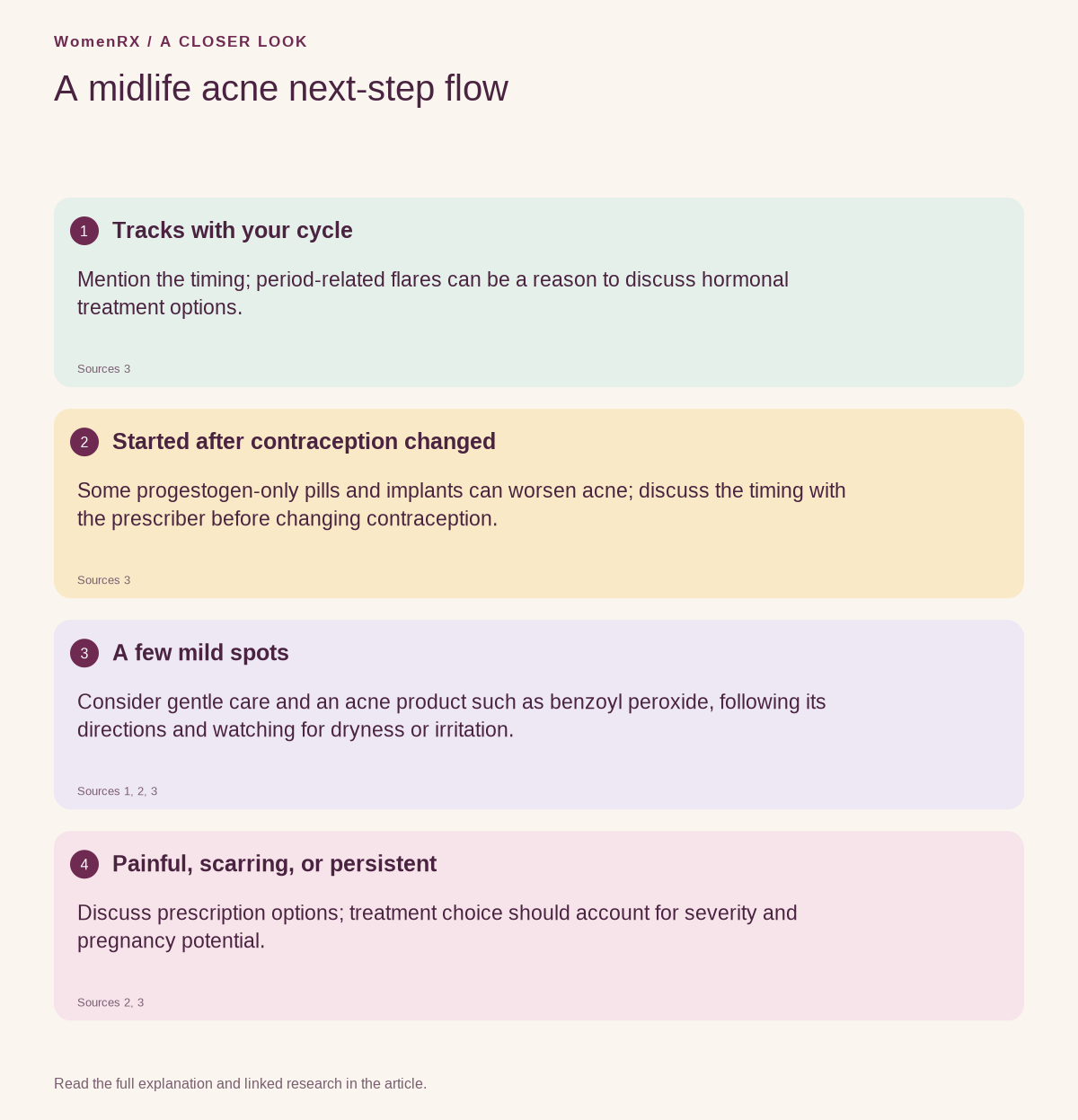
A midlife acne next-step flow
Tracks with your cycle: Mention the timing; period-related flares can be a reason to discuss hormonal treatment options.3
Started after contraception changed: Some progestogen-only pills and implants can worsen acne; discuss the timing with the prescriber before changing contraception.3
A few mild spots: Consider gentle care and an acne product such as benzoyl peroxide, following its directions and watching for dryness or irritation.123
Painful, scarring, or persistent: Discuss prescription options; treatment choice should account for severity and pregnancy potential.23
Read the figure as text
Use the pattern and practical constraints to decide what to review; these clues can guide a conversation but don’t diagnose the cause.- Tracks with your cycle: Mention the timing; period-related flares can be a reason to discuss hormonal treatment options.3
- Started after contraception changed: Some progestogen-only pills and implants can worsen acne; discuss the timing with the prescriber before changing contraception.3
- A few mild spots: Consider gentle care and an acne product such as benzoyl peroxide, following its directions and watching for dryness or irritation.123
- Painful, scarring, or persistent: Discuss prescription options; treatment choice should account for severity and pregnancy potential.23
More questions, answered
Does acne in your 40s mean you have PCOS?
No. Acne can occur with PCOS, but acne by itself doesn’t establish that diagnosis. If you have concerns about your menstrual pattern or other possible hormonal symptoms, include them in a conversation with your clinician. 3
Can I use tretinoin if I might become pregnant?
Topical retinoids, including tretinoin, aren’t suitable during pregnancy. If you’re pregnant, trying to conceive, or could become pregnant, discuss that before choosing an acne treatment. 3
Sources you can check
- Benzoyl peroxide: a medicine to treat acne - NHSAccessed 2026-09-25Return to first citation
- Acne - NHSAccessed 2026-09-25Return to first citation
- Acne - Treatment - NHSAccessed 2026-09-25Return to first citation
- Spironolactone for the Treatment of Moderate to Severe Acne in Adult Women: A Systematic Review and Meta-Analysis of Randomised Controlled Trials.Kow CS, Ramachandram DS, Hasan SS, Thiruchelvam K. · The Australasian journal of dermatology · 2025Return to first citation
- Adult and perimenopausal acne and the nurse's role in management.Parkinson H. · British journal of nursing (Mark Allen Publishing) · 2026Return to first citation
- Expression of interleukins in adult female acne: evaluating the effects of azelaic acid.Bomfim DP, Gil CD, Rocha M, Santos AA, Enokihara MMSES, Bagatin E. · Skin health and disease · 2026Return to first citation