Acne Treatments to Discuss Instead of Spironolactone
A topical treatment, combined pill, antibiotic, or severe-acne medicine may fit, depending on your skin and pregnancy plans.
There isn’t one direct substitute for spironolactone. Benzoyl peroxide and topical retinoids are common starting points; oral antibiotics, a combined oral contraceptive, or isotretinoin may fit other acne patterns. Pregnancy plans change the comparison: benzoyl peroxide can usually be used during pregnancy, while topical retinoids are generally avoided, and the oral options need medicine-specific discussion. 145
Start with the acne you’re trying to treat
Spironolactone is one treatment approach for acne associated with polycystic ovary syndrome (PCOS), but choosing something else isn’t simply a matter of finding another pill. 3 Treatment depends partly on whether you have mostly blackheads and whiteheads, inflamed pimples, or deeper, painful lesions. Guidelines consistently give topical treatments a central first-line role. 48
That makes a useful first question: What does my acne need treatment for right now? You can also say why spironolactone isn’t working for you, whether that’s an unwanted effect, a health concern, or simply a preference not to take it. Don’t stop or swap a prescribed medicine on your own; that conversation is a chance to agree on a plan that fits both your skin and the reason you’re changing course.
If you’d rather start on the skin
Benzoyl peroxide is a topical acne treatment that reduces bacteria on the skin and can help with spots and blocked pores. Dryness, peeling, or itching can make it hard to tolerate, so how your skin responds matters as much as whether the ingredient is a reasonable choice. If pregnancy is part of your decision, benzoyl peroxide can usually be used during pregnancy, though the NHS advises checking if you’re pregnant or become pregnant while using it. 1
Topical retinoids, such as adapalene or tretinoin, are another category to ask about. They help prevent dead skin cells from building up in hair follicles, but can sting or irritate skin. They aren’t interchangeable with benzoyl peroxide when pregnancy is possible: acne treatment guidance advises against topical retinoids during pregnancy. US prescribing information for topical tretinoin also says its use during pregnancy requires weighing potential benefit against potential fetal risk. 56
Topical treatments may be worth discussing even if you’ve taken spironolactone for a long time. They aren’t a pill-for-pill equivalent: they treat acne on the skin rather than serving as another oral hormonal approach. A review of acne guidelines found broad agreement on topicals as first-line treatment. That’s a reason to ask what each part of a proposed routine is meant to do, rather than assuming more products will be better. 4
When an oral option makes sense
For moderate or more inflammatory acne, an oral antibiotic may come up. Guidelines vary on exactly when to start one and on recommended duration; long courses are a concern, and guidelines agree that oral antibiotics should be used alongside a non-antibiotic topical treatment. 4 Pregnancy or breastfeeding can change which antibiotic is considered: acne guidance generally distinguishes tetracyclines from an option described as safer in those circumstances. A useful question is what topical treatment would accompany the antibiotic, how long the course is planned, and what the longer-term plan would be afterward. 5
If you want to discuss another hormonal approach, a combined oral contraceptive is a distinct option from spironolactone, not an automatic replacement. It may be particularly relevant if your acne flares around periods or occurs alongside a condition such as polycystic ovary syndrome (PCOS). Whether it fits also depends on whether you want contraception and on your health history. Blood pressure should be checked before starting combined hormonal contraception and monitored during use; hypertension can make it unsuitable. Acne alone doesn’t establish that you have PCOS. 357
For severe acne, isotretinoin may be part of the discussion. It’s a systemic treatment, not a routine swap for spironolactone or a first topical treatment. Acne guidance reserves it for severe cases that haven’t responded to other treatment and describes both substantial side-effect considerations and risks in pregnancy. Those are reasons for a specialist-led discussion about pregnancy plans and follow-up before considering it. 5
What changes if pregnancy is possible?
The distinction isn’t simply “topical versus oral.” Benzoyl peroxide can usually be used during pregnancy, while topical retinoids are generally avoided. An oral antibiotic requires a choice of medicine that takes pregnancy or breastfeeding into account. A combined oral contraceptive makes sense only if its contraceptive role suits your plans; isotretinoin calls for a separate discussion of pregnancy risk. Tell the prescriber if you’re pregnant, planning pregnancy, or might become pregnant so the comparison is about the actual medicine you’d use. 156
Follow-up differs, too. The combined pill calls for blood-pressure assessment, an antibiotic course needs a plan for what happens afterward, and isotretinoin warrants specialist oversight. Spironolactone’s potential to raise potassium doesn’t mean every alternative needs the same monitoring. If a potassium concern or another medicine is part of why you want to change treatment, include that in the discussion. 2457
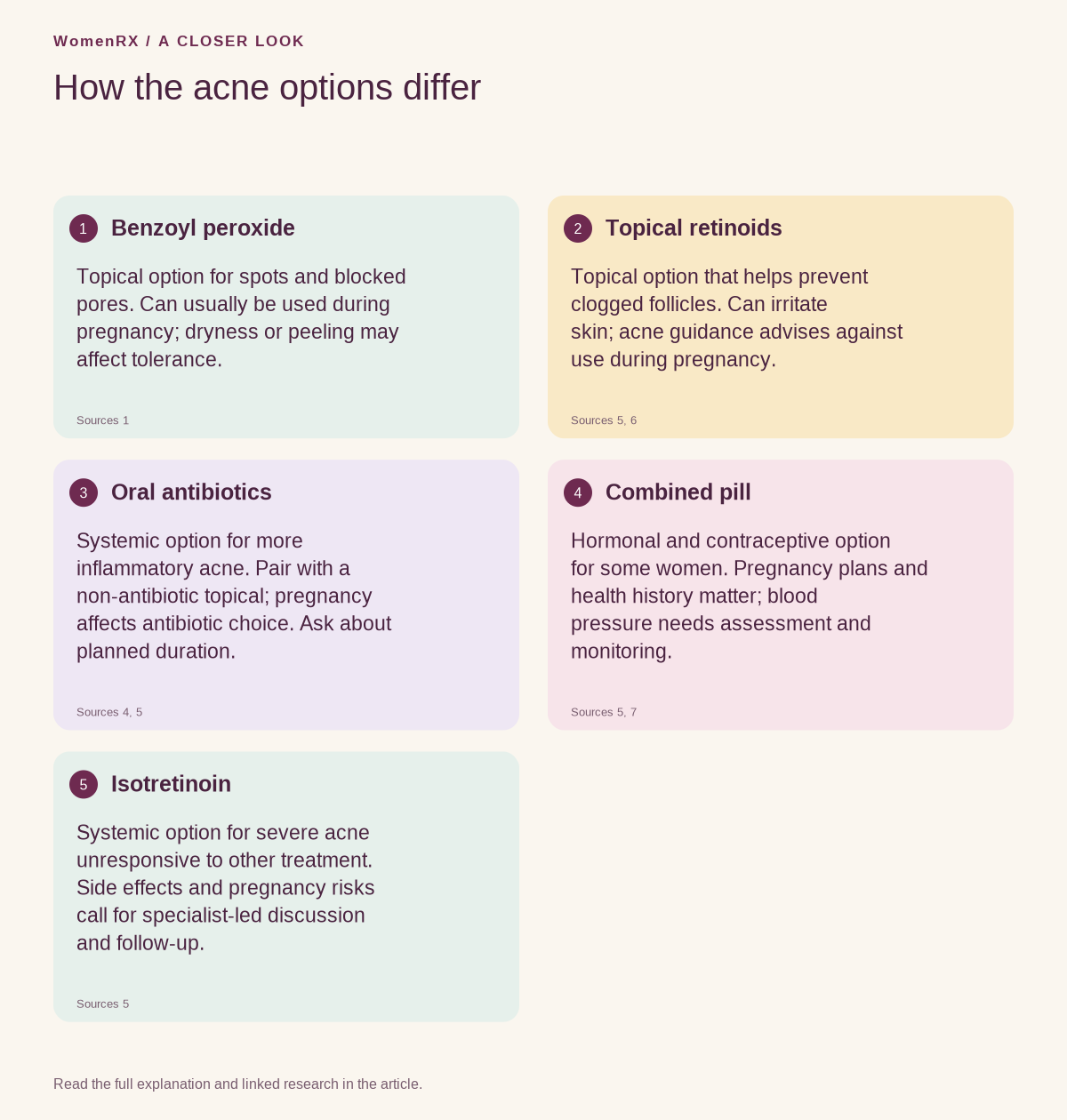
How the acne options differ
Benzoyl peroxide: Topical option for spots and blocked pores. Can usually be used during pregnancy; dryness or peeling may affect tolerance.1
Topical retinoids: Topical option that helps prevent clogged follicles. Can irritate skin; acne guidance advises against use during pregnancy.56
Oral antibiotics: Systemic option for more inflammatory acne. Pair with a non-antibiotic topical; pregnancy affects antibiotic choice. Ask about planned duration.45
Combined pill: Hormonal and contraceptive option for some women. Pregnancy plans and health history matter; blood pressure needs assessment and monitoring.57
Isotretinoin: Systemic option for severe acne unresponsive to other treatment. Side effects and pregnancy risks call for specialist-led discussion and follow-up.5
Read the figure as text
The category, acne pattern, and pregnancy or follow-up consideration change together. None is an automatic replacement for spironolactone.- Benzoyl peroxide: Topical option for spots and blocked pores. Can usually be used during pregnancy; dryness or peeling may affect tolerance.1
- Topical retinoids: Topical option that helps prevent clogged follicles. Can irritate skin; acne guidance advises against use during pregnancy.56
- Oral antibiotics: Systemic option for more inflammatory acne. Pair with a non-antibiotic topical; pregnancy affects antibiotic choice. Ask about planned duration.45
- Combined pill: Hormonal and contraceptive option for some women. Pregnancy plans and health history matter; blood pressure needs assessment and monitoring.57
- Isotretinoin: Systemic option for severe acne unresponsive to other treatment. Side effects and pregnancy risks call for specialist-led discussion and follow-up.5
Sources you can check
- Benzoyl peroxide: a medicine to treat acne - NHSAccessed 2026-09-25Return to first citation
- Spironolactone - NHSAccessed 2026-09-25Return to first citation
- Polycystic Ovary Syndrome-Associated Acne: The Interplay of Hyperandrogenism, Insulin Resistance, and Therapeutic Strategies.Damoulaki E, Sioutis D, Sarli V, Trakakis E, Mastorakos G, Katoulis A, Kastrinakis K, Koratzanis C, Machairiotis N, Panagopoulos P, Christodoulaki C. · Cureus · 2025Return to first citation
- Systematic review of clinical practice guidelines for acne vulgaris published between January 2017 and July 2021.Corcoran L, Muller I, Layton AM, Rucinski G, Venkatess V, Sufraz A, Dove S, Lown M, Stuart B, Francis N, Santer M. · Skin health and disease · 2023Return to first citation
- Acne - Treatment - NHSAccessed 2026-09-25Return to first citation
- TRETINOIN CREAM [REDPHARM DRUG] | US prescribing information and patient instructionsAccessed 2026-09-25Return to first citation
- Combined Hormonal Contraceptives | Contraception | CDCAccessed 2026-09-25Return to first citation
- Acne - Diagnosis - NHSAccessed 2026-09-25Return to first citation