Hormones and Acne: What the Pattern Can Tell You
Period-linked breakouts can reflect hormonal changes, but the best treatment depends on the acne itself and what else is going on in your life.
Hormones can contribute to acne by affecting the skin’s oil-producing glands and the way pores become blocked. Breakouts around a period, during pregnancy, or in the menopausal transition can be clues, not a diagnosis. Benzoyl peroxide and topical retinoids treat acne directly on the skin; combined oral contraceptives are an option for some women. The right choice depends on the spots, your skin’s tolerance, and pregnancy considerations. 2 3 4
Why a breakout can follow hormonal changes
Hormones affect the oil-producing glands beside your hair follicles. When oil and dead skin cells build up in a follicle, the pore can become blocked and inflamed. That’s why a breakout isn’t a sign that you haven’t cleaned your skin well enough: washing can’t remove a blockage forming inside the follicle. 2
Some women notice flares around their periods or during pregnancy. Acne can also persist into adulthood or worsen during the menopausal transition, when the balance between estrogen and androgens changes. Hormones aren’t the whole explanation, though. Genetics and other factors contribute, too. 2 4 5
A chin breakout or a predictable premenstrual flare may make you suspect hormones. It can’t tell you whether you have polycystic ovary syndrome (PCOS) or another hormone condition. Many women with adult acne have normal measured androgen levels, and oil glands can respond to hormonal activity within the skin. If acne is persistent and you’ve noticed other changes that concern you, that combination is more useful to bring up than the breakout’s location alone. 4 6 7
Match the treatment to the spots, not just the timing
For a few spots or clogged pores, start with the skin. Benzoyl peroxide reduces acne-related bacteria and inflammation and can help with blackheads and whiteheads. It may begin working within four weeks. Its drawbacks are dryness or irritation, plus a tendency to bleach fabric and hair. If it’s making your skin uncomfortable, adding more treatments isn’t necessarily the answer. 1 3
If blocked pores keep returning, a topical retinoid may be part of the plan. Tretinoin and adapalene help prevent dead skin cells from building up inside follicles. They can irritate sensitive skin, so tolerance matters when comparing them with other options. Azelaic acid is another skin-directed treatment that may be considered when benzoyl peroxide or a topical retinoid is too irritating. These treatments address acne without requiring you to establish that a hormone imbalance caused it. 3 5
If acne persists or is more widespread, treatment may need a different approach. Moderate to severe acne may be treated with a combination of topical medicines or with an oral antibiotic plus topical treatment. When a topical antibiotic is used, it’s generally paired with benzoyl peroxide rather than used alone because of antibiotic-resistance concerns. Deep, painful cysts deserve attention sooner: they carry the greatest risk of permanent scarring. 2 3 5
If you’re considering hormonal treatment, the combined pill is one option to compare. Combined oral contraceptives can improve acne for some women, including women with period-linked flares, and may be especially relevant if you also want contraception. They aren’t suitable for everyone, and the full acne benefit may take up to a year. A progestin-only pill or contraceptive implant, by contrast, can sometimes make acne worse. That’s a reason to discuss a change in breakouts after starting contraception, not to assume contraception is the only possible cause. 3 4 6
Most acne treatments require patience: many take two to three months to start working. If an over-the-counter approach isn’t helping, or your acne is painful or leaving scars, reassessing the treatment is more useful than repeatedly switching products after a few days. 2 3
Life stage changes the comparison
During pregnancy, treatment choices need another look rather than an automatic switch to a product labeled “gentle.” Benzoyl peroxide can usually be used during pregnancy, although the NHS advises checking whether it’s appropriate for you. That guidance doesn’t settle the choice of a topical retinoid or any other acne medicine. Pregnancy possibility is a factor to raise when choosing a treatment. 1 5
Around perimenopause, a new or worsening breakout can still be acne; it doesn’t by itself establish a hormone disorder. After menopause, the combined pill isn’t simply the next step because a breakout seems hormonal. An adult-female acne review calls for particular caution with oral contraceptives in postmenopausal women. Skin-directed options remain worth comparing according to the type and severity of acne and how your skin tolerates treatment. 4 5
The useful distinction is between a clue about what may be contributing and a reason to choose a particular medicine. Cycle timing can inform the conversation. Whether you have mostly clogged pores, inflamed spots, or deep painful lumps, along with your pregnancy plans, contraception needs, and experience with irritation, does more to narrow the treatment choice. 2 3 5
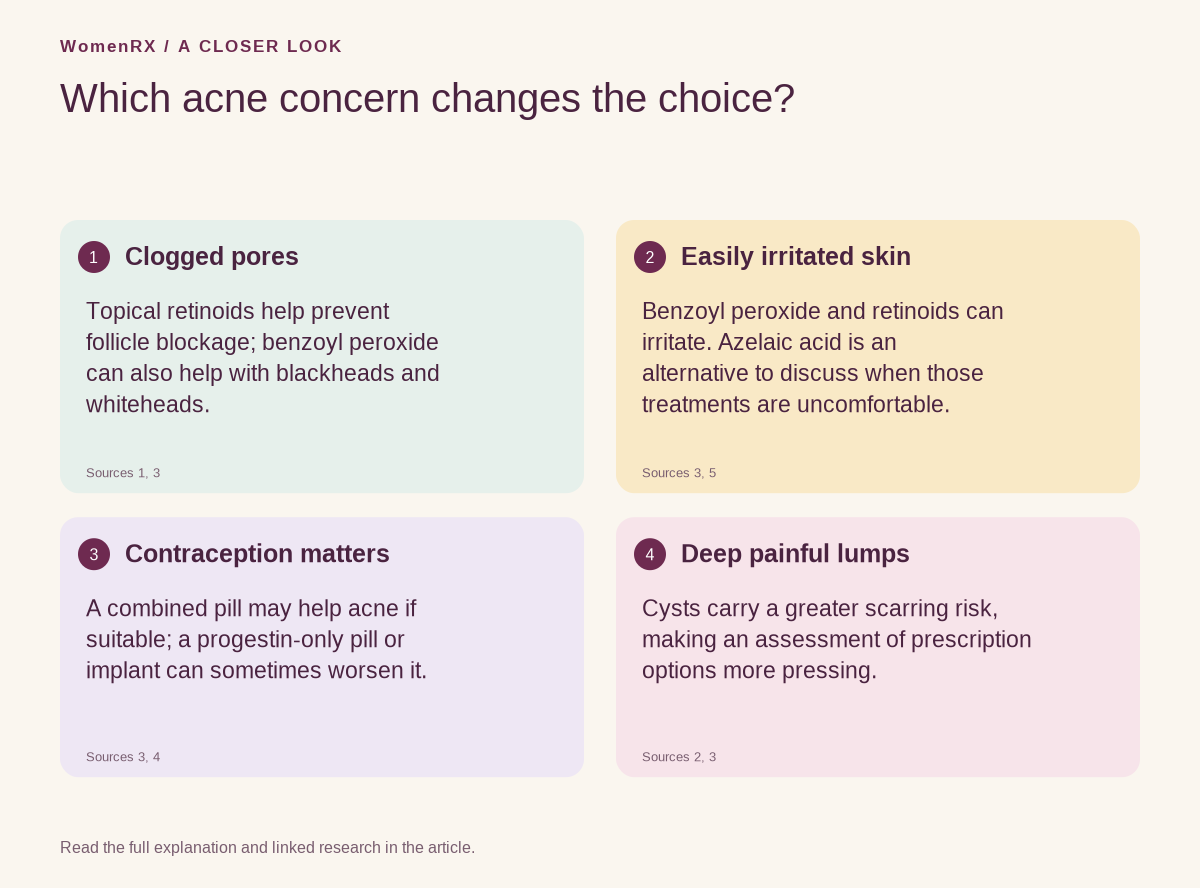
Which acne concern changes the choice?
Clogged pores: Topical retinoids help prevent follicle blockage; benzoyl peroxide can also help with blackheads and whiteheads.13
Easily irritated skin: Benzoyl peroxide and retinoids can irritate. Azelaic acid is an alternative to discuss when those treatments are uncomfortable.35
Contraception matters: A combined pill may help acne if suitable; a progestin-only pill or implant can sometimes worsen it.34
Deep painful lumps: Cysts carry a greater scarring risk, making an assessment of prescription options more pressing.23
Read the figure as text
Use the feature that matters most to compare treatment approaches. These are decision points, not a test for a hormonal cause.- Clogged pores: Topical retinoids help prevent follicle blockage; benzoyl peroxide can also help with blackheads and whiteheads.13
- Easily irritated skin: Benzoyl peroxide and retinoids can irritate. Azelaic acid is an alternative to discuss when those treatments are uncomfortable.35
- Contraception matters: A combined pill may help acne if suitable; a progestin-only pill or implant can sometimes worsen it.34
- Deep painful lumps: Cysts carry a greater scarring risk, making an assessment of prescription options more pressing.23
More questions, answered
Does a normal hormone test rule out hormonal influence on acne?
No. Many women with adult acne have normal measured androgen levels, and hormonal activity within the skin can still affect oil glands. A blood result and an acne pattern each answer a different question; neither identifies the cause of every breakout on its own. 4 7
Sources you can check
- Benzoyl peroxide: a medicine to treat acne - NHSAccessed 2026-09-25Return to first citation
- Acne - NHSAccessed 2026-09-25Return to first citation
- Acne - Treatment - NHSAccessed 2026-09-25Return to first citation
- Unveiling the Nuances of Adult Female Acne: A Comprehensive Exploration of Epidemiology, Treatment Modalities, Dermocosmetics, and the Menopausal Influence.Dias da Rocha MA, Saint Aroman M, Mengeaud V, Carballido F, Doat G, Coutinho A, Bagatin E. · International journal of women's health · 2024Return to first citation
- Adult female acne: Clinical and therapeutic particularities (Review).Branisteanu DE, Toader MP, Porumb EA, Serban IL, Pinzariu AC, Branisteanu CI, Vicovan A, Dimitriu A, Fartusnic IA, Boda D, Branisteanu DC, Brihan I, Nicolescu AC. · Experimental and therapeutic medicine · 2022Return to first citation
- Adult female acne: a guide to clinical practice.Bagatin E, Freitas THP, Rivitti-Machado MC, Machado MCR, Ribeiro BM, Nunes S, Rocha MADD. · Anais brasileiros de dermatologia · 2019Return to first citation
- ADT-G as a promising biomarker for peripheral hyperandrogenism in adult female acne.Rocha M, Cardozo KHM, Carvalho VM, Bagatin E. · Dermato-endocrinology · 2017Return to first citation