Why Acne Can Start or Continue in Adulthood
Adult breakouts can reflect the same blocked-follicle process as teenage acne, with hormones, medicines, and skin products sometimes affecting when they appear.
Acne can continue or begin in adulthood when oil and dead skin cells block hair follicles. Cycle-related hormone changes, pregnancy, family history, some medicines, and pore-clogging products may contribute, but a breakout alone doesn’t prove high androgen levels or PCOS. Seek an assessment for painful deep spots, scarring, acne that persists despite pharmacy treatment, or sudden-onset acne alongside irregular periods or excess body hair.128
The same skin process can show up at a different age
Acne starts in a hair follicle. When the nearby oil gland produces excess sebum, that oil can mix with dead skin cells and form a plug. You may see blackheads or whiteheads, inflamed spots, or deeper, painful lumps. Acne can persist beyond the teenage years or start later, so adult breakouts aren’t unusual simply because of your age.71
That basic process helps make sense of the possible contributors. A change in hormones may affect oil production. A skin product may add to pore blockage. A medicine may trigger an acne-like eruption. These are different possibilities, not one explanation that fits everyone.
What the timing can tell you about hormones
Some women notice flares just before a period. Pregnancy can also bring episodes of acne. These patterns make hormonal change a plausible contributor, but neither one tells you that your androgen levels are high. Androgens are hormones involved in oil-gland activity; having acne isn’t, by itself, a diagnosis of a hormonal disorder.71
Perimenopause can be another time of changing skin. A clinical review describes declining estrogen and relatively greater androgen influence as possible contributors to adult acne around this transition. That’s a possible explanation for a pattern, not a way to determine hormone levels from a breakout.9
There’s a distinction worth knowing: if acne suddenly begins in adulthood and you also have irregular or unusually light periods or increased body hair, those combined signs warrant an assessment for a possible hormonal condition. A pre-period flare on its own doesn’t mean you have PCOS.82
Consider what changed beyond your cycle
If spots began after a new medicine, bring up the timing with the clinician who prescribed it. Corticosteroids and JAK inhibitors, for example, can aggravate acne or cause acne-like eruptions; drug-related spots may look unusually similar to one another rather than showing a mix of blackheads, whiteheads, and inflamed spots. Certain targeted cancer treatments can also cause an acne-like rash, often without blackheads or whiteheads. That distinction matters because a new rash may need a different assessment, not simply a stronger acne product. Don’t stop a prescribed treatment just because you suspect a connection.345
Contraception can be relevant too. Combined oral contraceptives can help some women’s acne, while progestogen-only pills or contraceptive implants can sometimes make it worse. This isn’t a reason to change contraception on your own, but a change in breakout pattern after starting one is useful information to raise when reviewing your options.2
Finally, look at what regularly touches your skin. Oil-based makeup, skincare, or sunscreen may be more likely to block pores than water-based, non-comedogenic products. Acne is not a sign that you haven’t washed enough: its key changes happen below the skin’s surface, and frequent washing can aggravate your skin. A mild cleanser, removing makeup before bed, and leaving spots alone are more useful than scrubbing or squeezing.17
Match the next step to the breakout
For a few blackheads, whiteheads, or small spots, a simple routine and a topical acne treatment such as benzoyl peroxide may be enough. Give treatment time: improvement often takes months rather than days. If a product is irritating, more vigorous cleansing isn’t the answer. If pharmacy treatment has not worked, see a clinician to discuss other treatments.27
More widespread inflamed acne, painful nodules or cysts, or any scarring deserves a medical assessment. Deep lesions carry a greater risk of permanent scars. Seek help sooner, too, if breakouts are making you feel low or anxious; you don’t have to wait for acne to be classified as severe for it to matter.12
Treatment can then be matched to what your skin is doing. Options include topical retinoids such as tretinoin or adapalene, combinations of topical treatments, and, for some women, hormonal treatments. In a randomized study of 133 women with moderate acne, spironolactone used with benzoyl peroxide had greater treatment success at six months than a comparison regimen that used doxycycline with benzoyl peroxide initially. That result supports spironolactone as an option to discuss for moderate adult female acne; it doesn’t show that every woman with acne has high androgens.26
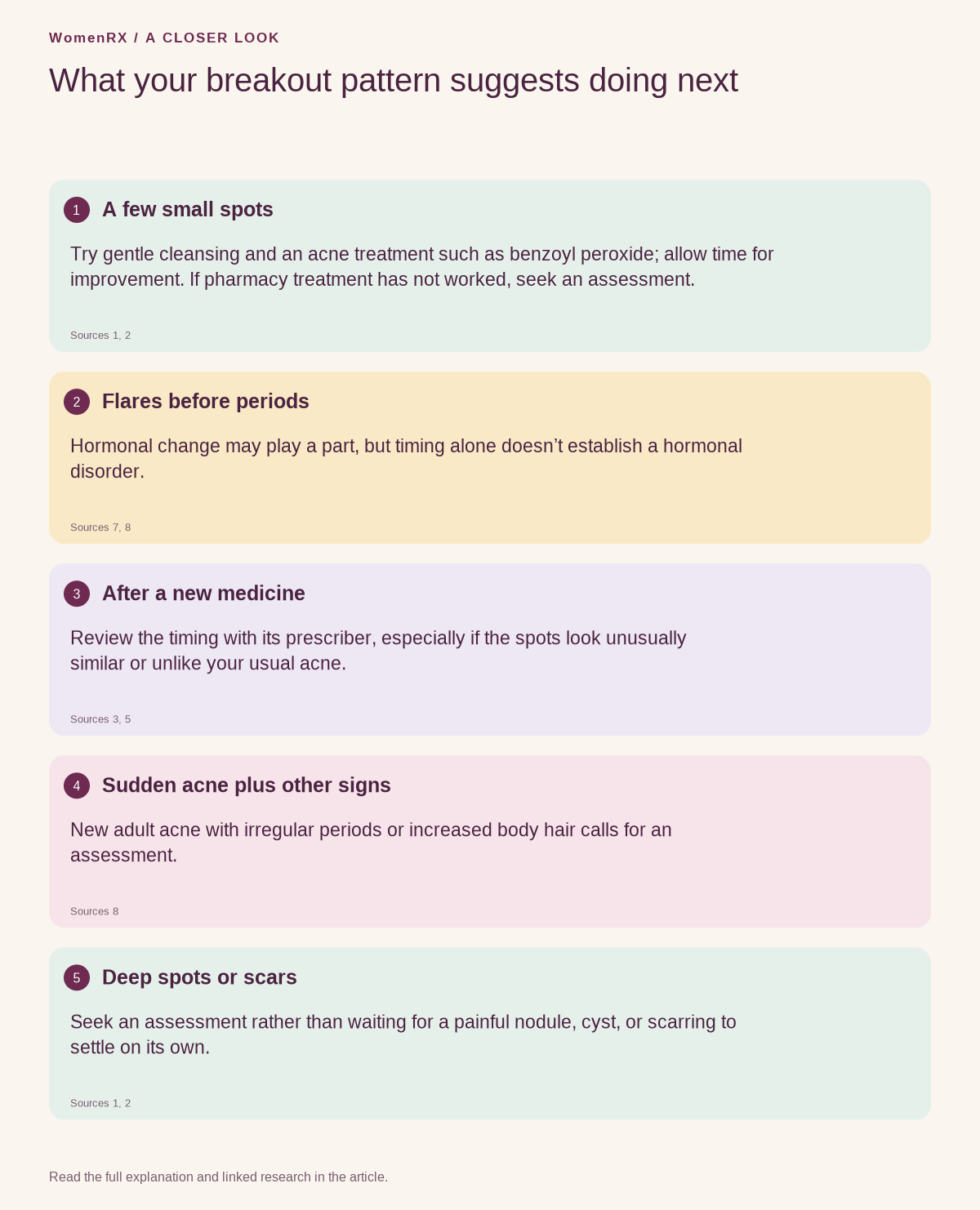
What your breakout pattern suggests doing next
A few small spots: Try gentle cleansing and an acne treatment such as benzoyl peroxide; allow time for improvement. If pharmacy treatment has not worked, seek an assessment.12
Flares before periods: Hormonal change may play a part, but timing alone doesn’t establish a hormonal disorder.78
After a new medicine: Review the timing with its prescriber, especially if the spots look unusually similar or unlike your usual acne.35
Sudden acne plus other signs: New adult acne with irregular periods or increased body hair calls for an assessment.8
Deep spots or scars: Seek an assessment rather than waiting for a painful nodule, cyst, or scarring to settle on its own.12
Read the figure as text
Use the pattern as a clue for choosing a next step, not as a self-diagnosis.- A few small spots: Try gentle cleansing and an acne treatment such as benzoyl peroxide; allow time for improvement. If pharmacy treatment has not worked, seek an assessment.12
- Flares before periods: Hormonal change may play a part, but timing alone doesn’t establish a hormonal disorder.78
- After a new medicine: Review the timing with its prescriber, especially if the spots look unusually similar or unlike your usual acne.35
- Sudden acne plus other signs: New adult acne with irregular periods or increased body hair calls for an assessment.8
- Deep spots or scars: Seek an assessment rather than waiting for a painful nodule, cyst, or scarring to settle on its own.12
More questions, answered
Does a breakout before my period mean I have PCOS?
No. Pre-period flares can happen without establishing a hormonal disorder. If acne starts suddenly in adulthood and comes with irregular or unusually light periods or increased body hair, those combined signs are worth discussing with a clinician.78
Sources you can check
- Acne - NHSAccessed 2026-09-25Return to first citation
- Acne - Treatment - NHSAccessed 2026-09-25Return to first citation
- Drug-Induced Acne in Inflammatory Bowel Disease: A Practical Guide for the Gastroenterologist.Temido MJ, Honap S, Bursztejn AC, Portela F, Jairath V, Danese S, Spencer A, Peyrin-Biroulet L. · The American journal of gastroenterology · 2025Return to first citation
- Acneiform eruption induced by molecularly targeted agents in antineoplastic therapy: A review.Yuan C, Wang B. · Journal of cosmetic dermatology · 2023Return to first citation
- Drug-induced acneiform eruption.Du-Thanh A, Kluger N, Bensalleh H, Guillot B. · American journal of clinical dermatology · 2011Return to first citation
- Efficacy of Spironolactone Compared with Doxycycline in Moderate Acne in Adult Females: Results of the Multicentre, Controlled, Randomized, Double-blind Prospective and Parallel Female Acne Spironolactone vs doxyCycline Efficacy (FASCE) Study.Dréno B, Nguyen JM, Hainaut E, Machet L, Leccia MT, Beneton N, Claudel JP, Célérier P, Le Moigne M, Le Naour S, Vrignaud F, Poinas A, Dert C, Boisrobert A, Flet L, Korner S, Khamma... · Acta dermato-venereologica · 2024Return to first citation
- Acne - Causes - NHSAccessed 2026-09-25Return to first citation
- Acne - Diagnosis - NHSAccessed 2026-09-25Return to first citation
- Adult and perimenopausal acne and the nurse's role in management.Parkinson H. · British journal of nursing (Mark Allen Publishing) · 2026Return to first citation