When Does Hormone-Linked Acne Need a Prescription?
A period-linked flare can help guide treatment, but the spots themselves, your contraception, and pregnancy plans matter just as much.
A prescription may be worth discussing if acne is moderate or severe, or hasn’t improved with nonprescription treatment. Before choosing one, a clinician should check whether the change fits acne, assess its severity, and ask about cycle timing, contraception, pregnancy plans, and breastfeeding. 1 2 5 If the change first appeared around menopause, mention that timing too; it does not establish a cause or determine treatment. Mention scarring too: deeper cysts carry a greater risk of permanent scars. 1
Start with the spots, not the hormone label
Acne usually shows up as recognizable spots: blackheads or whiteheads, inflamed spots, or deeper painful nodules and cysts. Oily skin can accompany it, but oily skin alone doesn’t describe the spots. Nodules and cysts are more severe forms, and cysts carry the greatest risk of permanent scarring. If what you notice doesn’t resemble these acne spots, describe the change before assuming an acne prescription fits. These spot descriptions can help start an assessment; they can’t identify a different skin condition. 1 2
Severity changes the decision. A few spots may respond to nonprescription treatment, while moderate or severe acne, or acne that hasn’t improved with that treatment, may call for a prescription. Painful deep spots, scarring, or acne on the chest and back are useful details to raise. Even an appropriate treatment may take several months to show improvement, so the discussion should include what to expect and when to reassess it. 1 2
What cycle timing can, and can’t, tell you
Hormonal changes during the menstrual cycle or pregnancy can contribute to acne episodes. If your spots repeatedly flare around your period, say so. Also mention whether they began or changed after starting, stopping, or switching contraception. Combined oral contraceptives can improve acne for some women, whereas a progestogen-only pill or contraceptive implant can sometimes make it worse. Those are useful treatment clues, not proof that every adult breakout is caused by a hormone disorder. 1 2
Acne can also occur alongside polycystic ovary syndrome (PCOS). Cycle timing is useful context for an acne discussion, but it isn’t a PCOS assessment. If PCOS is a concern, that question needs its own evaluation rather than an answer based on the timing of spots. 1 2 If a skin change first appeared around menopause, tell the clinician when it began and what the spots look like. That timing alone does not establish a cause or point to a particular prescription.
Match the prescription discussion to the findings
For acne that needs prescription treatment, the choice isn’t simply “hormonal” versus “not hormonal.” Topical treatments, sometimes combined with an oral antibiotic, are options depending on severity. An expert consensus review supports combining oral antibiotics with topical treatment for moderate-to-severe acne rather than treating antibiotics as a stand-alone, indefinite solution. 2 3
If contraception is also wanted, a combined oral contraceptive may address both needs. Its potential acne benefit has to be weighed against your health history: a review identifies clot-related risks, particularly with additional risk factors, and states that combined oral contraception is contraindicated for women with migraine with aura. A pill that suits a friend’s acne isn’t automatically a good choice for yours. 2 4
Spironolactone is another option a clinician may discuss for acne in women who are avoiding pregnancy. In a review of five placebo-controlled trials involving 563 participants, objective assessment of acne improvement favored spironolactone, while subjective assessment showed no clear difference. The review focused on women with acne, but one included study reported ages for male and female participants together; the review also couldn’t fully account for differences such as PCOS status or other treatments. Its findings don’t predict how any one woman will respond. 6 7
Bring the names of treatments you already use, including contraception and acne products, to that comparison. Mention a recent switch in contraception; pregnancy plans can rule out options that might otherwise be considered. 2 5
Pregnancy and breastfeeding call for separate decisions
If you’re pregnant or planning a pregnancy, say so before starting a prescription, even a cream. A review of acne treatment during pregnancy lists isotretinoin, spironolactone, and topical retinoids such as tretinoin among treatments to avoid. For mild-to-moderate acne, it describes options including azelaic acid and benzoyl peroxide; more severe acne may need a different plan that takes pregnancy stage into account. Tetracycline antibiotics are also generally avoided in pregnancy. 3 5
Breastfeeding isn’t the same medication decision as pregnancy. The pregnancy-and-lactation review assesses some treatments differently in the two stages, including topical retinoids and spironolactone. Tell the prescriber that you’re breastfeeding rather than assuming a medicine is either safe or unsuitable based on pregnancy advice alone. 5
The useful next question is specific: What about my skin change and health history makes this prescription a better fit than the alternatives? An answer should account for whether the spots fit acne, their severity and scarring risk, what you’ve tried, whether flares follow your cycle or a contraception change, and whether pregnancy or breastfeeding affects the choice. 1 2 5
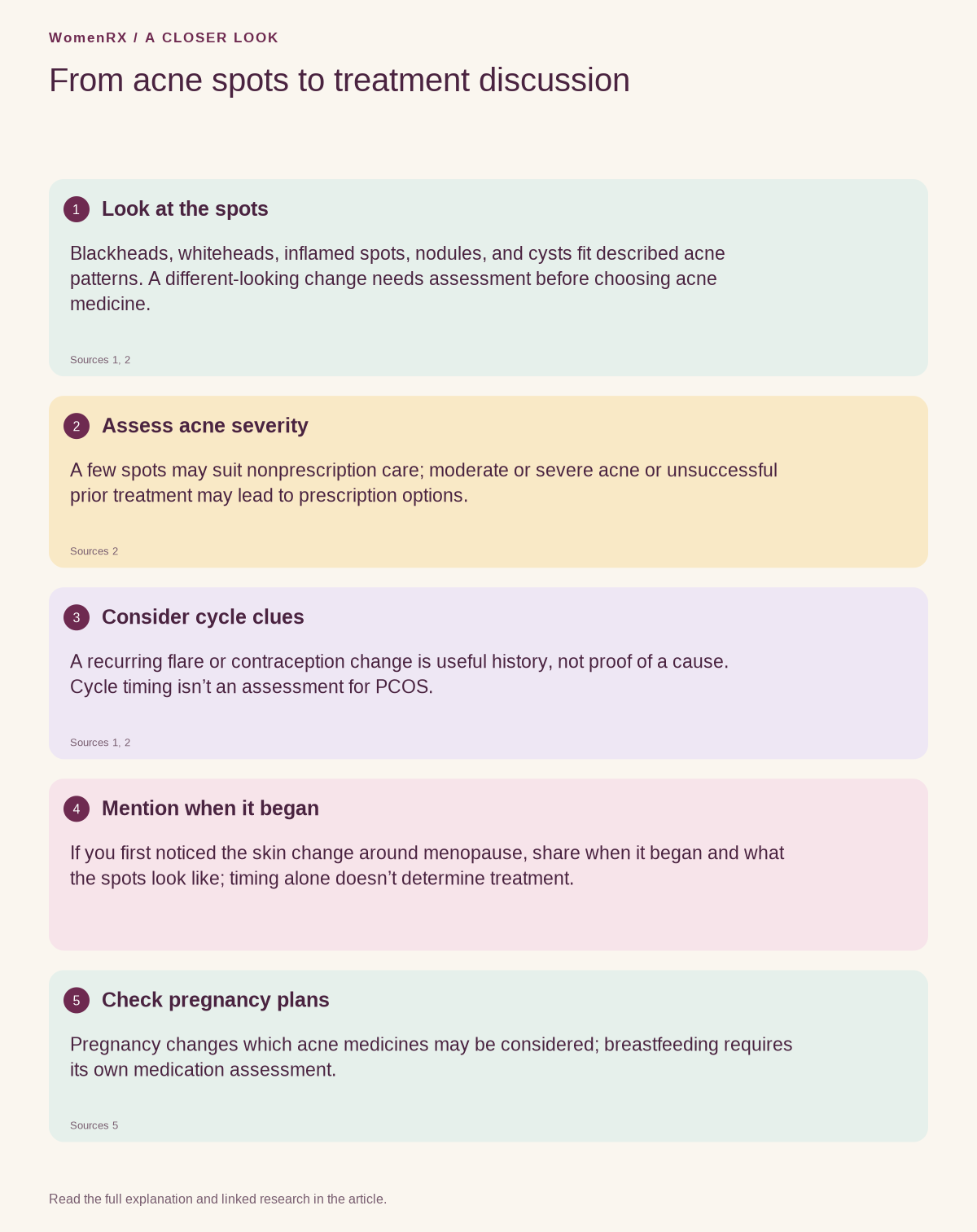
From acne spots to treatment discussion
Look at the spots: Blackheads, whiteheads, inflamed spots, nodules, and cysts fit described acne patterns. A different-looking change needs assessment before choosing acne medicine.12
Assess acne severity: A few spots may suit nonprescription care; moderate or severe acne or unsuccessful prior treatment may lead to prescription options.2
Consider cycle clues: A recurring flare or contraception change is useful history, not proof of a cause. Cycle timing isn’t an assessment for PCOS.12
Mention when it began: If you first noticed the skin change around menopause, share when it began and what the spots look like; timing alone doesn’t determine treatment.
Check pregnancy plans: Pregnancy changes which acne medicines may be considered; breastfeeding requires its own medication assessment.5
Read the figure as text
A spot pattern helps establish whether an acne-treatment discussion fits; severity and reproductive plans then shape the options.- Look at the spots: Blackheads, whiteheads, inflamed spots, nodules, and cysts fit described acne patterns. A different-looking change needs assessment before choosing acne medicine.12
- Assess acne severity: A few spots may suit nonprescription care; moderate or severe acne or unsuccessful prior treatment may lead to prescription options.2
- Consider cycle clues: A recurring flare or contraception change is useful history, not proof of a cause. Cycle timing isn’t an assessment for PCOS.12
- Mention when it began: If you first noticed the skin change around menopause, share when it began and what the spots look like; timing alone doesn’t determine treatment.
- Check pregnancy plans: Pregnancy changes which acne medicines may be considered; breastfeeding requires its own medication assessment.5
More questions, answered
Does acne before every period mean I have PCOS?
A recurring premenstrual flare is useful context: menstrual-cycle changes can contribute to acne, and acne can occur alongside PCOS. The timing of spots isn’t a PCOS assessment. If that’s your concern, ask for it to be evaluated separately. 1 2
Sources you can check
- Acne - NHSAccessed 2026-09-25Return to first citation
- Acne - Treatment - NHSAccessed 2026-09-25Return to first citation
- Optimal Use Recommendations and Stewardship Principles with Oral Antibiotics in Acne Vulgaris Management: An Expert Consensus Panel.Rosenberg AL, Shah M, Del Rosso JQ, Baldwin H, Harper J, Hebert AA, Keri J, Kwong P, Rieder E, Gold LS, Bartley B, Burshtein J, DeBusk L, Zakria D. · The Journal of clinical and aesthetic dermatology · 2025Return to first citation
- Comparison of Substances in Combined Oral Contraceptives Used in Acne Vulgaris, Hirsutism, Migraine, and Dysmenorrhea.Wójcikiewicz P, Durlej G, Satora M, Tarkowski R, Kułak K. · Medical science monitor : international medical journal of experimental and clinical research · 2026Return to first citation
- Treatment of Acne Vulgaris During Pregnancy and Lactation: A Narrative Review.Ly S, Kamal K, Manjaly P, Barbieri JS, Mostaghimi A. · Dermatology and therapy · 2023Return to first citation
- Steroids Used to Treat Acne Vulgaris: A Review of Efficacy, Safety, and Clinical Considerations.Cantrell W, Easley L, Squittieri K. · Journal of drugs in dermatology : JDD · 2024Return to first citation
- Efficacy and Safety of Oral Spironolactone for Women With Acne Vulgaris: A Systematic Review and Meta-Analysis of Randomized Placebo-Controlled Trials With Trial Sequential Analysis.Ghanem L, Kirmani N, De León Fernández N, Palacios-Ortiz MP, Rodríguez-Parra JD, Rusu CA. · Journal of cosmetic dermatology · 2025Return to first citation