Acne Treatment: Choose a Start and Know When to Step Up
Blackheads, inflamed pimples, and deep painful bumps call for different levels of treatment, and scarring is a reason to seek care sooner.
For mostly blackheads and whiteheads, a topical retinoid is a common starting option; for mild inflamed pimples, benzoyl peroxide may help. Deep painful nodules, cysts, or developing scars deserve clinician-guided treatment. Benzoyl peroxide may start working within about four weeks; seek advice if acne worsens or hasn’t improved after 12 weeks of using it. That checkpoint isn’t a universal deadline for other treatments. 1 2 4

Start with the kind of acne you have
Acne can include blackheads and whiteheads, small red bumps or pus-filled pimples, and deeper lumps beneath the skin. The distinction matters: clogged pores and inflamed spots can often be approached with topical treatment, while nodules and cysts carry a greater risk of permanent scarring. Acne can affect the face, chest, or back. 2
For mostly blackheads or whiteheads, topical retinoids such as adapalene or tretinoin are established options because they help address clogged follicles. They’re also used to help prevent new lesions, not just treat the ones already visible. Retinoids can irritate skin, so the best choice and way to use one depends on your skin and situation. 3 4
For mild red or pus-filled pimples, benzoyl peroxide is another topical option. It can help with spots and blocked pores, but it may cause dryness, peeling, or irritation, and it can bleach fabric. Starting with a lower-strength product can help you see how your skin tolerates it. 1
Some treatment plans combine ingredients that work in different ways. Guidelines describe combinations such as a retinoid with benzoyl peroxide for inflammatory acne, but combining irritating products can be hard on skin. Don’t assume that adding more actives will make a plan work faster; a clinician or pharmacist can help you choose a tolerable approach. 1 4
Give a plan time, but set a reassessment point
Acne treatments aren’t overnight fixes. Benzoyl peroxide may start working within about four weeks, but that doesn’t mean acne will be clear by then. NHS guidance suggests getting advice if acne worsens or hasn’t improved after 12 weeks of using benzoyl peroxide; acne treatment more broadly can take several months to show results. 1 2
If a product is irritating your skin, using more is not a shortcut. Benzoyl peroxide can cause dryness, peeling, or itching, and topical retinoids can cause irritation. If discomfort is making it difficult to keep using a treatment, that’s a reason to ask about adjusting the plan rather than simply layering on another active. 1 3
Use gentle cleansing rather than trying to scrub blackheads out or squeeze spots. Picking can worsen acne and cause lasting scars. Products labeled non-comedogenic are less likely to block pores, according to NHS guidance. 2
Know when home treatment isn’t the right level
Arrange clinician-guided care if you have deep painful nodules or cysts, acne that is leaving scars, or moderate-to-severe acne. These patterns may need prescription treatment; trying only topical products for a long time can delay care aimed at reducing scarring risk. Severe acne, or acne affecting the chest or back, may also need prescription treatment and is a reason to seek assessment. 2 4
It’s also reasonable to seek help if acne is making you very unhappy or isn’t responding to an initial plan. Treatment can be adjusted to the type and severity of acne; for more severe forms, guidelines include options beyond topical therapy. 2 4
If breakouts track your period
Hormonal changes during the menstrual cycle can contribute to acne flares. But a period-linked pattern by itself doesn’t establish that acne has a specific hormonal cause, and acne has more than one contributing mechanism. If flares keep recurring or the acne is persistent, mention the pattern when discussing treatment. Hormonal medicines are among the options clinicians may consider for some women with resistant acne, but they aren’t a default starting point for every menstrual flare. 2 3
Pregnancy and planning ahead
If you’re pregnant, check acne medicines with a clinician before starting or continuing them. A review of acne treatment in pregnancy recommends avoiding topical and oral retinoids. It describes benzoyl peroxide and azelaic acid among possible topical options, while also noting that safety data and recommendations have limitations. 5
If you’re planning a pregnancy, discuss your acne treatment choices with a clinician. The pregnancy recommendation to avoid retinoids applies to pregnancy; it doesn’t establish a separate preconception restriction or a stop interval. Benzoyl peroxide is also described as usually usable during pregnancy in NHS guidance, but that guidance advises checking first. 1 5
A useful plan matches the lesion pattern, how much irritation you can tolerate, and whether pregnancy is relevant. If you have deep lesions or scars, move to clinician-guided care sooner; if you’re trying a topical option for mild acne, set a clear point to reassess rather than switching products every few days.
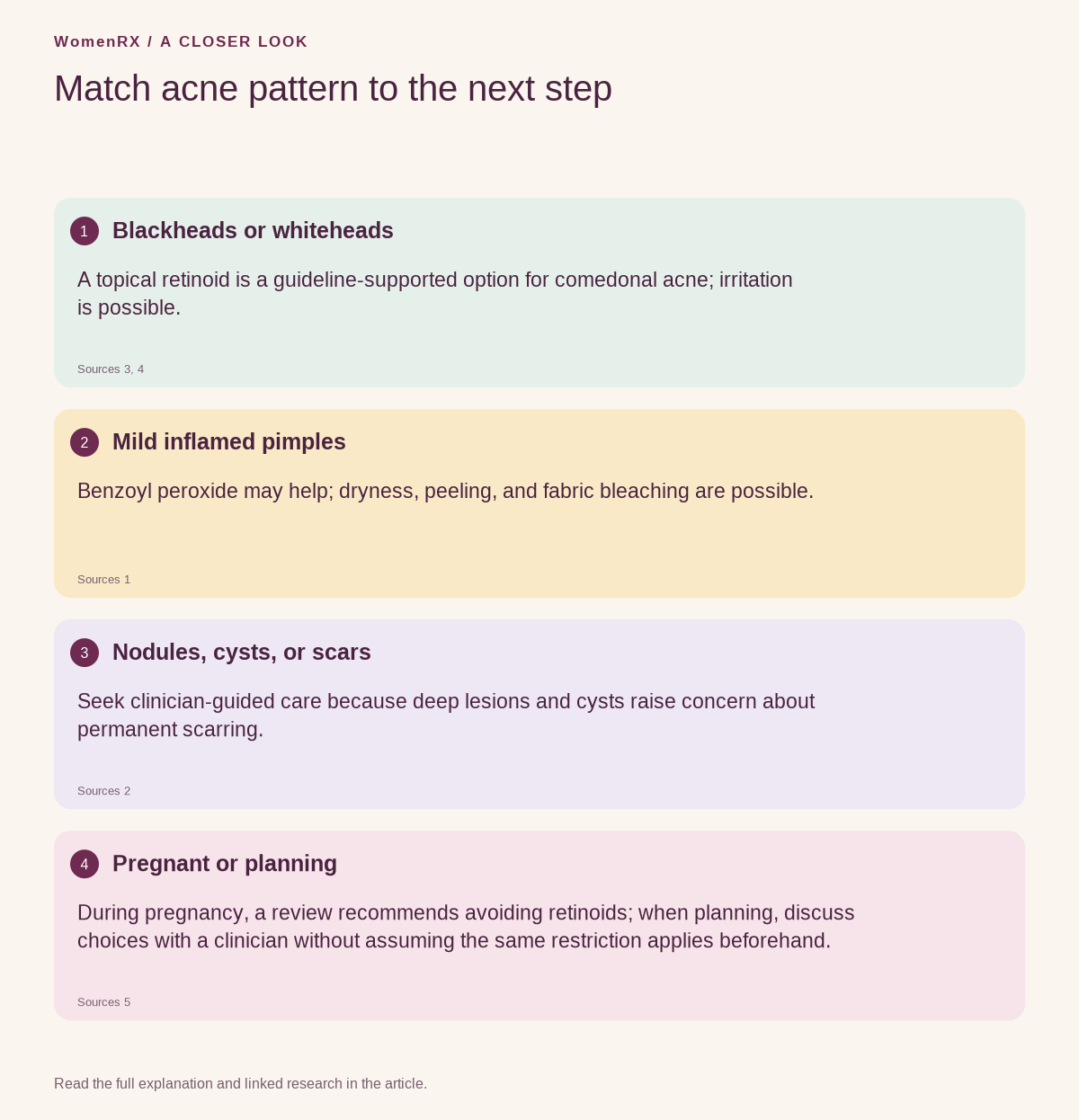
Match acne pattern to the next step
Blackheads or whiteheads: A topical retinoid is a guideline-supported option for comedonal acne; irritation is possible.34
Mild inflamed pimples: Benzoyl peroxide may help; dryness, peeling, and fabric bleaching are possible.1
Nodules, cysts, or scars: Seek clinician-guided care because deep lesions and cysts raise concern about permanent scarring.2
Pregnant or planning: During pregnancy, a review recommends avoiding retinoids; when planning, discuss choices with a clinician without assuming the same restriction applies beforehand.5
Read the figure as text
Use the visible lesion pattern and scarring risk to orient a starting discussion; pregnancy and planning ahead call for different questions about topical treatment.- Blackheads or whiteheads: A topical retinoid is a guideline-supported option for comedonal acne; irritation is possible.34
- Mild inflamed pimples: Benzoyl peroxide may help; dryness, peeling, and fabric bleaching are possible.1
- Nodules, cysts, or scars: Seek clinician-guided care because deep lesions and cysts raise concern about permanent scarring.2
- Pregnant or planning: During pregnancy, a review recommends avoiding retinoids; when planning, discuss choices with a clinician without assuming the same restriction applies beforehand.5
More questions, answered
Does acne around my period mean I need hormonal treatment?
No. Menstrual-cycle hormone changes can contribute to flares, but that pattern alone doesn’t establish a particular hormonal cause. Hormonal medicines may be considered for some women with resistant acne, rather than being an automatic first step for every period-linked breakout. 2 3
Which acne ingredients should I check before pregnancy?
If you’re planning a pregnancy, discuss your treatment choices with a clinician. A review recommends avoiding topical and oral retinoids during pregnancy and lists benzoyl peroxide and azelaic acid as possible topical options; it doesn’t establish a separate preconception restriction or timing rule. 5
Sources you can check
- Benzoyl peroxide: a medicine to treat acne - NHSAccessed 2026-09-25Return to first citation
- Acne - NHSAccessed 2026-09-25Return to first citation
- PRACT-India: Practical Recommendations on Acne Care and Medical Treatment in India-A Modified Delphi Consensus.Madnani N, Saraswat A, Nott A, Jakhar D, Gupta LK, Kohli M, Puhan MR, Sangolli P, Nagar R, Rathi SK, Aurangabadkar S, DA S, Ka S, Dogra S, Dhoot D, Balasubramanian A, Patil S, Bark... · Antibiotics (Basel, Switzerland) · 2025Return to first citation
- [S2k-guideline for therapy of acne].Nast A, Bayerl C, Borelli C, Degitz K, Dirschka T, Erdmann R, Fluhr J, Gieler U, Hartwig R, Meigel EM, Möller S, Ochsendorf F, Podda M, Rabe T, Rzany B, Sammain A, Schink S, Zoubou... · Journal der Deutschen Dermatologischen Gesellschaft = Journal of the German Society of Dermatology : JDDG · 2010Return to first citation
- Treatment of acne vulgaris during pregnancy and lactation.Kong YL, Tey HL. · Drugs · 2013Return to first citation