Alternatives to Tretinoin Depend on Your Skin Goal
Benzoyl peroxide is an established acne option, while alternatives for sun-damaged skin come with different evidence and tradeoffs.
If tretinoin isn’t working for you, start with what you want to treat. For acne, benzoyl peroxide is an established non-retinoid option. 1 For photoaging, retinaldehyde has some evidence but isn’t a proven equal substitute for tretinoin; regular sun protection helps prevent further damage. 45 Pregnancy planning changes the choice of retinoids. 78

First, separate breakouts from sun damage
Tretinoin can be used for acne and for signs of photoaging, but an alternative for one goal may do little for the other. Acne involves blocked follicles and inflammation. Sun-damaged skin may show fine wrinkles, uneven tone, or roughness. That distinction changes the shortlist. 346
It also helps to name why you need an alternative. If tretinoin irritates your skin, a non-retinoid acne treatment may be worth discussing. If you’re pregnant or planning pregnancy, the comparison changes more substantially: swapping tretinoin for a different topical retinoid isn’t a way around the pregnancy concern. 178
If the goal is acne
Adapalene is a topical retinoid, not a non-retinoid alternative. Topical retinoids are used for acne, but that class-level finding does not establish adapalene’s specific acne benefit or how it compares with tretinoin. Unlike benzoyl peroxide, adapalene does not sidestep the retinoid pregnancy concern. 48
Benzoyl peroxide is a non-retinoid option with a different job. It reduces acne-associated bacteria and can help with spots and blocked pores. It can also cause dryness or peeling, particularly alongside other irritating acne treatments, and it can bleach fabric and hair. If your reason for leaving tretinoin is irritated skin, that tradeoff matters as much as the word “alternative.” 1
Skin care can support treatment without replacing it. Washing more often won’t clear a blocked follicle and may make irritation worse. A mild cleanser and, if dryness is a problem, a fragrance-free moisturizer are more useful starting points than trying to scrub acne away. Deep, painful lumps or acne that may scar call for a treatment discussion rather than another round of experimenting with skin-care products. 3
If the goal is photoaging
Here the evidence favors a different comparison. A review combining eight randomized trials found that topical tretinoin improved clinical signs of fine and coarse facial wrinkles compared with its vehicle. That result doesn’t mean you must put up with a product your skin can’t tolerate, but it does set a meaningful benchmark for alternatives. 4
Retinaldehyde may be a second-line option to discuss. A systematic review of products compared directly with tretinoin found that many comparators were better tolerated. The authors identified some support for retinaldehyde and other retinoid precursors as second-line options, while cautioning that much of the comparative research was low quality or at risk of bias. “Less irritating” is therefore a useful possibility, not a promise of equal wrinkle improvement. 5
Daily sun protection has a different role: it helps prevent additional photoaging rather than acting as a direct replacement for tretinoin’s wrinkle-treatment effects. Procedures such as chemical peels or laser resurfacing may address visible sun damage, but their results can vary, and irritation or recovery time may matter. Those are separate decisions from choosing a topical product. 4
Botanicals and peptides sometimes appear in photoaging discussions. Research on these products varies in design and quality, and their effects shouldn’t be presented as equivalent to tretinoin’s. A product aimed primarily at discoloration, for example, is not necessarily the answer to a question about wrinkles. 56
Pregnancy planning changes the shortlist
If pregnancy is possible soon, say so before choosing another retinoid for either acne or photoaging. A review of topical retinoid exposure found limited pregnancy-outcome data, and guidance on nonprescription medicines in pregnancy advises avoiding topical retinoids, including adapalene. 78 The warning on oral tretinoin capsules is for a different drug use and should not be treated as the risk estimate for a facial cream. 2
Benzoyl peroxide may be an acne option during pregnancy, although it’s sensible to check whether it fits your situation. Sun protection remains relevant if your concern is photoaging. Neither choice requires pretending that acne treatment and wrinkle treatment are the same task. 14
A useful way to frame the decision is: “My main concern is active acne, marks, or sun-related wrinkles; tretinoin isn’t working for me because of irritation, access, or pregnancy plans. Which option targets that concern, and what tradeoff should I expect?”
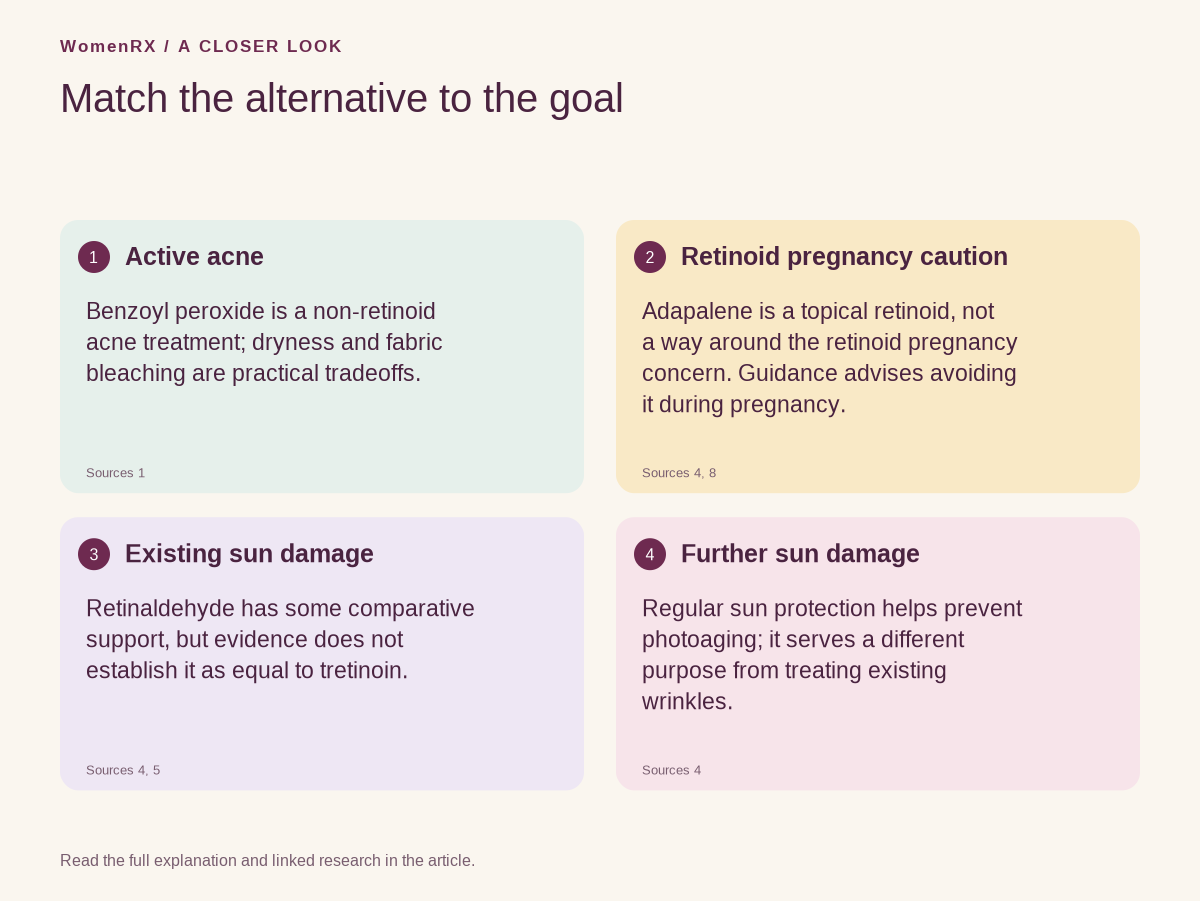
Match the alternative to the goal
Active acne: Benzoyl peroxide is a non-retinoid acne treatment; dryness and fabric bleaching are practical tradeoffs.1
Retinoid pregnancy caution: Adapalene is a topical retinoid, not a way around the retinoid pregnancy concern. Guidance advises avoiding it during pregnancy.48
Existing sun damage: Retinaldehyde has some comparative support, but evidence does not establish it as equal to tretinoin.45
Further sun damage: Regular sun protection helps prevent photoaging; it serves a different purpose from treating existing wrinkles.4
Read the figure as text
The closest-sounding product is not always the closest match for the concern you want to treat.- Active acne: Benzoyl peroxide is a non-retinoid acne treatment; dryness and fabric bleaching are practical tradeoffs.1
- Retinoid pregnancy caution: Adapalene is a topical retinoid, not a way around the retinoid pregnancy concern. Guidance advises avoiding it during pregnancy.48
- Existing sun damage: Retinaldehyde has some comparative support, but evidence does not establish it as equal to tretinoin.45
- Further sun damage: Regular sun protection helps prevent photoaging; it serves a different purpose from treating existing wrinkles.4
More questions, answered
Is adapalene the same as tretinoin?
No. They’re different topical retinoids. Their shared drug class does not establish how adapalene compares with tretinoin for acne. During pregnancy, guidance advises avoiding topical retinoids such as adapalene. 48
Can benzoyl peroxide replace tretinoin for wrinkles?
Benzoyl peroxide is an acne treatment, not an established substitute for tretinoin’s effects on sun-related wrinkles. The distinction matters if you’re treating both concerns. 14
Sources you can check
- Benzoyl peroxide: a medicine to treat acne - NHSAccessed 2026-09-25Return to first citation
- TRETINOIN CAPSULE [PAR HEALTH USA, LLC] | US prescribing information and patient instructionsAccessed 2026-09-25Return to first citation
- Acne - NHSAccessed 2026-09-25Return to first citation
- Tretinoin for Photodamaged Facial Skin: Systematic Review and Meta-Analysis of Randomized Controlled Trials.Huang HY, Lee LT. · Dermatology practical & conceptual · 2025Return to first citation
- Comparing Tretinoin to Other Topical Therapies in the Treatment of Skin Photoaging: A Systematic Review.Siddiqui Z, Zufall A, Nash M, Rao D, Hirani R, Russo M. · American journal of clinical dermatology · 2024Return to first citation
- Cosmeceuticals in photoaging: A review.Chan LKW, Lee KWA, Lee CH, Lam KWP, Lee KFV, Wu R, Wan J, Shivananjappa S, Sky WTH, Choi H, Yi KH. · Skin research and technology : official journal of International Society for Bioengineering and the Skin (ISBS) [and] International Society for Digital Imaging of Skin (ISDIS) [and] International Society for Skin Imaging (ISSI) · 2024Return to first citation
- Use of Topical Tazarotene for the Treatment of Acne Vulgaris in Pregnancy: A Literature Review.Han G, Wu JJ, Del Rosso JQ. · The Journal of clinical and aesthetic dermatology · 2020Return to first citation
- Over-the-Counter Medications in Pregnancy.Powers EA, Tewell R, Bayard M. · American family physician · 2023Return to first citation