Tretinoin Alternatives Depend on What You’re Treating
For acne, azelaic acid and benzoyl peroxide have clearer treatment guidance than bakuchiol; for wrinkles or discoloration, the evidence is less conclusive.
If you’re looking for a non-retinoid acne option, azelaic acid has clinical-guidance support, and benzoyl peroxide is another option for mild acne. Bakuchiol is marketed as a retinoid alternative, but many human studies are uncontrolled or test it in combination products, so they don’t establish that it works as a substitute for tretinoin. The best comparison depends on your skin concern. 1 2 4

Start with the concern, not the ingredient trend
Tretinoin is a topical retinoid used for acne. Retinoids can help keep dead skin cells from building up inside hair follicles, but they can also cause irritation or stinging. A non-retinoid alternative may be worth considering if irritation is a problem, but an ingredient marketed as “natural” isn’t automatically gentler, equally effective, or safe in pregnancy. 2
For acne: azelaic acid is a supported alternative
Azelaic acid is a non-retinoid acne treatment included in clinical guidance. It may be used as an alternative when benzoyl peroxide or topical retinoids are especially irritating or painful. That makes it a more evidence-grounded place to start comparing options than a product’s “retinol alternative” label. 2
Benzoyl peroxide is another option for mild acne. One practical tradeoff: it can bleach clothing. Acne treatments may take time to show an effect, so switching rapidly between products can make it hard to tell what’s helping. 1 2
Bakuchiol has some human acne research, but it doesn’t show that bakuchiol alone replaces tretinoin. In one randomized trial, 111 people with acne used adapalene, a different topical retinoid, alongside either a cream containing bakuchiol, Ginkgo biloba extract, and mannitol or a vehicle cream. After two months, some acne measures favored the combination containing those ingredients. Because bakuchiol was part of a multi-ingredient product added to adapalene, the result can’t tell us whether bakuchiol alone treats acne or can substitute for tretinoin. 3
A systematic review of human bakuchiol trials found that many were open-label and uncontrolled, and that combination formulas made it difficult to compare bakuchiol with retinoids. That’s a reason to be cautious about claims of equivalent results, not proof that bakuchiol has no effect. 4
For wrinkles or discoloration: don’t assume the acne evidence transfers
Bakuchiol has been studied for skin concerns including aging and post-inflammatory hyperpigmentation, but the quality and design of human studies limit what can be concluded. Evidence for one concern doesn’t automatically establish a useful effect for another. 4
So, if your goal is discoloration or signs of aging, look for evidence on the full formula and the specific concern rather than relying on a single “retinol alternative” ingredient claim. The available findings don’t establish that bakuchiol is a like-for-like replacement for tretinoin. 4
Pregnancy changes the decision
Acne-treatment guidance says topical retinoids are not suitable during pregnancy. That guidance does not establish whether bakuchiol or other non-retinoid alternatives are safe during pregnancy, so “natural” or “plant-based” marketing isn’t enough to answer that question. 2
When an alternative isn’t enough
If acne is causing deep, painful nodules or cysts, or you’re developing scars, it deserves more than a trial-and-error skincare swap. Those forms of acne can scar and need appropriate treatment. 1
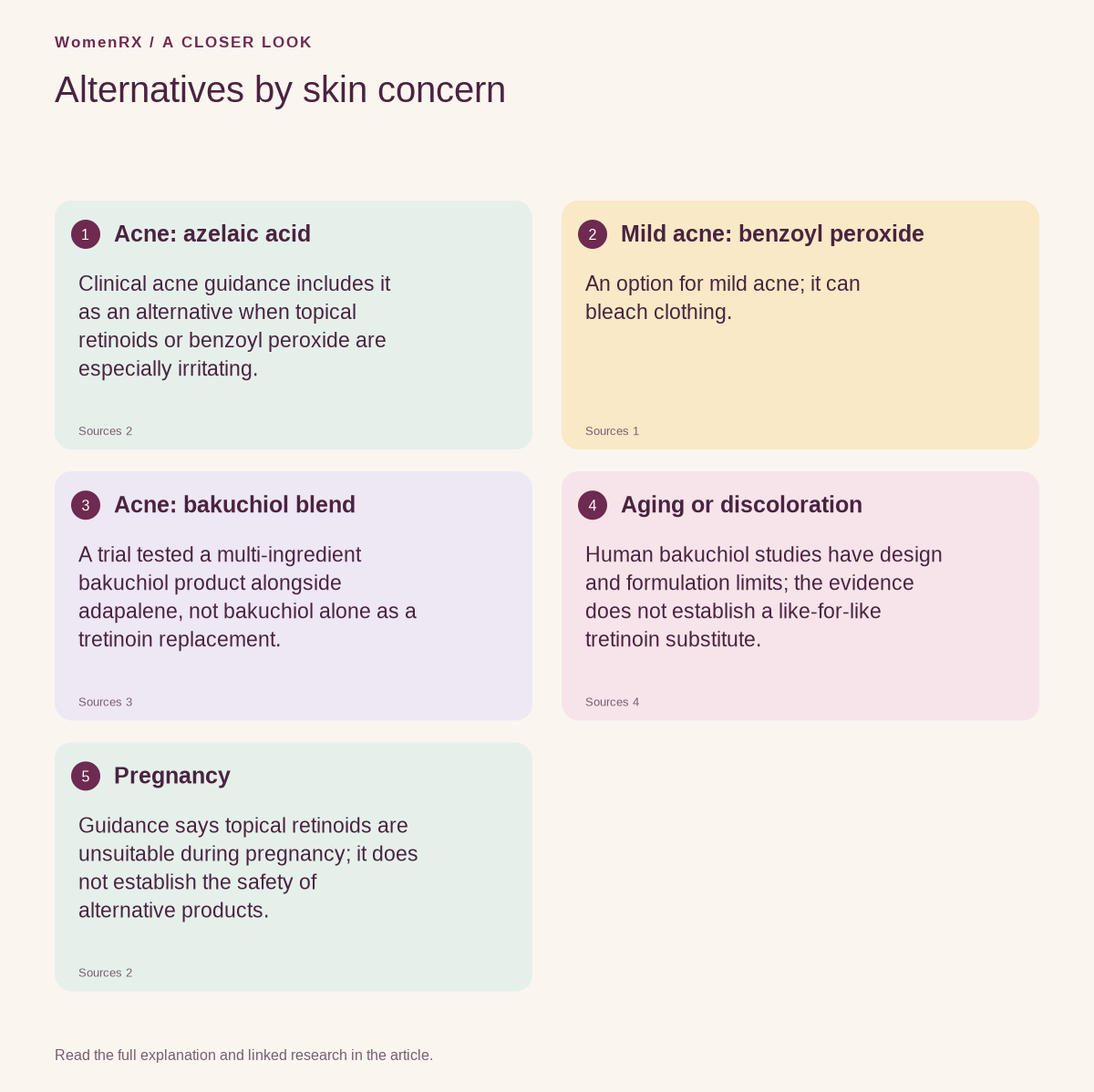
Alternatives by skin concern
Acne: azelaic acid: Clinical acne guidance includes it as an alternative when topical retinoids or benzoyl peroxide are especially irritating.2
Mild acne: benzoyl peroxide: An option for mild acne; it can bleach clothing.1
Acne: bakuchiol blend: A trial tested a multi-ingredient bakuchiol product alongside adapalene, not bakuchiol alone as a tretinoin replacement.3
Aging or discoloration: Human bakuchiol studies have design and formulation limits; the evidence does not establish a like-for-like tretinoin substitute.4
Pregnancy: Guidance says topical retinoids are unsuitable during pregnancy; it does not establish the safety of alternative products.2
Read the figure as text
The evidence depends on what you want to treat. These options are not interchangeable, and a multi-ingredient study does not establish an ingredient’s effect on its own.- Acne: azelaic acid: Clinical acne guidance includes it as an alternative when topical retinoids or benzoyl peroxide are especially irritating.2
- Mild acne: benzoyl peroxide: An option for mild acne; it can bleach clothing.1
- Acne: bakuchiol blend: A trial tested a multi-ingredient bakuchiol product alongside adapalene, not bakuchiol alone as a tretinoin replacement.3
- Aging or discoloration: Human bakuchiol studies have design and formulation limits; the evidence does not establish a like-for-like tretinoin substitute.4
- Pregnancy: Guidance says topical retinoids are unsuitable during pregnancy; it does not establish the safety of alternative products.2
More questions, answered
Does bakuchiol replace tretinoin for acne?
Human studies don’t establish that bakuchiol alone replaces tretinoin. One acne trial tested a multi-ingredient bakuchiol product alongside adapalene, so it can’t show how bakuchiol performs by itself. 3 4
Does “natural” mean a product is safe during pregnancy?
No. Topical retinoids are not suitable during pregnancy, but the acne-treatment guidance doesn’t establish the pregnancy safety of bakuchiol or other alternative products. “Natural” marketing alone doesn’t answer that question. 2
Sources you can check
- Acne - NHSAccessed 2026-09-25Return to first citation
- Acne - Treatment - NHSAccessed 2026-09-25Return to first citation
- A dermocosmetic containing bakuchiol, Ginkgo biloba extract and mannitol improves the efficacy of adapalene in patients with acne vulgaris: result from a controlled randomized trial.Poláková K, Fauger A, Sayag M, Jourdan E. · Clinical, cosmetic and investigational dermatology · 2015Return to first citation
- Human Clinical Trials Using Topical Bakuchiol Formulations for the Treatment of Skin Disorders: A Systematic Review.Fanning JE, McGee SA, Ibrahim OI. · Journal of drugs in dermatology : JDD · 2024Return to first citation