Can You Make Pores Look Smaller? What Actually Helps
You may be able to soften the look of visible pores, but treatments aim to change their appearance, not permanently close them.
Visible pores can look more prominent with excess oil, larger hair follicles, or reduced skin elasticity, so there isn’t one cause or one fix. Topical retinoids and in-office procedures are options, but the research offers limited guidance on the size and staying power of results. Think of treatment as a possible change in appearance, not pore closure. 2 4

Why pores stand out
Pores are openings associated with hair follicles and oil-producing glands. Their appearance can be influenced by several things at once: excess sebum, larger follicles, and less elastic skin. Age, acne, and skincare routines may also contribute. That means a pore-focused product may not address the factor that matters most for your skin. 2
Oil and skin support are different targets. Reducing the look of surface oil may help with shine, while reduced elasticity concerns the skin around the opening. Neither outcome, on its own, shows that the pore opening has been permanently changed. Studies of treatments typically measure visible features such as pore volume or pore counts, not permanent closure. 2 3
At-home retinoids: an option, not a guarantee
A dermatology review lists topical retinoids among the treatments used for enlarged facial pores, alongside approaches that address related factors such as oiliness and skin aging. It doesn’t give a reliable estimate of how much a retinoid will change pore appearance or how long any change will last. 4
Tretinoin cream can irritate skin and make it more susceptible to sunburn. Its prescribing information also cautions against piling on other products that dry or irritate the skin. If you’re considering tretinoin for pores, weigh those effects against a cosmetic benefit that isn’t well quantified. It’s not a case where using more will make pores change faster. 1
Procedures: measured changes, with limits
One small split-face randomized study tested two hyaluronic-acid filler formulations in people with enlarged pores. Of 30 enrolled participants, 29 completed the study. Each received one formulation on each cheek over three sessions spaced four weeks apart. Both sides had lower measured pore volume than at baseline through week 32. The study compared two fillers with each other, not a filler with no treatment, so it can’t tell you how much change to expect compared with doing nothing. Mild pain, swelling, and bruising were reported. 2
A separate randomized trial studied 38 Asian women ages 30 to 60, with 19 assigned to fractional picosecond laser and 19 to intense pulsed light. After three treatments, the laser group had better T-zone pore-count results than the IPL group. The abstract doesn’t report the size of that difference or establish how long it lasts; redness was the most frequent temporary response in both groups. This is a comparison between two procedures, not proof that either is the right choice for every woman or skin type. 3
The practical tradeoff is that procedures may offer measured cosmetic improvement but involve treatment sessions and procedure-related effects. The small studies above don’t show that the results are permanent. If you’re weighing a procedure, ask what outcome is measured, how long it was followed, and whether the comparison was against another treatment or against no treatment.
Do hormones explain visible pores?
Sex hormones are mentioned as one possible influence on pore size, but that doesn’t establish hormones as the reason an individual woman has visible pores. The laser trial included women only, so it shows results in that group but doesn’t compare women’s responses with men’s. The filler study also doesn’t establish a hormone-based explanation or a distinct treatment response for women. 2 3
A useful first decision is whether your main concern is shine, skin texture, or the appearance of pores around areas with less skin support. Those concerns can overlap, but they aren’t interchangeable. For an at-home option, retinoids have a place in the treatment discussion, with irritation as a real tradeoff. For a procedure, look for a clear explanation of the measured result and its follow-up period, rather than a promise to close pores.
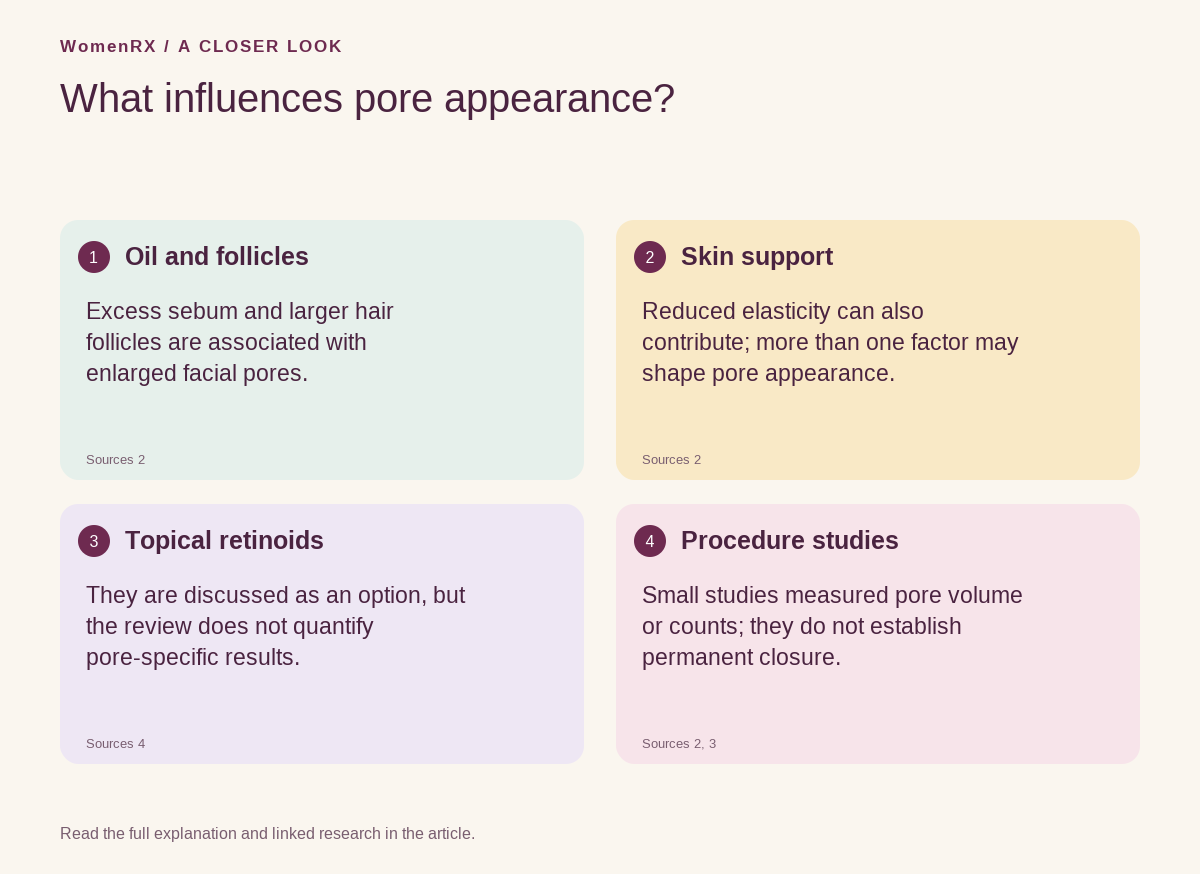
What influences pore appearance?
Oil and follicles: Excess sebum and larger hair follicles are associated with enlarged facial pores.2
Skin support: Reduced elasticity can also contribute; more than one factor may shape pore appearance.2
Topical retinoids: They are discussed as an option, but the review does not quantify pore-specific results.4
Procedure studies: Small studies measured pore volume or counts; they do not establish permanent closure.23
Read the figure as text
These factors and treatment findings help separate what may affect visible pores from what has been measured in small procedure studies.- Oil and follicles: Excess sebum and larger hair follicles are associated with enlarged facial pores.2
- Skin support: Reduced elasticity can also contribute; more than one factor may shape pore appearance.2
- Topical retinoids: They are discussed as an option, but the review does not quantify pore-specific results.4
- Procedure studies: Small studies measured pore volume or counts; they do not establish permanent closure.23
More questions, answered
Does having visible pores mean my hormones are the cause?
No. Hormones are one possible influence discussed in research, but visible pores can also relate to oil, follicle size, skin elasticity, age, and acne. The available findings don’t identify the cause for an individual woman. 2
Sources you can check
- TRETINOIN CREAM [REDPHARM DRUG] | US prescribing information and patient instructionsAccessed 2026-09-25Return to first citation
- Superficial Intradermal Injections of Cohesive Polydensified Matrix Hyaluronic Acid Fillers for the Improvement of Facial Pores and Skin Quality: A Split-Face Randomized Study.Rutnumnoi T, Palakornkitti P, Anuntrangsee T, Yongpisarn T, Sakpuwadol N, Vachiramon V. · Journal of cosmetic dermatology · 2025Return to first citation
- Comparative Study of a 1064 nm Fractional Picosecond Laser Versus Intense Pulsed Light in Facial Rejuvenation: A Prospective Randomized Trial.Zhang J, Wu C, Liu Y, Yan F, Chen Q, Zhu Y, Xiang LF, Ren J. · Lasers in surgery and medicine · 2026Return to first citation
- Enlarged facial pores: an update on treatments.Dong J, Lanoue J, Goldenberg G. · Cutis · 2016Return to first citation