Hyaluronic Acid or Retinol: Choose by Skin Goal
Hyaluronic acid is the clearer choice for hydration; retinol is a different kind of ingredient, with more uncertainty about what a particular cosmetic product will do.
Choose a hyaluronic-acid product if your main concern is skin that feels dry or looks temporarily less plump. If your goal is acne or longer-term changes in texture, don’t treat cosmetic retinol as interchangeable with a studied acne treatment: the stronger acne evidence concerns topical retinoids as a class. You can consider hydration alongside a retinoid, but tolerance, pregnancy, and breastfeeding change the decision. 365

Start with the change you want to see
Hyaluronic acid and retinol aren’t competing versions of the same product. Topical hyaluronic acid attracts and holds water, making hydration its most direct job. Small clinical trials in women have found improvements in skin hydration and, in some studies, measures of skin appearance. That makes it a reasonable ingredient to look for when your skin feels dry or you want a more hydrated look. It doesn’t follow that a hyaluronic-acid serum treats acne. 3
Retinol belongs to the retinoid family. 8 But the name on a cosmetic bottle doesn’t tell you that it will perform like a prescription retinoid. Topical retinoids have an established role in acne care because they help prevent clogged pores and new lesions; they can also irritate skin. That evidence is more useful for an acne decision than assuming any retinol-containing cosmetic will do the same job. 6
For visible wrinkles, there is some encouraging product-level evidence, with an important catch. In one placebo-controlled study of 87 women, a cream containing retinol, hyaluronic acid, and another ingredient reduced the appearance of wrinkles. Because the ingredients were tested together, the result can’t tell you how much retinol contributed or predict the result from a different retinol product. A separate laboratory study compared how retinol and other vitamin A derivatives behaved in human skin models; it wasn’t a clinical test of wrinkle improvement. 78
So if dryness is what you notice every day, start with hydration. If persistent acne is the problem, look for evidence-based acne care rather than expecting a hydrating serum to clear it or choosing cosmetic retinol solely because it’s a retinoid. If fine lines are your goal, judge a retinol product as a formulation, not a guaranteed effect of one ingredient. 367
Can you use both?
Yes, the goals can coexist: you might want a retinoid for acne while also wanting your skin to feel less dry. A cream containing both retinol and hyaluronic acid was studied without the combination itself being the research question. That study does not establish an ideal order for layering two separate products, or show that hyaluronic acid prevents retinoid irritation. 7
A practical way to think about a routine is to give each product one job. A hyaluronic-acid moisturizer or serum is there for hydration. A retinoid is there for the condition you’re trying to treat. If you already use prescription tretinoin and your skin is red or peeling, pay attention to that response before adding products that dry or irritate it. The prescribing information specifically cautions about strongly drying cleansers and cosmetics, as well as certain other topical treatments. It doesn’t identify hyaluronic acid as an incompatible ingredient. 2
You don’t need to use both just because both appear on skin-care shelves. If a simple hydrating product meets your goal, adding a retinoid introduces a different purpose and the possibility of irritation. 23
Pregnancy and breastfeeding change the retinoid decision
If you’re pregnant, avoid using a topical retinoid as a precaution. That advice isn’t the same as saying a past application is known to harm a pregnancy. A large Nordic cohort did not observe an increased rate of major congenital malformations among infants with recorded first-trimester topical-retinoid exposure, but its authors noted that studying pregnancies resulting in birth could miss some outcomes. A systematic review likewise found no statistically significant increase in major malformations or spontaneous abortion, with results driven largely by one large registry study. Neither finding establishes that ongoing topical-retinoid use during pregnancy is risk-free. 54
If you’re breastfeeding, don’t transfer the pregnancy finding into an answer about nursing. Whether a particular topical retinoid is suitable depends on the product and how it’s used; check the specific product with your prescribing clinician if you’re considering one. General breastfeeding guidance notes that some medicines can pass into breast milk, but it doesn’t establish what happens with your skin-care product. 1
Hyaluronic acid’s hydration evidence does not establish pregnancy or breastfeeding safety for every finished cosmetic formula, which may contain other ingredients. Check the full ingredient list rather than making the decision from the words “hyaluronic acid” alone. 3
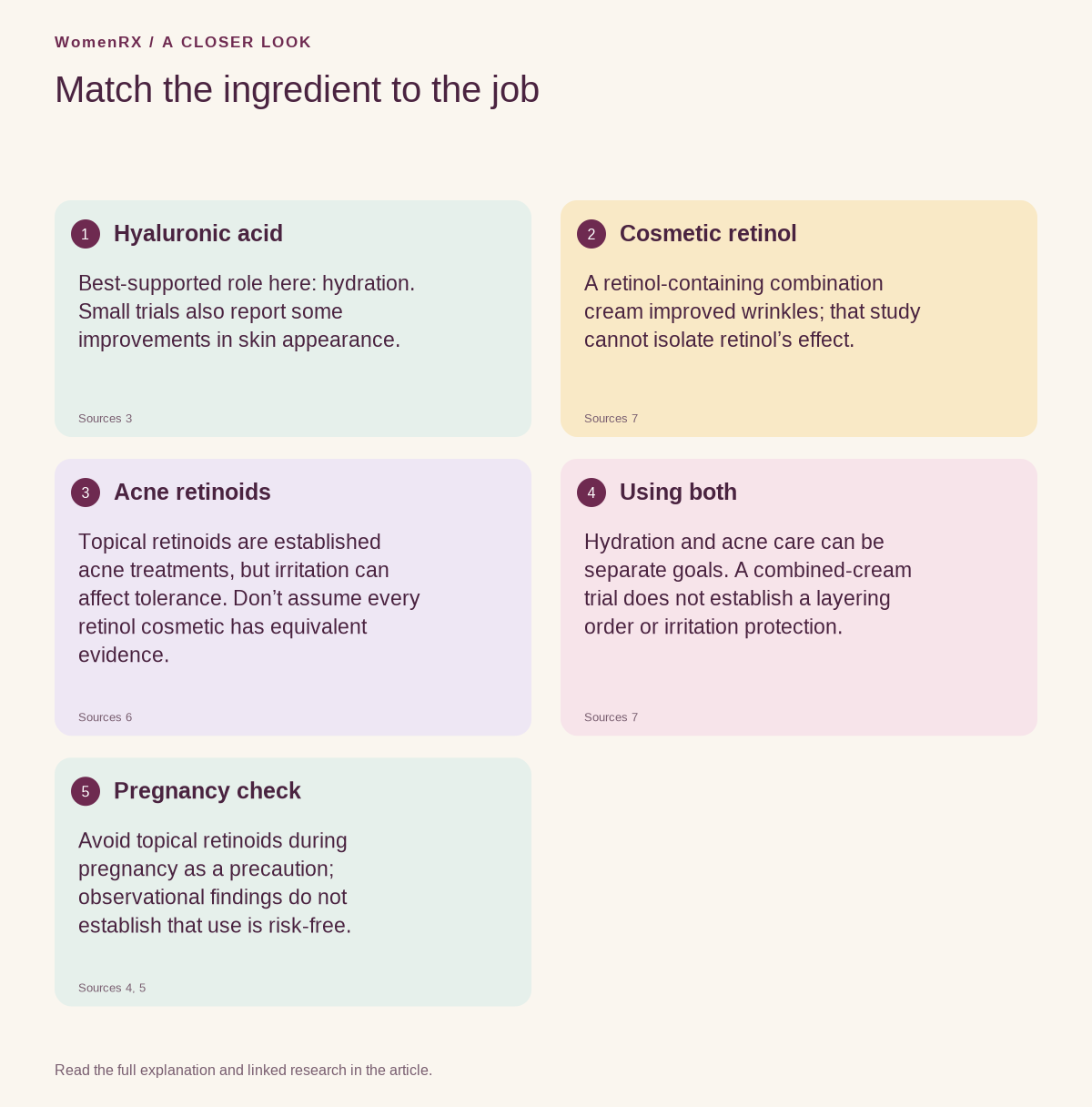
Match the ingredient to the job
Hyaluronic acid: Best-supported role here: hydration. Small trials also report some improvements in skin appearance.3
Cosmetic retinol: A retinol-containing combination cream improved wrinkles; that study cannot isolate retinol’s effect.7
Acne retinoids: Topical retinoids are established acne treatments, but irritation can affect tolerance. Don’t assume every retinol cosmetic has equivalent evidence.6
Using both: Hydration and acne care can be separate goals. A combined-cream trial does not establish a layering order or irritation protection.7
Pregnancy check: Avoid topical retinoids during pregnancy as a precaution; observational findings do not establish that use is risk-free.45
Read the figure as text
These are different decisions, not two interchangeable ways to treat dry skin.- Hyaluronic acid: Best-supported role here: hydration. Small trials also report some improvements in skin appearance.3
- Cosmetic retinol: A retinol-containing combination cream improved wrinkles; that study cannot isolate retinol’s effect.7
- Acne retinoids: Topical retinoids are established acne treatments, but irritation can affect tolerance. Don’t assume every retinol cosmetic has equivalent evidence.6
- Using both: Hydration and acne care can be separate goals. A combined-cream trial does not establish a layering order or irritation protection.7
- Pregnancy check: Avoid topical retinoids during pregnancy as a precaution; observational findings do not establish that use is risk-free.45
More questions, answered
Is retinol the same as prescription tretinoin?
No. They’re both retinoids 84, but evidence and instructions for a prescription tretinoin cream shouldn’t be assumed to apply to every cosmetic retinol formula. In particular, tretinoin’s product information describes possible early peeling and discomfort; it doesn’t measure the effects of an unrelated retinol serum. 2
Sources you can check
- Breastfeeding | Benefits of Breastfeeding | MedlinePlusAccessed 2026-09-25Return to first citation
- TRETINOIN CREAM [REDPHARM DRUG] | US prescribing information and patient instructionsAccessed 2026-09-25Return to first citation
- Benefits of topical hyaluronic acid for skin quality and signs of skin aging: From literature review to clinical evidence.Bravo B, Correia P, Gonçalves Junior JE, Sant'Anna B, Kerob D. · Dermatologic therapy · 2022Return to first citation
- Topical retinoids and risk of major congenital malformations and spontaneous abortion: a systematic review and meta-analysis.Alali AB, Alhammad FA, Almohammed Saleh JA, Alshaikh SB, Alshayeb ZK, Al Nujaidi AJ, Albinsaleh AA, Almutawah MR, Alhodibi MH, Albesher MA. · Frontiers in drug safety and regulation · 2026Return to first citation
- Topical retinoid use in women of reproductive age and risk of major congenital malformations in exposed pregnancies: a Nordic cohort study.Refsum E, Furu K, Cesta CE, Nørgaard M, Wittström F, Zoega H, Ulrichsen SP, Cohen JM. · The British journal of dermatology · 2026Return to first citation
- PRACT-India: Practical Recommendations on Acne Care and Medical Treatment in India-A Modified Delphi Consensus.Madnani N, Saraswat A, Nott A, Jakhar D, Gupta LK, Kohli M, Puhan MR, Sangolli P, Nagar R, Rathi SK, Aurangabadkar S, DA S, Ka S, Dogra S, Dhoot D, Balasubramanian A, Patil S, Bark... · Antibiotics (Basel, Switzerland) · 2025Return to first citation
- The skin aging index: a new approach for documenting anti-aging products or procedures.Nkengne A, Roure R, Rossi AB, Bertin C. · Skin research and technology : official journal of International Society for Bioengineering and the Skin (ISBS) [and] International Society for Digital Imaging of Skin (ISDIS) [and] International Society for Skin Imaging (ISSI) · 2013Return to first citation
- The vitamin A ester retinyl propionate has a unique metabolic profile and higher retinoid-related bioactivity over retinol and retinyl palmitate in human skin models.Bjerke DL, Li R, Price JM, Dobson RLM, Rodrigues M, Tey C, Vires L, Adams RL, Sherrill JD, Styczynski PB, Goncalves K, Maltman V, Przyborski S, Oblong JE. · Experimental dermatology · 2021Return to first citation