Menopausal Skin Changes: Choose Ingredients by Concern
Tretinoin has clinical evidence for sun-related skin changes, while claims that other ingredients reverse menopause-related dryness need more care.
If dryness or sensitivity is your main concern, don’t assume an ingredient marketed for “menopausal skin” has been tested for it. Lower estrogen is associated with changes in skin hydration and barrier function, but that doesn’t prove a particular cream will correct them. Tretinoin has stronger evidence for wrinkles and uneven pigmentation caused by sun exposure, not for reversing menopausal skin changes. 42
Skin can feel different around menopause, and the change may be especially noticeable when a familiar product no longer feels comfortable. A review focused on postmenopausal skin links lower estrogen with dryness, changes in the skin barrier, and reduced collagen. Sun exposure contributes to a different, overlapping set of concerns, including wrinkles, roughness, and uneven pigmentation. Those two explanations can overlap on your face, but studies of sun damage don’t automatically answer questions about menopause-related dryness. 41
If dryness is the problem, look past the ingredient story
Hyaluronic acid: The name has a real connection to skin biology. The postmenopausal skin review describes lower hyaluronic acid content within the skin alongside reduced hydration. It doesn’t follow that applying hyaluronic acid in a serum restores what changed beneath the surface or has a proven menopause-specific benefit. That’s a distinction between a change researchers describe and a result a product has demonstrated. 4
Ceramides: They may appear on products aimed at dry skin, but an ingredient name alone can’t tell you how a finished product will feel on your skin or whether it improves dryness specifically linked to menopause. If comfort is the goal, judge a product by that goal rather than by a claim that it replaces lost estrogen or reverses skin aging. The postmenopausal skin review describes barrier changes, but it does not establish a ceramide treatment result. 4
If a product stings or leaves your skin feeling worse, its promise on the label is less useful than your experience using it. Persistent or troublesome skin changes also deserve a closer look rather than automatically being attributed to menopause.
If wrinkles or uneven tone bother you, ask what caused them
Tretinoin has a clearer treatment record for photoaging, the skin changes associated with repeated sun exposure. A systematic review of seven randomized trials reported improvements in concerns such as wrinkling and mottled pigmentation. Four trials enrolled only women; women were the majority in the other three. The review did not report results by menopausal stage, so it cannot tell you whether tretinoin works differently during perimenopause or after menopause. 2
A separate review comparing topical treatments also assessed facial photoaging, not menopause-related dryness or thinning. That makes tretinoin worth distinguishing from ingredients supported mainly by a biological explanation, but it isn’t a reason to treat every new skin concern with a photoaging ingredient. The tretinoin trials also varied in formulation and how they measured improvement. 12
For example, if your main concern is uneven, sun-related pigmentation, the tretinoin research is relevant to the question you’re asking. If your main concern is a newly tight, uncomfortable feeling after washing your face, wrinkle results don’t answer it. And if your skin is already sensitive, how you tolerate a product matters alongside any reported improvement; comparisons of photoaging treatments include adverse effects as well as benefits. 12
Topical estrogen is a different decision
Because estrogen affects skin biology, a postmenopausal skin review discusses topical estrogen as a possible way to address some changes. That proposal isn’t an established reason to use estrogen as a routine facial ingredient. Menopause hormone-therapy guidance addresses treatment for concerns such as bothersome hot flashes and genitourinary symptoms, with benefits and risks considered for the individual. Its recommendation of low-dose vaginal estrogen for certain genitourinary symptoms is not a recommendation to apply estrogen to facial skin. 43
A useful filter is to finish this sentence before choosing a product: “I want help with ___.” Dry, uncomfortable skin; visible sun damage; and a proposed hormonal skin treatment are different questions. The ingredient with the strongest evidence for one isn’t necessarily the right answer to another.
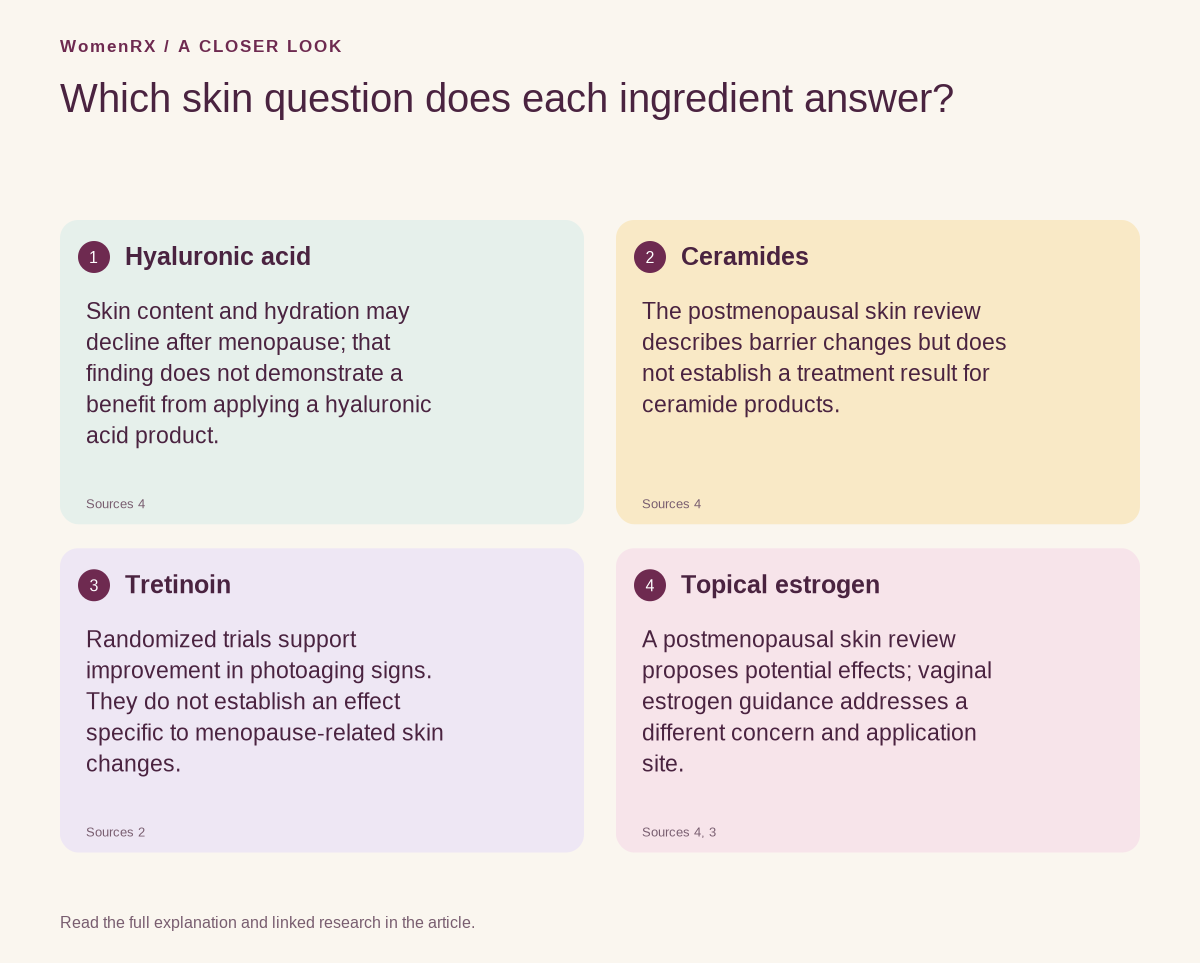
Which skin question does each ingredient answer?
Hyaluronic acid: Skin content and hydration may decline after menopause; that finding does not demonstrate a benefit from applying a hyaluronic acid product.4
Ceramides: The postmenopausal skin review describes barrier changes but does not establish a treatment result for ceramide products.4
Tretinoin: Randomized trials support improvement in photoaging signs. They do not establish an effect specific to menopause-related skin changes.2
Topical estrogen: A postmenopausal skin review proposes potential effects; vaginal estrogen guidance addresses a different concern and application site.43
Read the figure as text
Compare the concern you want to address with the type of evidence behind each ingredient.- Hyaluronic acid: Skin content and hydration may decline after menopause; that finding does not demonstrate a benefit from applying a hyaluronic acid product.4
- Ceramides: The postmenopausal skin review describes barrier changes but does not establish a treatment result for ceramide products.4
- Tretinoin: Randomized trials support improvement in photoaging signs. They do not establish an effect specific to menopause-related skin changes.2
- Topical estrogen: A postmenopausal skin review proposes potential effects; vaginal estrogen guidance addresses a different concern and application site.43
Sources you can check
- Comparative efficacy of topical interventions for facial photoaging: a network meta-analysis.Lin L, Chen X, Liu C, Wang Q, Lian W, Xu X, Guo Y, Zhong H, Zhong J, Zhao N, Cheng W, Shu P, Xu Z. · Scientific reports · 2025Return to first citation
- Topical tretinoin for treating photoaging: A systematic review of randomized controlled trials.Sitohang IBS, Makes WI, Sandora N, Suryanegara J. · International journal of women's dermatology · 2022Return to first citation
- The 2022 hormone therapy position statement of The North American Menopause Society.“The 2022 Hormone Therapy Position Statement of The North American Menopause Society” Advisory Panel. · Menopause (New York, N.Y.) · 2022Return to first citation
- Menopause and the Skin: Old Favorites and New Innovations in Cosmeceuticals for Estrogen-Deficient Skin.Lephart ED, Naftolin F. · Dermatology and therapy · 2021Return to first citation