Does Topical Hyaluronic Acid Help Dry Skin?
Topical hyaluronic acid can help skin feel hydrated, but it’s an optional addition to a moisturizer that already works for you.
Topical hyaluronic acid can help skin retain moisture near its surface, so it may be worth trying if your skin feels dry. You can use it as an optional layer before a moisturizer you already tolerate. Keep expectations to hydration and temporary changes in appearance: a topical product and an injectable filler are different uses of hyaluronic acid. 1 2
What you can expect from a topical product
Hyaluronic acid (HA) is a water-binding substance naturally present in skin. In a serum or cream, it can help retain moisture near the surface. Hydrated skin may feel more comfortable, and fine lines may look less noticeable while the skin is moisturized. That isn’t the same as removing wrinkles. 1 2
HA is also used in injectable fillers, but those are aesthetic procedures, not topical skincare. Evidence about one use doesn’t establish what the other can do. If a product description borrows language or images from filler treatments, judge the serum or cream by the more modest outcome it can offer: hydration. 1
How it fits alongside moisturizer
If you want to try an HA serum, a simple approach is to apply it before your usual moisturizer, following the products’ directions. Treat the serum as an optional hydrating layer, not a necessary replacement for a moisturizer you like. A study of one moisturizer formulated with natural moisturizing factors and lipids found improved surface hydration and reduced water loss over four weeks. It didn’t test whether adding an HA serum works better than using that moisturizer alone. 3
You don’t need a separate serum just because a label highlights HA. Some moisturizers already contain it, and a product without HA may still suit your dry skin. For example, if your current moisturizer leaves your skin comfortable, an extra layer may offer little practical benefit. If dryness still bothers you, the useful question is whether adding the serum makes a noticeable difference to how your skin feels.
Should you look for a particular molecular weight?
HA comes in different molecular sizes. Larger forms tend to remain closer to the skin’s surface, while some smaller forms can penetrate farther. Researchers are still working out exactly how topical HA moves through skin, and penetration alone doesn’t tell you how well a finished product will relieve dryness. 1 2
A “low molecular weight” label, then, isn’t a reliable shortcut to the best product. How the whole formula feels on your skin matters more to this decision than a promise that one ingredient reaches deeper.
Does the answer change for women?
The evidence described in reviews of topical HA doesn’t establish a different hydration effect for women or identify a best HA formula by women’s age or skin type. That’s a limit on making tailored claims, not proof that everyone’s skin responds alike. For this decision, start with your skin’s dryness and how well your current moisturizer works rather than a product’s claim to be made specifically for women. 1
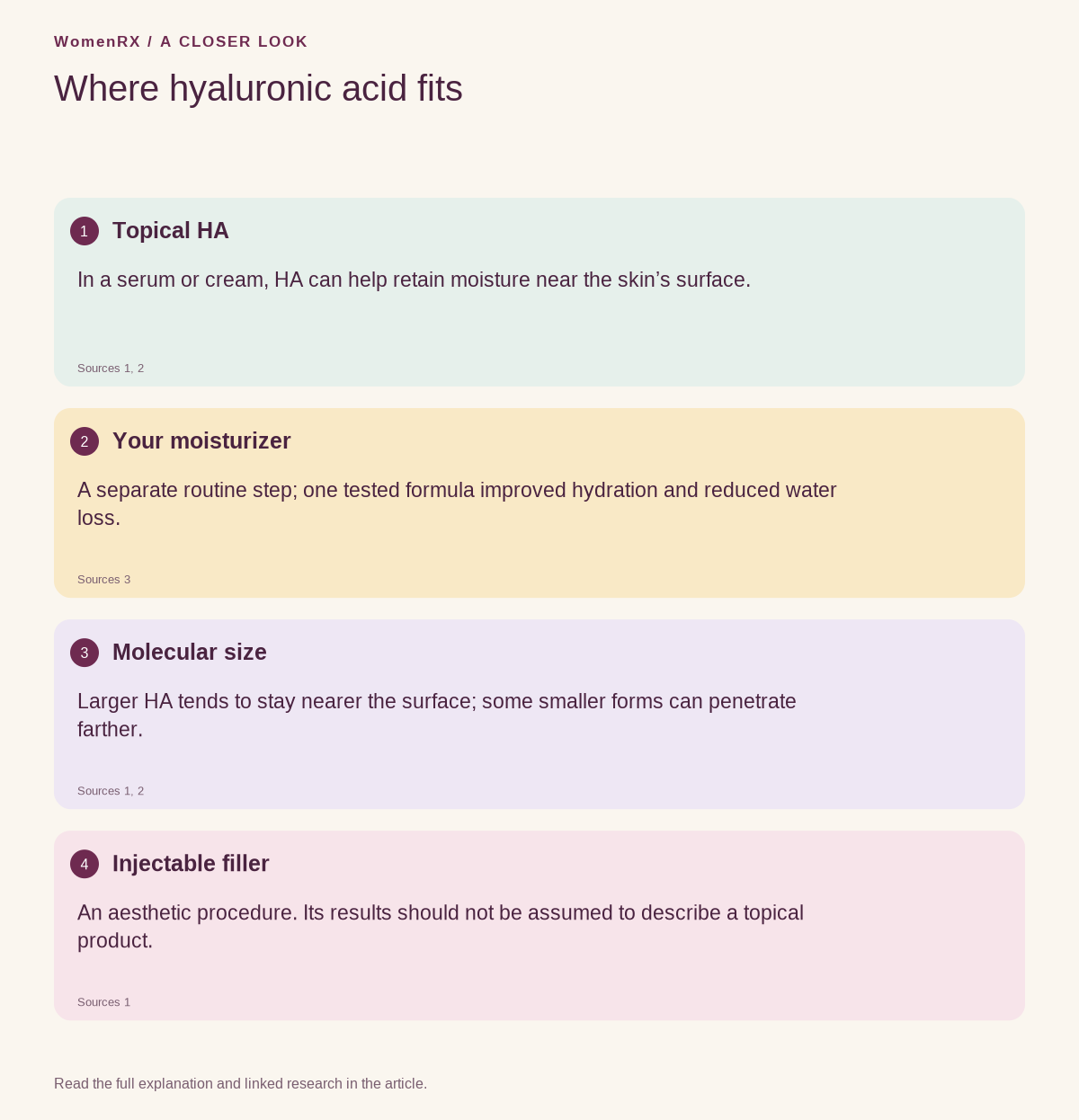
Where hyaluronic acid fits
Topical HA: In a serum or cream, HA can help retain moisture near the skin’s surface.12
Your moisturizer: A separate routine step; one tested formula improved hydration and reduced water loss.3
Molecular size: Larger HA tends to stay nearer the surface; some smaller forms can penetrate farther.12
Injectable filler: An aesthetic procedure. Its results should not be assumed to describe a topical product.1
Read the figure as text
These uses of hyaluronic acid answer different questions about dry skin and appearance.- Topical HA: In a serum or cream, HA can help retain moisture near the skin’s surface.12
- Your moisturizer: A separate routine step; one tested formula improved hydration and reduced water loss.3
- Molecular size: Larger HA tends to stay nearer the surface; some smaller forms can penetrate farther.12
- Injectable filler: An aesthetic procedure. Its results should not be assumed to describe a topical product.1
Sources you can check
- Hyaluronic Acid in Topical Applications: The Various Forms and Biological Effects of a Hero Molecule in the Cosmetics Industry.Zanchetta C, Scandolera A, Reynaud R. · Biomolecules · 2025Return to first citation
- Hyaluronic Acid-like Skin Plumping and Radiance Benefits of a Porphyridium Sulfated Exopolysaccharide- and Natural PDRN-Rich Extract.Havas F, Krispin S, Cohen M, Attia-Vigneau J. · Marine drugs · 2026Return to first citation
- Skin Barrier Benefits of a Natural Moisturizing Factor and Lipids-Based Moisturizer for Clinically Sensitive Skin.Bernhardt KT, Zaleski E, Li WH, Patel R, Parsa R, Miller D, Draelos ZD, Bianchini JM. · Journal of drugs in dermatology : JDD · 2025Return to first citation