Dry Skin in Perimenopause: What Helps and What’s Different
Hormonal changes may contribute to dry skin, but ongoing itch, redness, or a recurring rash can point to something more than ordinary dryness.
Dryness can become more noticeable around menopause, and lower estrogen may play a role, but it isn’t the only possible cause. Try a simple routine: use a gentle cleanser, pause products that seem to irritate your skin, and moisturize regularly. Persistent itch, redness, scaling, or a recurring rash can suggest an inflammatory skin condition that needs a different approach. 3 1
Hormones may be part of the picture, not the whole story
Dryness and itch are reported around menopause. A review of research on menopause and skin describes a possible link between lower estrogen, changes in the skin barrier, and increased water loss. But the authors also say the mechanisms need more study. That makes hormonal change a plausible contributor, not a diagnosis or proof that every dry patch is hormone-related. 3
Dry skin can also reflect everyday exposures, an inflammatory skin condition, or another skin disorder. For example, the menopause review describes eczema-like eruptions, including allergic contact dermatitis, among skin conditions reported in perimenopausal and menopausal women. 3
Try a simpler routine first
Keep the routine gentle and easy to assess. Wash with a gentle cleanser, moisturize regularly, and pause products that sting or seem to bring on irritation. If you’re trying to work out whether a product is bothering your skin, choose a fragrance-free option and avoid introducing several new products at once. This is a practical way to reduce possible irritants and make patterns easier to spot, not a proven menopause-specific treatment.
Make one change at a time when you can. If several new products enter your routine together, it’s harder to tell which one is helping or causing irritation. Notice whether a particular product or repeated exposure seems to make symptoms worse, and set it aside if it consistently stings or brings on redness. This is a practical way to look for a trigger, not a test that identifies an allergy.
Dryness or an inflamed skin condition?
General dryness often feels rough, tight, or flaky without a persistent, clearly inflamed rash. A regular moisturizer may make the skin feel more comfortable. If the dryness persists or keeps returning, consider other possible causes rather than assuming hormones explain it.
Eczema or dermatitis is more likely to involve itch along with visible inflammation. Atopic dermatitis is a chronic inflammatory condition; possible signs include redness, scaling, dry skin, and, in some cases, weeping or thickened skin from repeated scratching. Itch is a defining symptom of atopic dermatitis, but itch alone cannot tell you which condition you have. 1
Contact dermatitis is another possibility when a rash seems connected to contact with a product or other exposure. A recurring or persistent itchy, red, or scaly area deserves attention, particularly if a simple routine doesn’t settle it. The menopause review identifies allergic contact dermatitis among reported eczematous conditions, but the appearance of a rash alone can’t confirm its cause. 3
When moisturizer may not be enough
Moisturizers can support the skin barrier, but inflamed eczema may need treatment aimed at inflammation as well. Topical corticosteroids are described as first-line anti-inflammatory treatment for atopic dermatitis. They aren’t a reason to apply a steroid cream indefinitely on your own: prolonged or frequent use can have side effects, and what treatment is suitable depends on the skin problem. 2
If your symptoms keep returning, are significantly itchy, or include a persistent rash, seek an assessment rather than attributing them to perimenopause alone. The useful next step is identifying whether you’re dealing with uncomplicated dryness, dermatitis, or another cause, since the treatments can differ.
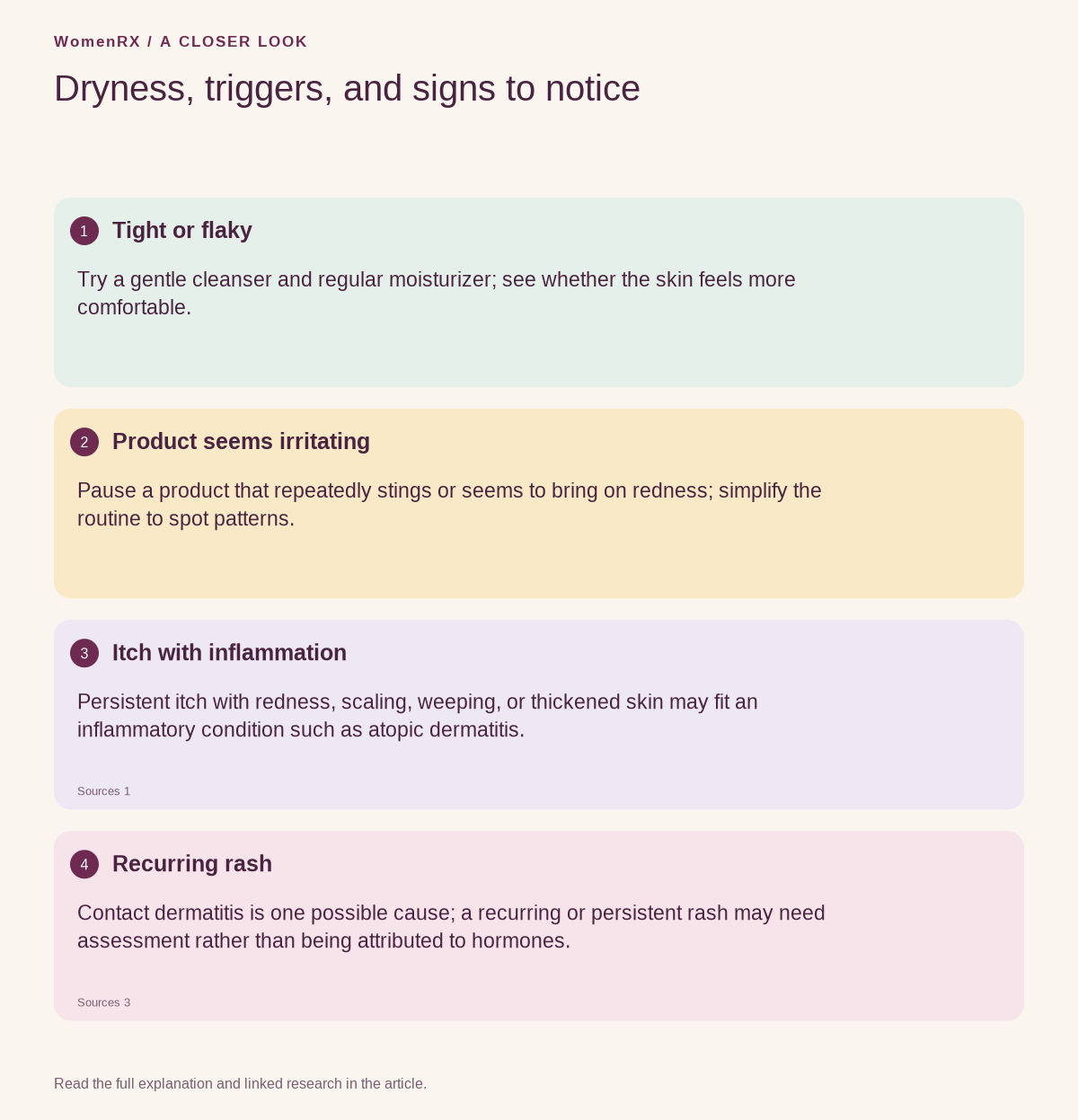
Dryness, triggers, and signs to notice
Tight or flaky: Try a gentle cleanser and regular moisturizer; see whether the skin feels more comfortable.
Product seems irritating: Pause a product that repeatedly stings or seems to bring on redness; simplify the routine to spot patterns.
Itch with inflammation: Persistent itch with redness, scaling, weeping, or thickened skin may fit an inflammatory condition such as atopic dermatitis.1
Recurring rash: Contact dermatitis is one possible cause; a recurring or persistent rash may need assessment rather than being attributed to hormones.3
Read the figure as text
Use these distinctions to decide whether a gentle routine seems sufficient or whether persistent inflammation may need assessment.- Tight or flaky: Try a gentle cleanser and regular moisturizer; see whether the skin feels more comfortable.
- Product seems irritating: Pause a product that repeatedly stings or seems to bring on redness; simplify the routine to spot patterns.
- Itch with inflammation: Persistent itch with redness, scaling, weeping, or thickened skin may fit an inflammatory condition such as atopic dermatitis.1
- Recurring rash: Contact dermatitis is one possible cause; a recurring or persistent rash may need assessment rather than being attributed to hormones.3
More questions, answered
Does dry skin during perimenopause mean estrogen is low?
No. Menopause-related hormonal changes may contribute to skin dryness, but dryness alone doesn’t establish a hormone deficiency or explain its cause. Other skin conditions and exposures can also be involved. 3
Should I use a steroid cream for an itchy patch?
An itchy patch can have different causes, and the appropriate treatment depends on the diagnosis. Topical corticosteroids are used as anti-inflammatory treatment for atopic dermatitis, but frequent or long-term use can have side effects. Get guidance if the rash persists or keeps returning rather than extending use on your own. 2
Sources you can check
- Emerging Methods to Objectively Assess Pruritus in Atopic Dermatitis.Smith MP, Ly K, Thibodeaux Q, Weerasinghe T, Wu JJ, Yosipovitch G, Bhutani T, Liao W. · Dermatology and therapy · 2019Return to first citation
- The efficacy and safety of oral microecological agents as add-on therapy for atopic dermatitis: A systematic review and meta-analysis of randomized clinical trials.Xue P, Qin H, Qin D, Liu H, Li J, Jin R, Xiao X. · Clinical and translational allergy · 2023Return to first citation
- Menopause, skin and common dermatoses. Part 2: skin disorders.Kamp E, Ashraf M, Musbahi E, DeGiovanni C. · Clinical and experimental dermatology · 2022Return to first citation