Dry Skin in Midlife: What to Try and Check
A gentle skin-care reset may help with new dryness, while a recurring rash or persistent itch calls for a closer look.
Skin may feel drier around menopause, but dryness alone doesn’t prove estrogen is the cause. 2 A one-time survey can’t tell you how long dryness will last. 3 For dryness without a rash, try fragrance-free cream or ointment and brief, warm showers. Seek assessment if dryness persists despite these changes, or if you have a recurring rash or severe itch. 7 4 5
Menopause may contribute, but it isn’t the only explanation
A review describes reduced skin hydration among changes associated with menopause and discusses possible estrogen-related changes to skin structure. Aging and sun exposure can also affect skin structure. These changes can overlap, so a dry patch can’t show on its own whether hormones are responsible. 2 Dryness is also a recognized change in aging skin. 6
One survey offers a snapshot of women’s reports of dry skin, not a timeline. In a survey of women aged 53 and 54, dry skin wasn’t significantly more common among postmenopausal women who weren’t using hormone therapy than among women using it or premenopausal women of the same age. That survey measured reported symptoms at one point, not skin hydration over time. 3
Try a gentler routine for dryness without a rash
If your skin feels dry but you don’t have an ongoing rash, start with changes that address irritation and help skin feel more comfortable:
- Moisturize regularly with a fragrance-free cream or ointment, especially while your skin is still damp after washing. Creams and ointments are more effective for dry skin than lotions. 7
- Keep showers or baths warm and brief. 7
- Set aside products that seem to sting or irritate. Fragranced products can irritate dry skin; some soaps, lotions, and fabrics can irritate skin affected by eczema. 7 1
- If it itches, cool rather than scratch. A cool, damp cloth may ease itching, while scratching eczema can make redness, swelling, and itching worse. 1 4
This is a way to care for uncomplicated dryness, not a test of whether menopause caused it. If the dryness continues despite trying these changes, seek an assessment; an underlying skin or health condition may need attention. 7
A rash changes the question
Dryness with an itchy rash on the hands, feet, face, inside the elbows, or behind the knees can fit an eczema pattern. Adults can have eczema, and it may improve and flare again over time. 1 A rash isn’t automatically eczema, though. Itching can also occur with reactions to products or medicines and with other skin conditions. 4 5
An ongoing or recurring itchy rash is worth having assessed rather than treating it as an expected part of perimenopause. The same goes for itching that is severe, affects much of your body, disrupts daily life, or hasn’t improved after a few weeks of self-care. A new rash, lump, or swelling that worries you also deserves a closer look. 4 5
You don’t need to settle the hormone question before caring for your skin. Start with the simple changes if the problem is dryness alone; let dryness that doesn’t improve, a persistent rash, or troublesome itch shift your attention toward finding its cause. 7 4
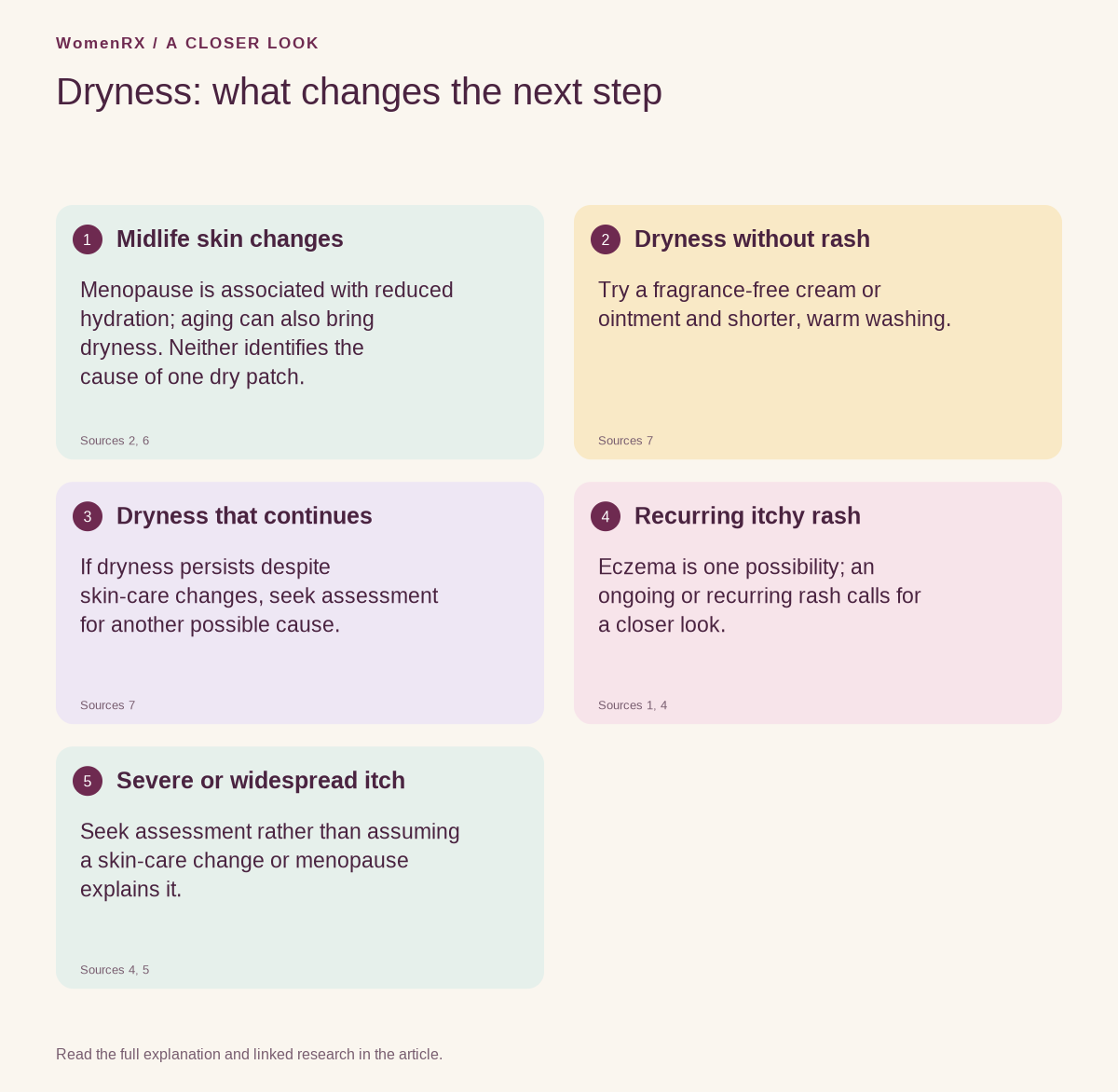
Dryness: what changes the next step
Midlife skin changes: Menopause is associated with reduced hydration; aging can also bring dryness. Neither identifies the cause of one dry patch.26
Dryness without rash: Try a fragrance-free cream or ointment and shorter, warm washing.7
Dryness that continues: If dryness persists despite skin-care changes, seek assessment for another possible cause.7
Recurring itchy rash: Eczema is one possibility; an ongoing or recurring rash calls for a closer look.14
Severe or widespread itch: Seek assessment rather than assuming a skin-care change or menopause explains it.45
Read the figure as text
Several influences can overlap. What accompanies the dryness is more useful for choosing a next move than its timing alone.- Midlife skin changes: Menopause is associated with reduced hydration; aging can also bring dryness. Neither identifies the cause of one dry patch.26
- Dryness without rash: Try a fragrance-free cream or ointment and shorter, warm washing.7
- Dryness that continues: If dryness persists despite skin-care changes, seek assessment for another possible cause.7
- Recurring itchy rash: Eczema is one possibility; an ongoing or recurring rash calls for a closer look.14
- Severe or widespread itch: Seek assessment rather than assuming a skin-care change or menopause explains it.45
Sources you can check
- Eczema | Dermatitis | Atopic Dermatitis | MedlinePlusAccessed 2026-09-25Return to first citation
- Menopause and Dermal White Adipose Tissue Depletion: Mechanistic Links, Adipogenesis, and Regenerative Therapeutic Replacement.Widgerow AD, Ziegler ME, Shafiq F. · Journal of cosmetic dermatology · 2026Return to first citation
- The prevalence of symptoms possibly related to the climacteric in pre- and postmenopausal women in Linköping, Sweden.Jansson C, Johansson S, Lindh-Astrand L, Hoffmann M, Hammar M. · Maturitas · 2003Return to first citation
- Itchy skin - NHSAccessed 2026-09-25Return to first citation
- Itching | Pruritus | Itchy skin | MedlinePlusAccessed 2026-09-25Return to first citation
- Aging Skin | Sunlight | MedlinePlusAccessed 2026-09-25Return to first citation
- Dermatologists' top tips for relieving dry skinAccessed 2026-09-25Return to first citation