Dry Skin in Perimenopause: Care Steps and Signs to Check
Midlife skin can feel drier, but perimenopause may not be the only reason, and a steady moisturizer routine is a sensible place to start.
Dry skin can show up around midlife, but that timing alone doesn’t prove perimenopause is the cause. Regular emollient use can help dry skin by rehydrating it and supporting the skin barrier. If dryness comes with a lasting itchy, scaly rash, painful cracks, or oozing or crusting, it may need more than basic moisturizer care. 3 1 2
Start with a steady moisturizer routine
Dryness around perimenopause can be frustrating, especially when your usual routine no longer feels like enough. Skin changes are discussed in research on menopause, but that association doesn’t tell you what’s causing dryness in your own skin. Cold weather and skin conditions such as atopic dermatitis can also contribute to dry skin. 3 4
A practical starting point is regular use of an emollient, a moisturizer made to rehydrate skin and support its barrier. Formulas vary, and studies of dry-skin products don’t always compare like with like, so there isn’t a universal product choice that fits everyone. Choose a product you can use consistently, and notice whether your skin feels more comfortable. 3
If a new skin product is followed by a new rash or irritation, consider whether the timing might be related. Contact allergy is one reported, generally uncommon and usually mild, skin-related adverse effect of emollients. 3
Dryness isn’t proof that hormones are the cause
Menopause-related hormone changes are one possible part of the midlife skin picture, but an individual’s dry skin can have other explanations. A systematic review and meta-analysis included 15 studies and 1,589 menopausal women, using randomized and non-randomized clinical trials. Although it reported improvements in some skin measures with menopausal hormone therapy, the pooled result for skin dryness was not statistically significant. That finding doesn’t establish hormone therapy as a treatment for dryness. 4
The review studied menopausal women, not specifically women in perimenopause. It also cannot determine the cause of dryness for an individual. In everyday terms, treat the dry skin itself with basic skin care rather than assuming a hormone treatment will restore it. 4 3
When it may be a rash, not just dry skin
Dryness that comes with redness, itching, scaling, or fissures can be hand eczema, which may be related to irritants, allergies, or an atopic tendency. Repeated exposure to environmental or workplace irritants can matter, too. If the problem persists, keeps returning, becomes severe, or interferes with using your hands, seek clinical assessment rather than relying on moisturizer alone. 1
Pay attention to signs that can suggest infection in skin affected by eczema, such as pustules, oozing, yellow-colored crust, or areas that are eroded or ulcerated. A study of eczema outpatients used these findings when identifying clinically suspected bacterial infection. They’re reasons to have the skin assessed, not a way to diagnose infection on your own. 2
If dryness is persistent or changing, a clinician can look for a skin condition or another underlying cause. The useful clues are what the skin looks like, where it appears, whether it itches or cracks, and whether it is getting better with regular moisturizing. Dry skin is a symptom, not a diagnosis. 3
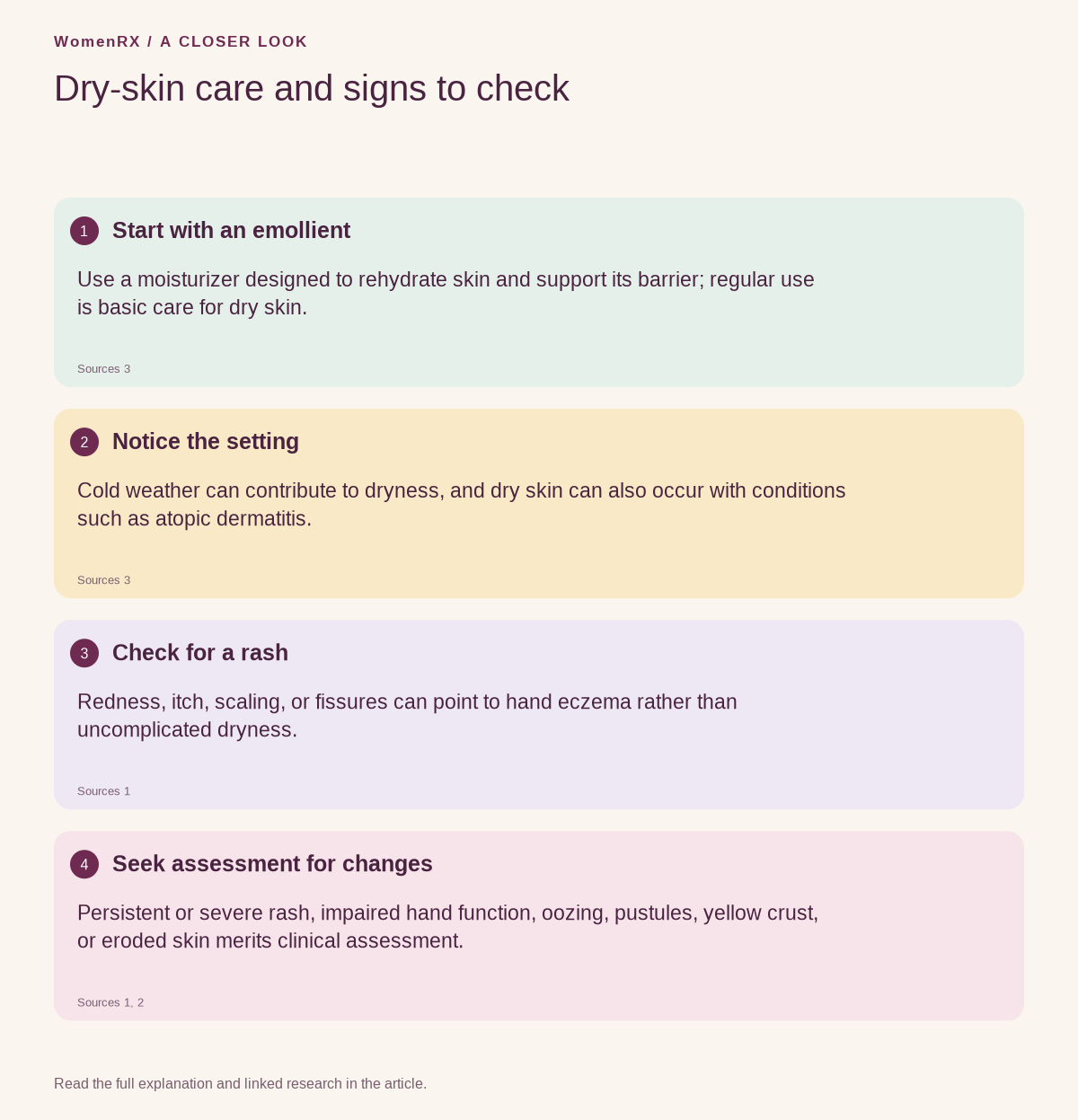
Dry-skin care and signs to check
Start with an emollient: Use a moisturizer designed to rehydrate skin and support its barrier; regular use is basic care for dry skin.3
Notice the setting: Cold weather can contribute to dryness, and dry skin can also occur with conditions such as atopic dermatitis.3
Check for a rash: Redness, itch, scaling, or fissures can point to hand eczema rather than uncomplicated dryness.1
Seek assessment for changes: Persistent or severe rash, impaired hand function, oozing, pustules, yellow crust, or eroded skin merits clinical assessment.12
Read the figure as text
Use this checklist to separate basic dry-skin care from changes that may need assessment.- Start with an emollient: Use a moisturizer designed to rehydrate skin and support its barrier; regular use is basic care for dry skin.3
- Notice the setting: Cold weather can contribute to dryness, and dry skin can also occur with conditions such as atopic dermatitis.3
- Check for a rash: Redness, itch, scaling, or fissures can point to hand eczema rather than uncomplicated dryness.1
- Seek assessment for changes: Persistent or severe rash, impaired hand function, oozing, pustules, yellow crust, or eroded skin merits clinical assessment.12
More questions, answered
Can menopausal hormone therapy improve dry skin?
A review of trials in menopausal women found no statistically significant pooled effect of menopausal hormone therapy on skin dryness. It reported changes in some other skin measures, but that doesn’t show that hormone therapy treats an individual’s dry skin. 4
When should I get a rash checked?
Consider clinical assessment if dryness comes with a persistent or recurring itchy, red, scaly rash or fissures, or if it is severe or affects hand function. Oozing, pustules, yellow crust, or skin erosion also warrant assessment. 1 2
Sources you can check
- [Hand eczema: comprehensive management and therapeutic perspectives in primary care].Navarro-Triviño FJ. · Semergen · 2026Return to first citation
- Risk Factors in Outpatients with Dermatitis and Eczema in Tertiary Hospitals of China Who Have Clinically Suspected Bacterial Infection.Li Y, Xu W, Li L. · BioMed research international · 2020Return to first citation
- Clinical Benefits of Basic Emollient Therapy for the Management of Patients With Xerosis Cutis.Vestergaard C, Torrelo A, Christen-Zaech S. · International journal of dermatology · 2025Return to first citation
- Skin Rejuvenation in Women using Menopausal Hormone Therapy: A Systematic Review and Meta-Analysis.Pivazyan L, Avetisyan J, Loshkareva M, Abdurakhmanova A. · Journal of menopausal medicine · 2023Return to first citation