Itchy Skin During Perimenopause: What Might Explain It?
Midlife skin changes may play a part, but where the itch is and what you can see can point to other causes worth checking.
Perimenopause may coincide with drier, more easily irritated skin, which can contribute to itching, but itch alone doesn’t show that hormones are the cause. A small itchy patch, widespread itch without an obvious rash, and persistent vulvar itch call for different considerations. Notice where the itch is and whether the skin has changed; seek assessment if it persists, spreads, or affects daily life. 2 5

Start with the pattern, not the hormone theory
Skin dryness and itching are reported around menopause, and falling estrogen may affect skin structure and its protective barrier. But the evidence describes associations, not a way to diagnose perimenopause from itch. Dryness, irritation, eczema, an allergy or another skin condition may also be involved. So a new itch deserves attention to its location and appearance, rather than being automatically labeled a menopause symptom. 2 5
A useful first distinction is whether the itch is on a particular patch of skin, all over, or around the vulva or vagina. Also notice whether you can see dryness, a rash, bumps, swelling, or another change. Those details can help guide what kind of assessment may be useful; they don’t identify the cause on their own. 1 2
If the skin looks dry or irritated
Dry, cracked or irritated skin can itch. Heat, irritating fabrics and some products may add to the discomfort. Menopause-related skin changes could be one part of the picture, but they don’t rule out eczema, contact irritation, allergy or other skin conditions. 2 5
For mild itch on ordinary body skin, try a cool compress, pat rather than scratch, and avoid perfumed soaps and moisturizers. Shorter bathing and avoiding soap or other irritants may also help when dryness is part of the problem. If a rash appears, the itch keeps returning, or these measures aren’t helping, arrange an assessment rather than assuming the skin simply needs more moisture. 1 2 5
If you can see a rash or skin change
A visible rash, bump or swelling changes the question from “Is my skin dry?” to “What is irritating or affecting this area?” Possible causes of itchy skin include allergic reactions, heat reactions, eczema, psoriasis and infections, among others. The appearance and location matter, and similar symptoms can have different causes. 1 2
This distinction matters especially on the vulva, the external genital skin. Vulvar itch can occur with inflammatory skin conditions, including contact dermatitis and lichen sclerosus; vulvovaginal symptoms can also come from conditions such as vaginitis or genitourinary syndrome of menopause. Persistent or unexplained vulvar itch, or a visible change there, is a reason to seek assessment rather than repeatedly trying products on the area. 3
It can help to describe whether the itch is on external vulvar skin, seems to be inside the vagina, or occurs along with other vaginal or urinary symptoms. These are different details, and the cause shouldn’t be presumed to be ordinary body-skin dryness. 3 4
If the itch is widespread and there’s no clear skin cause
Itching all over without an obvious rash or dry patch may need a broader assessment. Medicines can cause itching, and health conditions affecting the thyroid, liver or kidneys are among the other possible causes. That doesn’t mean one of these is responsible; it means widespread, unexplained itch shouldn’t automatically be attributed to perimenopause. 1 2
A clinician can ask about your symptoms and medicines, examine your skin, and decide whether further evaluation, such as blood testing, might help identify a cause. Seek assessment if the itch is severe, has no apparent cause, lasts for a few weeks, affects daily life, or keeps coming back. 1 2
What to do while you’re figuring it out
For a short-lived, mild itch, keep the routine simple: avoid scratching, try a cool compress, and reduce exposure to heat, irritating fabrics and perfumed products. If the itch is localized, check whether the skin itself looks different. If it’s widespread without an obvious skin cause, or persistent on the vulva, prioritize getting the cause assessed instead of treating every pattern as menopause-related dryness. 1 2 3
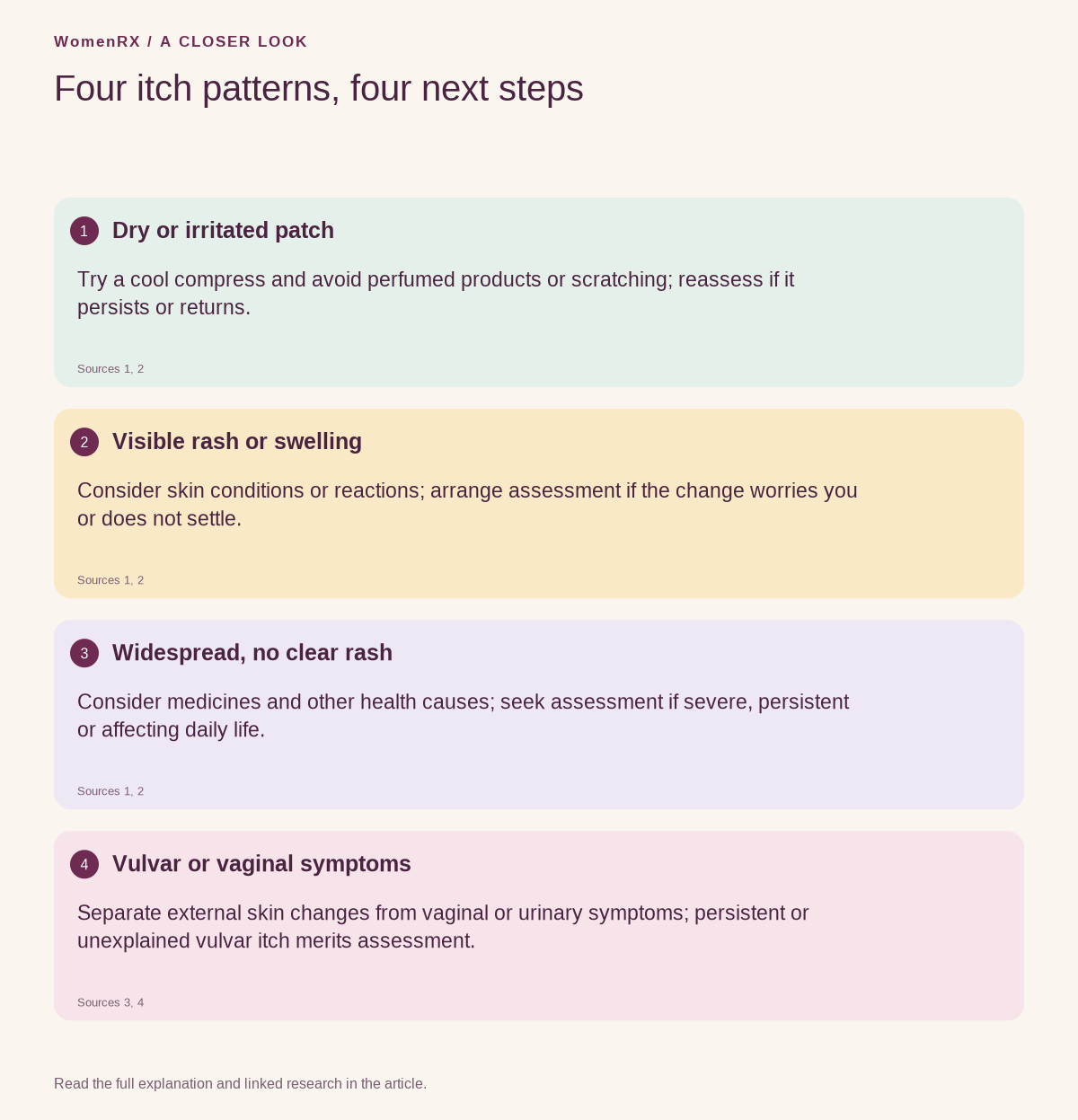
Four itch patterns, four next steps
Dry or irritated patch: Try a cool compress and avoid perfumed products or scratching; reassess if it persists or returns.12
Visible rash or swelling: Consider skin conditions or reactions; arrange assessment if the change worries you or does not settle.12
Widespread, no clear rash: Consider medicines and other health causes; seek assessment if severe, persistent or affecting daily life.12
Vulvar or vaginal symptoms: Separate external skin changes from vaginal or urinary symptoms; persistent or unexplained vulvar itch merits assessment.34
Read the figure as text
Use the location and visible skin changes to choose what to pay attention to and when assessment may help.- Dry or irritated patch: Try a cool compress and avoid perfumed products or scratching; reassess if it persists or returns.12
- Visible rash or swelling: Consider skin conditions or reactions; arrange assessment if the change worries you or does not settle.12
- Widespread, no clear rash: Consider medicines and other health causes; seek assessment if severe, persistent or affecting daily life.12
- Vulvar or vaginal symptoms: Separate external skin changes from vaginal or urinary symptoms; persistent or unexplained vulvar itch merits assessment.34
More questions, answered
Does itchy skin mean I should use hormone therapy?
No. Itch by itself doesn’t establish a hormone-related cause. A review of menopause and skin says hormone therapy isn’t indicated for skin or hair symptoms alone; the cause of persistent or bothersome itch should be considered separately. 5 6
Sources you can check
- Itching | Pruritus | Itchy skin | MedlinePlusAccessed 2026-09-25Return to first citation
- Itchy skin - NHSAccessed 2026-09-25Return to first citation
- Diagnosis and Management of Vulvar Skin Disorders: ACOG Practice Bulletin, Number 224.American College of Obstetricians and Gynecologists' Committee on Practice Bulletins, Gynecology. · Obstetrics and gynecology · 2020Return to first citation
- The 2022 hormone therapy position statement of The North American Menopause Society.“The 2022 Hormone Therapy Position Statement of The North American Menopause Society” Advisory Panel. · Menopause (New York, N.Y.) · 2022Return to first citation
- Menopause, skin and common dermatoses. Part 2: skin disorders.Kamp E, Ashraf M, Musbahi E, DeGiovanni C. · Clinical and experimental dermatology · 2022Return to first citation
- Skin, hair and beyond: the impact of menopause.Zouboulis CC, Blume-Peytavi U, Kosmadaki M, Roó E, Vexiau-Robert D, Kerob D, Goldstein SR. · Climacteric : the journal of the International Menopause Society · 2022Return to first citation