Menopause and Itchy Skin: What Estrogen May Explain
Itchy skin can show up after menopause, but that timing alone can’t tell you whether estrogen is involved.
A hormonal contribution to itchy skin around menopause is plausible. A research review describes associations between menopause, dry skin, and itching, and discusses estrogen’s role in skin function. But that doesn’t prove estrogen changes caused your itch or that hormone therapy would treat it. Dryness, skin conditions, irritants, medicines, and other health problems are also possible causes. 5 1 2
A plausible link, not a clear-cut cause
Itching is reported after menopause. A review of menopause-related skin research describes associations with dry skin and pruritus, the medical term for itching. It also discusses estrogen’s involvement in water loss through the skin and in dermal collagen. Together, those findings make a hormone-skin connection plausible. They don’t show that an estrogen change is the cause of any one person’s itch. 2 5
A possible biological pathway isn’t the same as a proven explanation for a symptom. The review calls for more research into the mechanisms and treatment options. 5
Other explanations are worth considering
Dry skin, eczema, psoriasis, allergies, irritating products, and reactions to medicines can all cause itching. Less commonly, itching can accompany thyroid, liver, or kidney problems. A rash, hives, or the location of the itch may offer clues, but itch alone can’t identify its cause. 1 2
Where you feel it matters, too. Vulvar itching, for example, isn’t automatically the same as dry or itchy skin elsewhere. ACOG identifies several inflammatory vulvar skin conditions associated with itching, including contact dermatitis, lichen simplex chronicus, lichen sclerosus, and lichen planus. Persistent vulvar symptoms are worth assessing rather than assuming they’re simply a menopause effect. 4
Ease the itch while you work out why it’s happening
If your skin feels dry or irritated, a cool damp cloth or a cool-to-lukewarm shower may ease discomfort. Avoiding perfumed soaps and moisturizers, and patting rather than scratching, may also reduce irritation and help limit skin damage. These steps can help with symptoms without telling you whether estrogen played a role. 2
If itching continues, affects daily life, or worries you, an evaluation can help look for skin conditions and other causes. Mention if it began after a new medicine or skin product, since medicines and irritants can trigger itching. 1 2
Is hormone therapy an itch treatment?
A review of menopause-related skin symptoms says hormone therapy isn’t indicated for skin and hair symptoms alone because of its risk-benefit balance. A possible link between estrogen and skin function doesn’t establish hormone therapy as a treatment for itching. If you’re considering hormone therapy for another menopause symptom, that’s a separate decision based on that symptom and your individual circumstances. 6 3
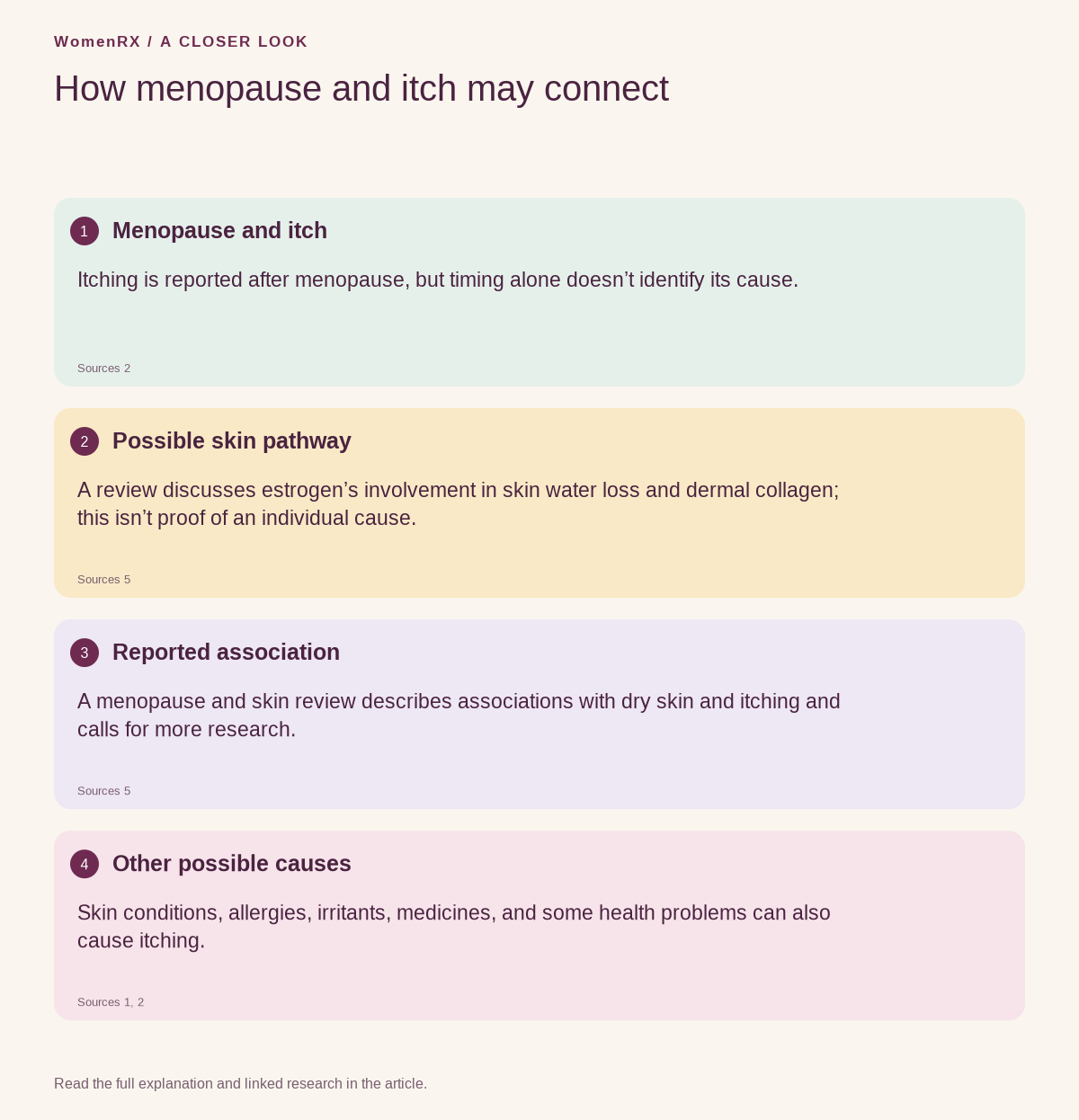
How menopause and itch may connect
Menopause and itch: Itching is reported after menopause, but timing alone doesn’t identify its cause.2
Possible skin pathway: A review discusses estrogen’s involvement in skin water loss and dermal collagen; this isn’t proof of an individual cause.5
Reported association: A menopause and skin review describes associations with dry skin and itching and calls for more research.5
Other possible causes: Skin conditions, allergies, irritants, medicines, and some health problems can also cause itching.12
Read the figure as text
This figure separates a proposed estrogen-skin pathway from the observed association and other possible causes of itching.- Menopause and itch: Itching is reported after menopause, but timing alone doesn’t identify its cause.2
- Possible skin pathway: A review discusses estrogen’s involvement in skin water loss and dermal collagen; this isn’t proof of an individual cause.5
- Reported association: A menopause and skin review describes associations with dry skin and itching and calls for more research.5
- Other possible causes: Skin conditions, allergies, irritants, medicines, and some health problems can also cause itching.12
More questions, answered
Does itchy skin mean my estrogen is low?
No. Itching can occur after menopause, but it has many possible causes. The symptom by itself can’t tell you your estrogen level or establish that a hormone change is responsible. 2 1 5
Sources you can check
- Itching | Pruritus | Itchy skin | MedlinePlusAccessed 2026-09-25Return to first citation
- Itchy skin - NHSAccessed 2026-09-25Return to first citation
- The 2022 hormone therapy position statement of The North American Menopause Society.“The 2022 Hormone Therapy Position Statement of The North American Menopause Society” Advisory Panel. · Menopause (New York, N.Y.) · 2022Return to first citation
- Diagnosis and Management of Vulvar Skin Disorders: ACOG Practice Bulletin, Number 224.American College of Obstetricians and Gynecologists' Committee on Practice Bulletins, Gynecology. · Obstetrics and gynecology · 2020Return to first citation
- Menopause, skin and common dermatoses. Part 2: skin disorders.Kamp E, Ashraf M, Musbahi E, DeGiovanni C. · Clinical and experimental dermatology · 2022Return to first citation
- Skin, hair and beyond: the impact of menopause.Zouboulis CC, Blume-Peytavi U, Kosmadaki M, Roó E, Vexiau-Robert D, Kerob D, Goldstein SR. · Climacteric : the journal of the International Menopause Society · 2022Return to first citation