Itchy Skin Around Menopause: What Else Could Be Going On?
Itching is common after menopause, but its location, appearance, and timing can point toward causes worth checking.
Itching is common after menopause, and a research review describes an association with dry skin and itch. That doesn’t mean hormones caused your particular symptoms. Notice whether the itch is localized or widespread, whether the skin has changed, and whether it began after a new product or medicine. Get it assessed if it’s severe, unexplained, persistent, recurring, or affecting daily life. 1 2 4
Start with where it itches
Is the itch in one place, such as your arms or vulva, or does it seem to be all over? Do you see dry or cracked skin, a rash, hives, or swelling? Itching can happen in one area or across the body, with or without a visible rash. These details help describe the problem, but no single pattern tells you its cause. 1
If one area itches, think about what has touched it. A new soap, cosmetic, detergent, or irritating fabric may be relevant. If the itch is widespread, dry skin, an allergy, or a medicine reaction may still be possible. Less commonly, thyroid, liver, or kidney problems can cause itching. Widespread itch isn’t proof of an internal condition, just as localized itch isn’t proof of a product reaction. 1 2
How menopause fits into the picture
Itchy skin is common after menopause. A research review describes associations between menopause, dry skin, and itching, and discusses possible effects of lower estrogen on the skin. It also calls for more research into the mechanisms. That leaves room for menopause-related skin changes to be part of the picture without assuming they explain a new itch in the perimenopausal years or after menopause. 2 4
Other possibilities include eczema or psoriasis, an irritating or allergic reaction, fungal infection, or parasites such as scabies or lice. A medicine can also cause itching. The useful question isn’t only Could this be menopause? It’s What else fits the timing, location, and skin changes? 1 2
Vulvar itch deserves its own look. The vulva is the external skin around the vaginal opening, and itching there can occur with inflammatory skin conditions, including contact dermatitis, lichen sclerosus, and lichen planus. If vulvar itching persists or returns, have the skin assessed rather than assuming it’s ordinary dryness or a menopause symptom. 3
Try gentle relief without losing track of the cause
If your skin seems dry or irritated, avoiding perfumed soaps and moisturizers or fabrics that bother it may help. A cool, damp cloth and patting rather than scratching can ease the urge to scratch. Relief is welcome, but it won’t necessarily tell you what caused the itch. 1 2
Note when the itch began and whether it followed a new product, insect bite, or medicine change. For example, an itch that began where a new lotion was applied is a different clue from an itch that appeared across your body without a visible rash. Neither is a diagnosis, but that distinction can make the next conversation more useful. 1 2
When to have it checked
Seek an assessment if itching is severe, lasts a few weeks, has no apparent cause, keeps returning, or interferes with daily life. A new rash, lump, or swelling that worries you is another reason to get it checked. A clinician can examine the skin and, depending on what they find, may consider tests to look for a cause. 1 2
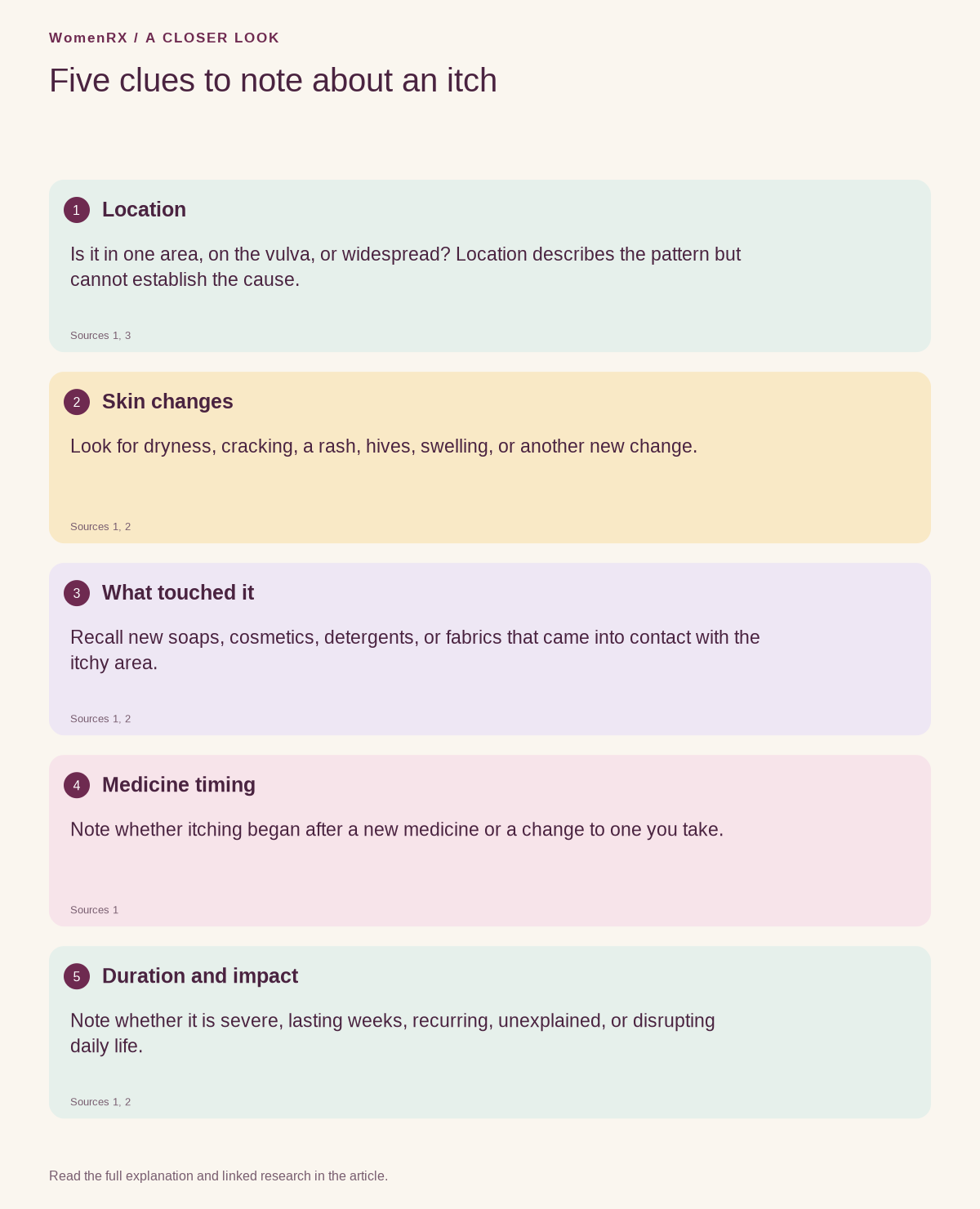
Five clues to note about an itch
Location: Is it in one area, on the vulva, or widespread? Location describes the pattern but cannot establish the cause.13
Skin changes: Look for dryness, cracking, a rash, hives, swelling, or another new change.12
What touched it: Recall new soaps, cosmetics, detergents, or fabrics that came into contact with the itchy area.12
Medicine timing: Note whether itching began after a new medicine or a change to one you take.1
Duration and impact: Note whether it is severe, lasting weeks, recurring, unexplained, or disrupting daily life.12
Read the figure as text
These observations help describe the problem and choose a next step. They are not a diagnostic test.- Location: Is it in one area, on the vulva, or widespread? Location describes the pattern but cannot establish the cause.13
- Skin changes: Look for dryness, cracking, a rash, hives, swelling, or another new change.12
- What touched it: Recall new soaps, cosmetics, detergents, or fabrics that came into contact with the itchy area.12
- Medicine timing: Note whether itching began after a new medicine or a change to one you take.1
- Duration and impact: Note whether it is severe, lasting weeks, recurring, unexplained, or disrupting daily life.12
Sources you can check
- Itching | Pruritus | Itchy skin | MedlinePlusAccessed 2026-09-25Return to first citation
- Itchy skin - NHSAccessed 2026-09-25Return to first citation
- Diagnosis and Management of Vulvar Skin Disorders: ACOG Practice Bulletin, Number 224.American College of Obstetricians and Gynecologists' Committee on Practice Bulletins, Gynecology. · Obstetrics and gynecology · 2020Return to first citation
- Menopause, skin and common dermatoses. Part 2: skin disorders.Kamp E, Ashraf M, Musbahi E, DeGiovanni C. · Clinical and experimental dermatology · 2022Return to first citation