Nausea Around Menopause: What Else Could Be Going On?
Changing periods may put menopause on your mind, but nausea deserves a look at what else is happening.
Nausea during perimenopause doesn’t identify its cause. Check pregnancy possibility, migraine, stomach illness, reflux, dizziness and medicine changes. Sudden nausea with heavy chest pain or shortness of breath needs emergency help; so does sudden, sharp abdominal pain. Contact a care provider immediately for dehydration signs, and arrange a routine visit if nausea keeps returning or doesn’t improve in a few days. 12467
Start with what came with the nausea
Perimenopause changes the pattern of your periods, sometimes making it hard to know what to expect from one cycle to the next. That timing can be useful context, but it doesn’t identify the cause of nausea. Instead, look at the whole picture: Could you be pregnant? Is this happening with a familiar migraine? Did it begin around a treatment change? Are you also having abdominal pain or vomiting? 1456
A late or unusual period: If pregnancy is possible, don’t rule it out because you think you’re nearing menopause. A pregnancy test may be part of the evaluation for nausea. Continuous combined menopausal hormone therapy (HRT), if you use it, does not work as contraception. 16
A headache with light or sound sensitivity: Migraine often includes nausea. A review of migraine across reproductive life stages notes that hormonal fluctuations in perimenopause can aggravate migraine, though that doesn’t mean every bout of nausea at this age is hormone-related. If nausea arrives with your familiar migraine symptoms, that’s useful context, but it doesn’t establish the cause. 4
Other symptoms that offer clues: Diarrhea or vomiting can occur with a stomach bug or food poisoning. Heartburn or bloating after eating may point toward reflux; dizziness may point toward vertigo. These patterns are possibilities, not diagnoses, and they’re worth considering whether or not your periods are changing. 7
A change in treatment: Note whether the nausea began around a change in a medicine or another treatment, and what changed. Medicines are one possible cause of nausea, but timing alone can’t tell you the cause. It’s useful context to share if you seek help. 17
Know when the other symptoms change the plan
Get emergency help if nausea comes on suddenly with tight or heavy chest pain, pain spreading to your arms, back, neck or jaw, or shortness of breath. That combination can signal a heart attack, not a menopause symptom. 7
Get medical help immediately if nausea or vomiting comes with severe abdominal pain, or if abdominal pain is sudden and sharp. Vomiting blood, blood in your stool, or being unable to pass stool while vomiting also calls for immediate help. These are not symptoms to set aside as part of menopause. 12
Vomiting can become urgent even without significant pain if you’re losing more fluid than you can take in. Contact a care provider immediately if you have signs of dehydration such as dry mouth, infrequent urination or dark urine. Get medical help right away if confusion develops. If you’re having trouble keeping liquids down but can still sip, try small amounts of clear liquid often while you assess how you’re doing. 13
If there’s no warning sign, notice what accompanies the nausea rather than assigning it to menopause. For example, nausea with a familiar migraine pattern raises a different possibility from nausea with a possible pregnancy. If you also have non-severe abdominal pain, contact a care provider rather than just watching it; abdominal pain with other symptoms merits a call. Arrange a routine visit if nausea keeps coming back or doesn’t improve in a few days. Your period pattern, associated symptoms and treatment history are useful details to bring; an evaluation may include a pregnancy test when relevant. 12457
Where nausea points next
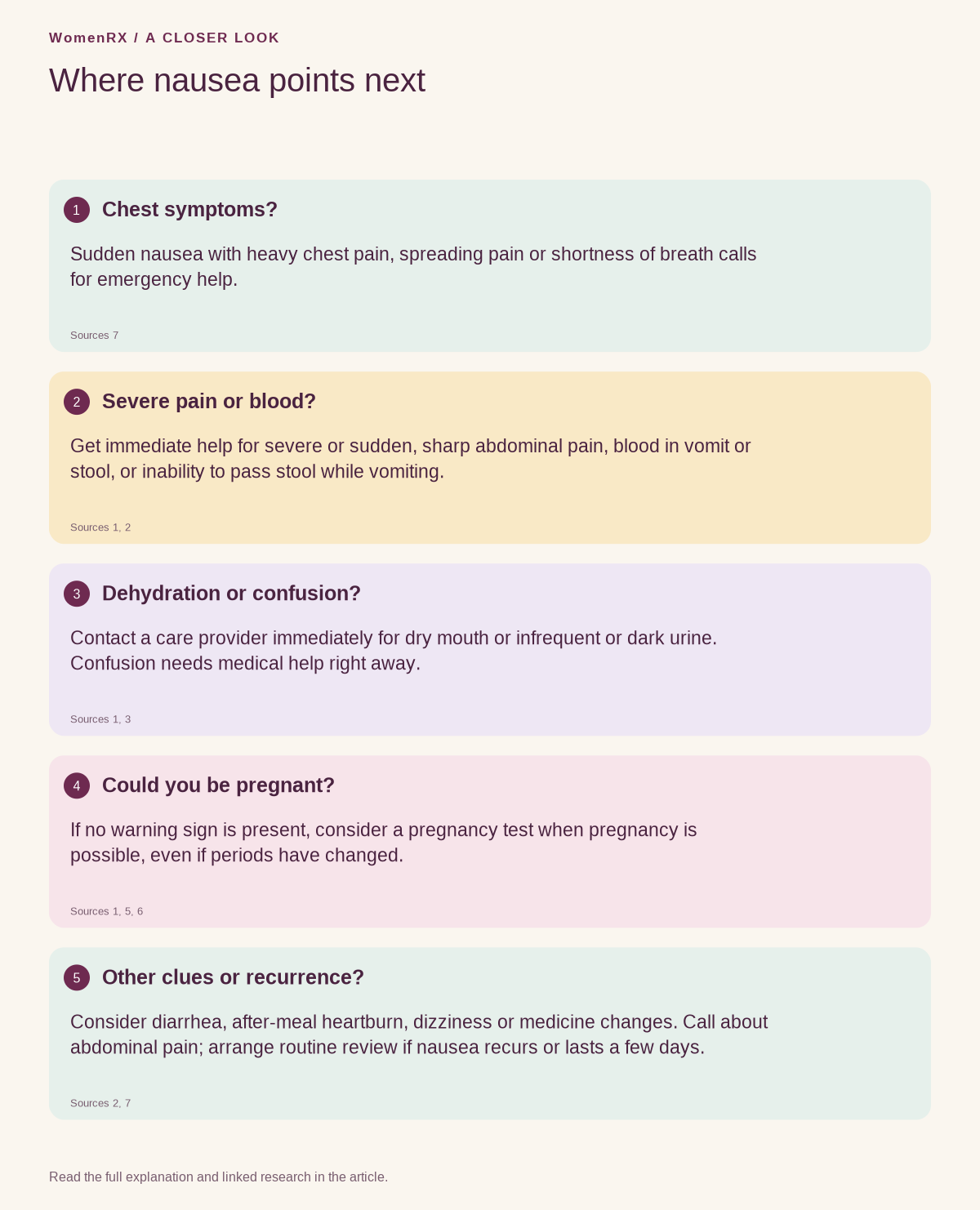
Chest symptoms?: Sudden nausea with heavy chest pain, spreading pain or shortness of breath calls for emergency help.7
Severe pain or blood?: Get immediate help for severe or sudden, sharp abdominal pain, blood in vomit or stool, or inability to pass stool while vomiting.12
Dehydration or confusion?: Contact a care provider immediately for dry mouth or infrequent or dark urine. Confusion needs medical help right away.13
Could you be pregnant?: If no warning sign is present, consider a pregnancy test when pregnancy is possible, even if periods have changed.156
Other clues or recurrence?: Consider diarrhea, after-meal heartburn, dizziness or medicine changes. Call about abdominal pain; arrange routine review if nausea recurs or lasts a few days.27
Read the figure as text
Check for warning signs first. If none are present, consider pregnancy possibility, other symptoms and whether the nausea persists or returns.- Chest symptoms?: Sudden nausea with heavy chest pain, spreading pain or shortness of breath calls for emergency help.7
- Severe pain or blood?: Get immediate help for severe or sudden, sharp abdominal pain, blood in vomit or stool, or inability to pass stool while vomiting.12
- Dehydration or confusion?: Contact a care provider immediately for dry mouth or infrequent or dark urine. Confusion needs medical help right away.13
- Could you be pregnant?: If no warning sign is present, consider a pregnancy test when pregnancy is possible, even if periods have changed.156
- Other clues or recurrence?: Consider diarrhea, after-meal heartburn, dizziness or medicine changes. Call about abdominal pain; arrange routine review if nausea recurs or lasts a few days.27
More questions, answered
Can I be pregnant if my periods have become irregular?
Yes. Pregnancy can still be possible during the menopause transition, and irregular periods alone won’t rule it out. If pregnancy is possible and you feel nauseated, consider a pregnancy test. 156
Sources you can check
- Nausea | Vomiting | MedlinePlusAccessed 2026-09-25Return to first citation
- Abdominal Pain | MedlinePlusAccessed 2026-09-25Return to first citation
- Dehydration: MedlinePlusAccessed 2026-09-25Return to first citation
- Sex-specific considerations in migraine therapy.Rubio-Beltran E, MaassenVanDenBrink A. · Neurotherapeutics : the journal of the American Society for Experimental NeuroTherapeutics · 2026Return to first citation
- Menopause and perimenopause - NHSAccessed 2026-09-25Return to first citation
- Pregnancy, breastfeeding and fertility while taking continuous combined HRT - NHSAccessed 2026-09-25Return to first citation
- Feeling sick (nausea) - NHSAccessed 2026-09-25Return to first citation